Current CTA papers, representative review and API verification
This review uses the released 607 CTA proteins in OncoRef 1.35.0. It records new evidence and recommendations; it does not change released classifications.
Which papers cover the current CTAs?
487 have membership in the 15 nomination-source collection. 90 more have qualifying papers in the broader review. 30 lack a verified qualifying exact-human paper. Thus 577/607 have paper coverage; 120 are outside the nomination collection.
The 577 comprise 572 proteins whose member loci all have coverage and 5 with coverage for only some member loci. A paper can describe normal function, disease association or counterevidence, including reviewed gene-level results in supplementary tables. Paper coverage is not a declaration that the paper nominated a CTA or demonstrated tumor protein.
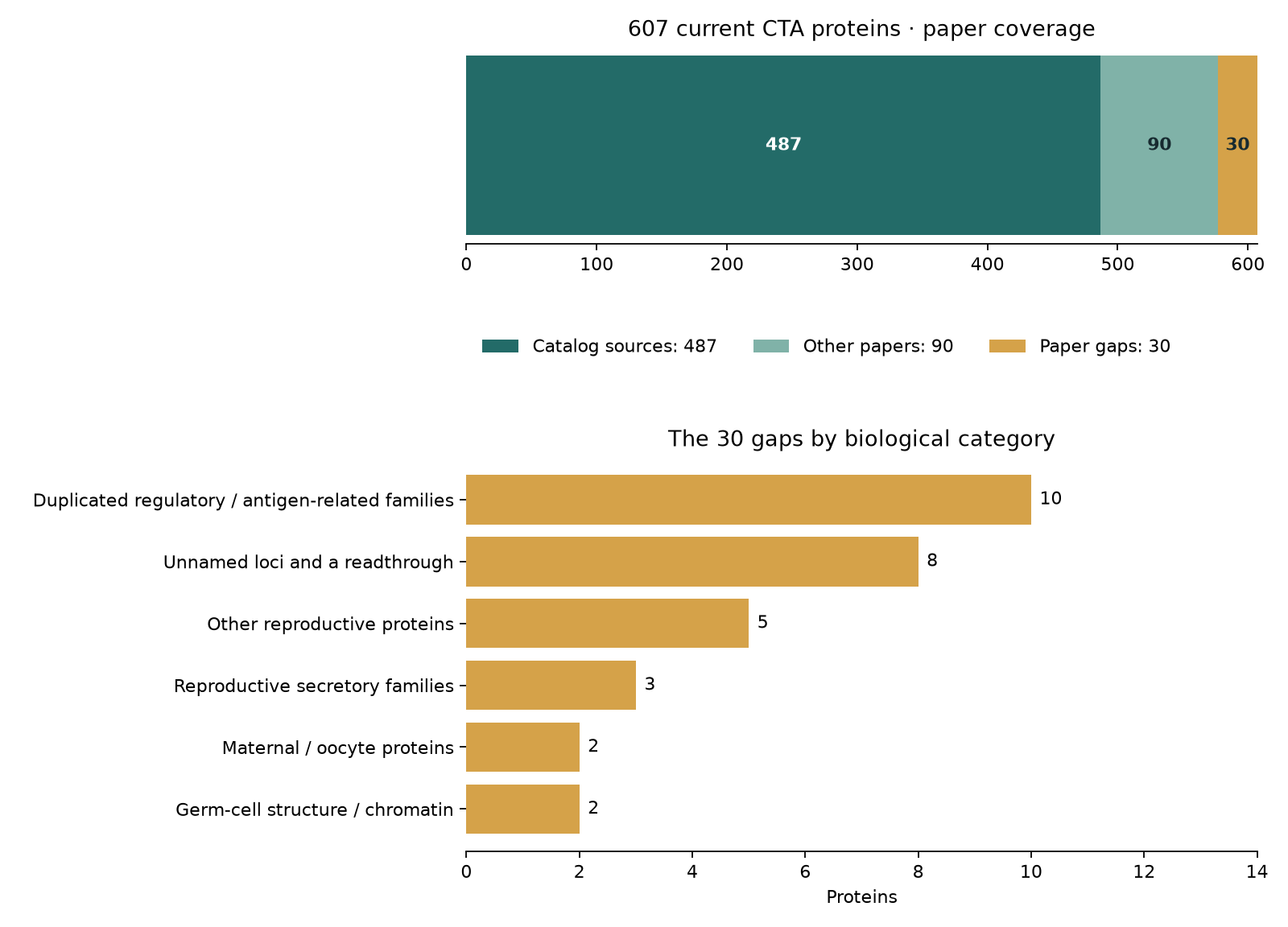
The old frozen report said 569/602 with 33 gaps. Remapping its memberships gives 573/607 with 34 gaps. Human CALHM3, TRIM75, TMEM269 and SSU72L1 findings close four gaps. The two latter findings are significant RNA results in supplementary tables, not focused target studies. A reported UBTFL1 embryo assay is rejected for coverage because its primers match mouse Sod1. New evidence, source roles and proposed normal holds.
The current reading set has 81 core and 74 supplementary sources. The core covers every presently covered CTA locus and no core source can be removed without losing coverage. Supplementary sources retain normal findings, methods, mechanisms and independent measurements. This objective differs from the older 83-core/67-supplementary set, which also covered proteins outside CTA.
Every current CTA and its papers · All 120 outside nomination papers · Sources, links and roles
| Shared protein | Member loci without qualifying paper coverage |
|---|---|
| CDY2A/B | CDY2A · ENSG00000182415 |
| ETDA/B | ETDA · ENSG00000238210 |
| HNRNPCL3/4 | HNRNPCL3 · ENSG00000277058 |
| PRAMEF25/6 | PRAMEF26 · ENSG00000280267 |
| TP53TG3/B/C/D/E/F | TP53TG3E · ENSG00000275034, TP53TG3F · ENSG00000278848 |
A missed human normal-tissue paper
CALHM3: human taste-bud RNA in Figure 10D now supplies an Other:Review hold in the pending replay. The cell-subtype in situ experiments are macaque data. Moyer et al., 2009. The same replay applies the shared normal-brain finding to all represented TAF11-like copies, including TAF11L12. Seven category changes and their rationale.
Judgment of each remaining paper gap
These proteins are CTA in the released catalog under the rule allowing a qualifying coding reference. Biological programs and evidence gaps are annotations, not separate classes. Missing papers alone do not make them Unsafe. Tumor maxima below are single-sample RNA observations, not prevalence or protein abundance. TPM and HPA pTPM remain separate; a dash means unmeasured, not zero.
| Protein | Pending decision | Biological category | Maximum tumor TPM | Maximum HPA pTPM | Evidence / review | Related paper |
|---|---|---|---|---|---|---|
| ATF7-NPFF | CTA | Unnamed loci and a readthrough | 79.6 | 20 | The coding reference passes; tumor RNA does not establish the readthrough junction or the exact protein. Junction and protein identity are the priority. | — |
| CIMIP3 | CTA | Germ-cell structure and chromatin | 1.2 | 55.4 | Mouse sperm structure supports its biological category. Tumor maxima are 1.2 TPM and 55.4 HPA pTPM in separate sources, so the lower TPM value alone does not justify low priority. | Liu Q et al. (2026) |
| CTAGE15 | CTA | Other poorly characterized reproductive proteins | 31.1 | 1.98 | Its cTAGE-family name is not antigen evidence. Verify this copy rather than borrowing other CTAGE results. | — |
| CTXND2 | CTA | Other poorly characterized reproductive proteins | 16.2 | 29 | Placental association and the coding reference are the support; function and protein localization are uncharacterized. | — |
| DEFB113 | CTA | Reproductive secretory families | 2.27 | 63.7 | HPA tumor RNA reaches 63.7 pTPM despite a 2.3 TPM maximum in the separate tumor source. Human tumor secretion has not been established. | Patil AA et al. (2005); Ebersole JL et al. (2022) |
| ENSG00000237378 | CTA | Unnamed loci and a readthrough | 8.16 | 10.6 | Establish a sequence-linked identity and endogenous protein detection before stronger claims. | — |
| ENSG00000241690 | CTA | Unnamed loci and a readthrough | 5.7 | 9.99 | Coding annotation and expression support inclusion; the broad scoring table supplies no independent functional validation. | — |
| ENSG00000258417 | CTA | Unnamed loci and a readthrough | 6.76 | 98.6 | Resolve transcript and sequence identity before importing named-gene literature. | — |
| ENSG00000273155 | CTA | Unnamed loci and a readthrough | 50.9 | 43.3 | Prioritize identity review. A shared mitochondrial ribosomal-protein annotation makes it essential to distinguish this locus from MRPL30-associated records before transferring normal or tumor protein evidence. | — |
| ENSG00000274944 | CTA | Unnamed loci and a readthrough | 13.5 | 82.2 | The 110-aa canonical protein passes, with TSL 2 and no MANE designation. No exact-locus study was verified; database links to MYCBP are not evidence for this protein. | — |
| ENSG00000284934 | CTA | Unnamed loci and a readthrough | 77.1 | 29 | Tumor RNA is substantial in at least one sample; exact-locus translation remains experimentally unverified. | — |
| ENSG00000289809 | CTA | Unnamed loci and a readthrough | 0.0679 | — | Lowest tumor-expression priority in this set: the recorded maximum is about 0.068 TPM. It passes the presence rule, but that is very weak evidence of a useful tumor target. | — |
| GOLGA8T | CTA | Other poorly characterized reproductive proteins | 13.7 | 1.39 | Family homology does not establish this copy's protein production. | — |
| H2AL1Q | CTA | Germ-cell structure and chromatin | 4.02 | — | The retrieved proteomics is mouse evidence; human copy-specific protein detection is missing. | El Kennani S et al. (2018); Seal RL et al. (2022) |
| LCN9 | CTA | Reproductive secretory families | 85.5 | 110 | Mouse reproductive studies support the category; human tumor secretion is unverified. | Suzuki K et al. (2004); Sakurai N et al. (2024); Gong QQ et al. (2021) |
| MSANTD5 | CTA | Duplicated regulatory and antigen-related families | 3.43 | 12.2 | Tumor maxima are 3.4 TPM and 12.2 HPA pTPM in separate sources. Its high developmental RNA establishes the association, while protein function remains uncharacterized. | — |
| OOSP4B | CTA | Maternal / oocyte-associated proteins | 30.6 | 1.18 | Its category comes from measured RNA; OOSP1 or OOSP4A experiments do not validate OOSP4B. | — |
| PABPN1L | CTA | Maternal / oocyte-associated proteins | 58.5 | 18.5 | Mouse experiments establish a maternal-to-zygotic transition role and human RNA supports the developmental association. Human protein and tumor evidence remain the next steps. | PABPN1L mediates cytoplasmic mRNA decay as a placeholder during the maternal-to-zygotic transition |
| PRAMEF18 | Other:Review | Duplicated regulatory and antigen-related families | 3.58 | 10.4 | Other:Review in the pending replay. A treated human vascular-cell study reports a combined PRAMEF18/PRAMEF19 feature; the responsible copy is unresolved. The published label remains CTA until release. | Chinnappan M et al. (2019) |
| PTTG1IP2 | CTA | Other poorly characterized reproductive proteins | 3.23 | 1.94 | Little characterization and about 3.2 TPM maximum tumor RNA. PTTG1IP/PBF experiments do not establish this paralog's function. | — |
| SPADH | CTA | Reproductive secretory families | 11.7 | 27.4 | Human secretion and spermadhesin function need exact-sequence evidence; livestock spermadhesin studies do not establish them. | — |
| SSU72L2 | CTA | Duplicated regulatory and antigen-related families | 991 | 29.3 | It has the highest recorded tumor TPM maximum in this gap set, but neither enzyme function nor endogenous protein follows from that RNA value. | — |
| SSU72L3 | CTA | Duplicated regulatory and antigen-related families | 363 | 16.9 | Its RNA pattern is promising; resolve this copy independently of SSU72 and the other SSU72L loci. | — |
| SSU72L4 | CTA | Duplicated regulatory and antigen-related families | 344 | 14.7 | Substantial tumor RNA warrants follow-up; family-wide phosphatase literature is not exact-copy protein evidence. | — |
| SSU72L5 | CTA | Duplicated regulatory and antigen-related families | 414 | 9.94 | Substantial tumor RNA warrants follow-up; endogenous protein production and exact-copy attribution remain unverified. | — |
| TAF11L11 | Other:Review | Duplicated regulatory and antigen-related families | 35.5 | 111 | Other:Review in the pending replay. The macrosatellite study reports family RNA in brain and testis without resolving this copy. The published label remains CTA until release. | Tremblay DC et al. (2010) |
| TAF11L13 | Other:Review | Duplicated regulatory and antigen-related families | 23.5 | 11.9 | Other:Review in the pending replay. Family-level brain RNA cannot be assigned to, or dismissed for, this copy. The published label remains CTA until release. | Tremblay DC et al. (2010) |
| TAF11L14 | Other:Review | Duplicated regulatory and antigen-related families | 38.7 | 27.9 | Other:Review in the pending replay. The same unresolved neural/reproductive macrosatellite signal applies; a separate copy-specific assay is needed. The published label remains CTA until release. | Tremblay DC et al. (2010) |
| TEDDM1 | CTA | Other poorly characterized reproductive proteins | 15.2 | 20.4 | Reproductive RNA is strong; the retrieved discovery experiment is mouse evidence, not human tumor protein evidence. | Yamazaki K et al. (2006) |
| UBTFL1 | CTA | Duplicated regulatory and antigen-related families | 27 | 7.76 | The claimed human Ubtfl1 qPCR assay in Zhu 2021 uses primers matching mouse Sod1; do not credit that assay. UniProt has protein-level evidence, but this review did not resolve tissue-specific peptides. | Yamada M et al. (2010); Zhu et al., 2021 |
Full gap evidence and judgments
What the 563 loci actually mean
None is currently CTA. They comprise 381 Other and 182 Unsafe loci. The Unsafe label comes from normal-expression evidence independently of representative selection. '563 await review' combines source limitations with already reviewed findings.
The pinned reference has no qualifying primary alternative for 543 loci; 20 have at least one. The original reasons were 557 designated translations failing the contract, four reviewed evidence holds, and two loci with no primary translation. This audit triages every locus and examines the 20 alternative cases. It does not claim 563 separate literature reviews.
| Review category | Loci |
|---|---|
| No qualifying primary alternative | 525 |
| Selenoprotein outside AA20 contract | 25 |
| Qualified alternative available | 7 |
| Reviewed evidence hold | 4 |
| No primary reference translation | 2 |
25 are selenoproteins. Their U residues encode selenocysteine; they are not unknown X residues. The current AA20 output contract rejects them. Known or proposed non-AUG starts also require a better distinction from missing biological starts. Non-AUG initiation study.
GDPD4: the 520-aa MANE translation exactly matches UniProt Q6W3E5-2 after applying its two annotated variant features. The 623-aa sequence is isoform 1. The annotation-only hold should be resolved in the next classification rebuild. UniProt isoforms.
OR6C3: ENST00000641364.1 passes qualification and encodes exactly the same 311-aa sequence as MANE ENST00000641740.2, whose GTF lacks a complete stop feature. An explicit reviewed sequence preference can resolve selection without changing the amino-acid sequence.
Reviewed GDPD4 and OR6C3 resolution records pass the selector's validation and select both proteins in an isolated check. They are ready for the next classification rebuild; the released assets retain their existing labels.
| Protein | Current class | Reviewed decision | Source |
|---|---|---|---|
| FNDC5 | Unsafe | Retain the Unsafe exclusion. Examine the complete 260-aa upstream-start alternative against the 2024 study; the shorter 153-aa transcript is not an adequate automatic substitute for the designated precursor. | source |
| WDR26 | Unsafe | Retain the Unsafe exclusion. Non-AUG initiation is documented or proposed for this gene; a missing GTF start-codon feature is not evidence that the protein is fictitious. Do not replace the extended protein merely to meet the start-feature check. | source |
| PKD1L2 | Unsafe | Retain review: the 240/306-aa alternatives do not resolve the 2459-aa LoF-designated product. Passing sequence syntax alone cannot establish that a fragment is representative. | source |
| GPX4 | Unsafe | U denotes selenocysteine, not an unknown residue. Preserve the full sequence and exclusion; do not substitute a shorter U-free transcript solely to pass AA20. | source |
| GDPD4 | Other:Review | Resolve the annotation-only hold: MANE 520 aa exactly matches UniProt isoform Q6W3E5-2. Retain 623-aa isoform 1 separately. A canonical-isoform difference does not challenge translation. | source |
| SELENOF | Unsafe | U denotes selenocysteine, not an unknown residue. Preserve the full sequence and exclusion; do not substitute a shorter U-free transcript solely to pass AA20. | source |
| TXNRD2 | Unsafe | U denotes selenocysteine, not an unknown residue. Preserve the full sequence and exclusion; do not substitute a shorter U-free transcript solely to pass AA20. | source |
| TEAD1 | Unsafe | Retain the Unsafe exclusion. Non-AUG initiation is documented or proposed for this gene; a missing GTF start-codon feature is not evidence that the protein is fictitious. Do not replace the extended protein merely to meet the start-feature check. | source |
| MRTFA | Unsafe | Retain the Unsafe exclusion and review the start-codon contract. RefSeq describes non-AUG initiation; shorter qualifying alternatives do not invalidate the longer representative. | source |
| DIO3 | Unsafe | U denotes selenocysteine, not an unknown residue. Preserve the full sequence and exclusion; do not substitute a shorter U-free transcript solely to pass AA20. | source |
| MSRB1 | Unsafe | U denotes selenocysteine, not an unknown residue. Preserve the full sequence and exclusion; do not substitute a shorter U-free transcript solely to pass AA20. | source |
| SELENOT | Unsafe | U denotes selenocysteine, not an unknown residue. Preserve the full sequence and exclusion; do not substitute a shorter U-free transcript solely to pass AA20. | source |
| FRG2 | Other:Review | Retain the reviewed coding hold. The experimental challenge concerns protein production; choosing another annotated transcript does not answer it. | source |
| OR6C3 | Other:Review | Approve an explicit same-sequence preference in the next rebuild: ENST00000641364.1 passes and encodes the identical 311-aa protein as the incomplete-stop MANE record. No amino-acid change is required. | source |
| DIO2 | Unsafe | U denotes selenocysteine, not an unknown residue. Preserve the full sequence and exclusion; do not substitute a shorter U-free transcript solely to pass AA20. | source |
| DIO1 | Unsafe | U denotes selenocysteine, not an unknown residue. Preserve the full sequence and exclusion; do not substitute a shorter U-free transcript solely to pass AA20. | source |
| KCTD11 | Unsafe | Retain the Unsafe exclusion. Non-AUG initiation is documented or proposed for this gene; a missing GTF start-codon feature is not evidence that the protein is fictitious. Do not replace the extended protein merely to meet the start-feature check. | source |
| FRG2B | Other:Review | Retain the reviewed coding hold. The experimental challenge concerns protein production; choosing another annotated transcript does not answer it. | source |
| GPX1 | Unsafe | U denotes selenocysteine, not an unknown residue. Preserve the full sequence and exclusion; do not substitute a shorter U-free transcript solely to pass AA20. | source |
| SLCO1B3-SLCO1B7 | Other:Review | Retain the 748-aa hold. The studied 687-aa alternative has human hepatocyte ER protein evidence, so selecting it also requires normal-evidence adjudication. | source |
All 563 decisions, failed checks and qualifying alternatives
Why 602 became 607
602 + 8 admissions − 4 translation holds + 1 split identity = 607.
New proteins: BOLL, IZUMO2, ARL13A, CATSPER4, GAGE1, C16orf90, ENSG00000274944 and the shared TP53TG3/B/C/D/E/F protein. Four moved to Other:Translation: GDPD4, SLCO1B3–SLCO1B7, FRG2 and FRG2B. CDY1 and CDY1B now have different selected sequences and count separately. The eight admissions contain 13 loci; protein counts and locus counts differ. The GDPD4 correction above is a new finding, not part of the published 607 calculation.
Does the API identify the transcript and matching sequence?
Yes. All 655 selected transcript versions across the 607 CTAs matched their sequence records exactly: zero mismatches and no X or other non-AA20 residues. Checks covered exact gene, versioned transcript, versioned protein accession, sequence hash, source peptide bytes and sequence role. This verifies reference provenance; it does not infer tumor-specific isoform production.
The new cta_representatives.records('BOLL', annotation_release=115) accessor returns the chosen versioned transcript and protein accession, length, sequence hash and reference without downloading the bundle. It accepts exact symbols or Ensembl gene IDs and rejects a requested release mismatch. The legacy Canonical_Transcript_ID field is not the current selection contract. LLCFC1, mentioned in issue #683, is now Unsafe from normal bulk evidence and is therefore absent from this CTA-only accessor.
transcript_selection.records() exposes selected_transcripts and selected_sequence_sha256 for all reference genes, including non-CTA genes. cta_selection.profiles() exposes representative_transcripts and representative_sequence_sha256s. sequence_bundle.load(...).records() supplies the actual amino-acid sequence, transcript occurrences and policy role. Candidate transcripts under review are separate from approved transcripts.
from oncoref import cta_literature, cta_selection, transcript_selection, sequence_bundle

coverage = cta_literature.current_coverage()
gaps = coverage[coverage.paper_coverage == 'no_paper']
choices = transcript_selection.records()
choice = choices[choices.gene_id == 'ENSG00000152430'].iloc[0]  # BOLL
bundle = sequence_bundle.load('/path/to/verified/bundle')
chosen = [r for r in bundle.records()
          if r['sequence_sha256'] == choice.selected_sequence_sha256
          and any(o['gene_id'] == choice.gene_id
                  and o['transcript_id'] in choice.selected_transcripts
                  for o in r['occurrences'])]
Verified transcript IDs, protein IDs and sequences · Machine-readable summary
Reproduce: .venv/bin/python scripts/reconcile_cta_reviews.py --sequence-bundle /path/to/verified/bundle. The historical literature API remains cta_literature.cta_coverage() (602 proteins); use current_coverage() for the current catalog.