Benchmark overview and head-to-head comparisons
This page summarizes TCRsift's evaluation across 15 public human and mouse single-cell datasets and compares each pipeline stage against open-source baselines (Scanpy score_genes, single-gene CXCL13, stitchr, OLGA, and per-cell, CLR, and Gaussian-mixture multimer callers). Per-patient tables and sensitivity analyses are on the cohort pages for solid-tumor CD8 TILs, infectious disease and blood, paired blood-tumor, post-ACT, and CD4 TILs, and murine models.
Choosing a command and flags
All workflows load Cell Ranger VDJ and GEX inputs, classify CD4/CD8 lineage, score clonotypes, apply database and QC filters, and optionally assemble full-length constructs. Only the clonotype scoring step changes with study design:
| Study design | Command | Key options |
|---|---|---|
| Fresh solid-tumor CD8 TIL (human or mouse) | tcrsift prioritize samples.yaml -o out/ --context solid-tumor --assemble |
Size-matched random-group and subset cutoffs, tiered round-robin (TumorReactive, MANAscore, NeoTCR8), strict_ab MART-1 exclusion |
| Fresh solid-tumor CD4 TIL | tcrsift prioritize samples.yaml -o out/ --context solid-tumor --tcell-type cd4 --exclude-treg --assemble |
pre_sorted: CD4 on FACS-sorted rows, hg19 symbol aliases, FOXP3 Treg exclusion |
| Cancer-patient peripheral blood (CD8) | tcrsift prioritize samples.yaml -o out/ --context blood-tumor --assemble |
NeoTCR_PBL Tier-1 ranking, strict_ab database matching |
| Infection or vaccine blood (optional pMHC multimers) | tcrsift prioritize samples.yaml -o out/ --context blood [--call-multimers] [--assemble] |
CirculatingMemory and Differentiated panels, negative-control and clonal-concordance multimer calling |
| Peptide-stimulated culture or 16 h restimulation | tcrsift run -s samples.yaml -o out/ [--method stimulation] [--germline-vdj-fallback] |
Expansion tiers (threshold or logistic), or paired within-clone ΔAIM over source: control (stimulation) |
| Mouse tumor, autoimmune, or viral cohorts | Add --species mouse (auto-detected) and --germline-vdj-fallback when contig FASTAs are absent |
MGI Ccl3/Ccl4 TumorReactive, MusMusculus strict_ab matching, -dv V-gene normalization, Trbj/Trbc parity |
Summary across 15 public cohorts
| Setting | Cohorts | Main finding | Cohort page |
|---|---|---|---|
| Solid-tumor CD8 TILs | Meng PDAC, Chiffelle melanoma, Caushi NSCLC, Eberhardt HPV+ HNSCC, Pulliam MCC tumor | Ranking by clone size is at or below chance where reactivity was tested directly (AUROC 0.34 in PDAC, 0.49 in melanoma, 0.45 in NSCLC). TumorReactive reaches 0.81 in Meng PDAC (94 reactive vs 55 non-reactive; top-200 shortlist 58 reactive and 12 non-reactive, 82.9% precision vs 52.9% for within-donor clone size), 0.78 in Chiffelle melanoma (72 vs 94), and 0.69 in Caushi NSCLC (18 vs 13; 0.87 on the 20 clones passing --min-cd3 10). In two virus-driven tumors without tested negatives (Eberhardt HPV+ HNSCC, 0.47; Pulliam MCC tumor, 0.58), TumorReactive does not improve over clone size (0.74 and 0.73). |
TIL |
| Cancer blood, mouse TILs, and post-ACT biopsies | Pulliam MCC blood, Chiffelle T0/T30 melanoma, MC38 multi-organ, Kasmani NOD diabetes |
CXCL13 is absent in circulating antitumor blood CD8 T cells (AUROC 0.50) and mouse CD8 TILs (0.11% Cxcl13+ cells). In Pulliam MCC blood (32 MCPyV vs 14 CMV/EBV/Flu clones), NeoTCR_PBL reaches 0.82 vs 0.33 for CirculatingMemory and 0.50 for CXCL13. In mouse MC38 (11,779 CD8 TILs: 38.8% Ccl3+, 73.6% Ccl4+), MGI TumorReactive reaches 0.99 vs lymph node and spleen (clone size 0.78); in Kasmani NOD diabetes (59 islet vs 75 splenic IGRP tetramer+ clones) it reaches 0.97, with 50 of 51 shared sister clones scoring higher in islets. In Chiffelle Day-30 post-ACT melanoma biopsies (T30), TumorReactive drops from 0.74 (T0, 62.5% shortlist precision) to 0.61 (T30, 28.6% precision). |
Blood & CD4, Mouse |
| Overnight (16 h) peptide restimulation | Fischer 2021 SARS-CoV-2 Spike PBMC (GT_6, GT_2) |
T cells transcribe cytokines overnight without dividing, so count-based Fisher tests detect 0 of 58 persistent clones in GT_6 and 0 of 15 in GT_2 at FDR < 0.05. Comparing each clone against its paired unstimulated well (score_stimulation_response) identifies 9 of 58 clones in GT_6 and 2 of 15 in GT_2 with Δeffector_cytokines > 0.5 and ΔAIM shifts up to +2.47 despite flat cell counts. |
Infectious |
| Human and mouse CD4+ TILs, CD4 dropout, and Tregs | Veatch 2022 melanoma CD4, Oh 2020 bladder CD4, Khatun 2021 mouse GP66 CD4 | Droplet scRNA-seq misses CD4 mRNA in 88.5% of FACS-sorted human CD4 T cells; setting pre_sorted: CD4 increases retention from 708 to 6,144 cells (8.7x; shortlist 103 vs 7 clones) in Oh 2020 and from 9,046 to 11,413 cells (+26.2%) in Khatun 2021, while hg19 symbol aliases resolve all 40 NeoTCR4 genes. Because intratumoral FOXP3+ Tregs express ENTPD1, CTLA4, TIGIT, and TNFRSF9 (AIM AUROC 0.16 for effectors vs CD4IL2RAHI Tregs), --exclude-treg removes all 61 FOXP3+ Treg picks on Veatch 2022 (38.1% to 0.0% of shortlist) while keeping 9 of 9 CD4_neo and 5 of 5 CD4_self picks. |
Blood & CD4, Mouse |
| Public TCR databases and VDJdb circularity | 10x Donors 1 & 2, Minervina SARS-CoV-2, Kasmani NOD, Khatun LCMV, MC38 | On study-held-out Minervina SARS-CoV-2 (4,212 clones), paired strict_ab gives 92.1% virus and 78.9% epitope precision vs 49.9% and 44.0% under ab_with_partial (237 off-target β-chain hits out of 473 matches). On held-out 10x Donors 1 and 2, strict_ab gives 100.0% epitope precision (44/44 and 65/65). On Kasmani NOD IGRP, recall is 91.4% on full VDJdb (circular) and 0.0% once PMID:35667687 is held out; strict_ab cuts false matches on C57BL/6 MC38 TILs from 135/1,763 (7.7%) to 1/1,763 (0.06%). |
Infectious, Mouse |
| Multiplexed pMHC multimer calling | 10x Healthy Donors 1 & 2 (44 pMHC + 6 negative controls) | Requiring UMI >= 10, >=5x max(NC, 1), at least 2 binding cells, and at least 50% clonal concordance cuts sticky KLGGALQAK CMV clones from 837 to 31 (-96.3%), removes HIV Gag false positives (8 to 0), and reaches 100.0% (109/109) cognate precision on 10x-held-out strict_ab VDJdb. |
Infectious, Multimer calling |
| Construct assembly (human and mouse) | Minervina CR6 (46), Fischer 5'-truncated (160), MC38 + Khatun mouse (101) | Donor-contig assembly keeps 9 of 46 (19.6%) polymorphic donor V-regions on Minervina CR6 contigs (46/46 built); --germline-vdj-fallback builds 160 of 160 5'-truncated Fischer clones with M... leaders (33 partial 5' contigs rescued); --species mouse normalizes -dv V-gene names and corrects 52 Cell Ranger Trbc1/Trbc2 miscalls across 101 mouse clones with 0 validation errors. |
Infectious, Mouse, Construct assembly |
Comparisons against open-source baselines
benchmarks/head_to_head/run.py runs external open-source tools on the same cached inputs across four pipeline stages. Two published 2024 TIL classifiers are omitted from execution: predicTCR (Tan et al., Nature Biotechnology 2024) hosts its trained weights behind a proprietary web portal (predictcr.com), and TRTpred (Pétremand et al., Nature Biotechnology 2024) was trained on melanoma cohorts overlapping public melanoma test sets. All comparators below (Scanpy 1.12.3, stitchr / thimble 1.3.1, OLGA 1.3.0, and per-cell, CLR, and GMM multimer callers) run offline without training on the evaluation cohorts.
Ex vivo prioritization: tcrsift vs Scanpy score_genes and CXCL13
Across five human TIL and cancer-blood cohorts, tcrsift prioritize (at its selected shortlist size $K$) is compared against four baselines taking the top $K$ expanded (≥2-cell) clones:
clone_size: within-donor clonal abundance rank (size_percentile, ties broken bycell_count).raw_CXCL13: clone meanlog1p(CP10K)CXCL13 expression.scanpy_score_genes_NeoTCR:scanpy.tl.score_genes(ctrl_size=50, n_bins=25, with HGNC/hg19symbol harmonization) onNeoTCR8(CD8 TIL),NeoTCR_PBL(MCC blood), orNeoTCR4(CD4 TIL).scanpy_composite_topk: equal-weighted mean ofscanpy.tl.score_genesacross all signatures in the context preset.
Because select_round_robin produces a discrete shortlist rather than a single global score across unselected clones, the tcrsift AUROC column below reports the first Tier-1 signature of each context preset (TumorReactive for --context solid-tumor and NeoTCR_PBL for --context blood-tumor).
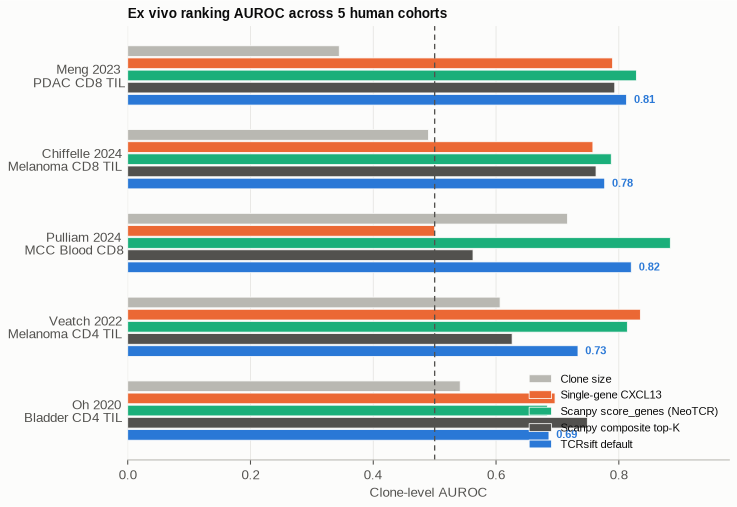
Clone-level AUROC across five human TIL and cancer-blood cohorts comparing tcrsift (first Tier-1 signature of the context preset) against clone_size, single-gene CXCL13, scanpy.tl.score_genes (NeoTCR8/NeoTCR4/NeoTCR_PBL), and an equal-weighted Scanpy composite across preset signatures.
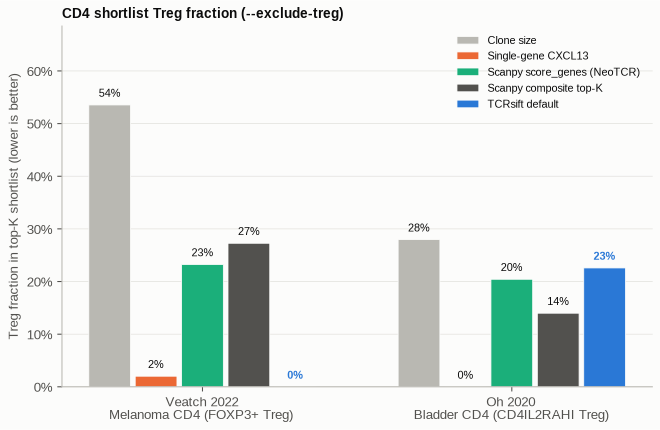
Fraction of top-$K$ shortlisted CD4+ TIL clones annotated as FOXP3+ Tregs (Veatch 2022, $K=99$) or CD4IL2RAHI Tregs (Oh 2020, $K=93$) across methods; tcrsift is run with --exclude-treg.
| Cohort (positives vs negatives) | Method | AUROC (95% CI) | Budget $K$ | Positives in top $K$ | Negatives in top $K$ | Tested precision | Treg fraction in top $K$ |
|---|---|---|---|---|---|---|---|
| Meng 2023 PDAC CD8 TIL (94 TR vs 55 NTR) | clone_size |
0.345 (0.252–0.445) | 200 | 45 | 40 | 52.9% | — |
raw_CXCL13 |
0.790 (0.717–0.858) | 200 | 42 | 1 | 97.7% | — | |
scanpy_score_genes_NeoTCR (NeoTCR8) |
0.829 (0.758–0.895) | 200 | 56 | 2 | 96.6% | — | |
scanpy_composite_topk |
0.793 (0.717–0.864) | 200 | 54 | 3 | 94.7% | — | |
tcrsift_default (TumorReactive) |
0.813 (0.739–0.887) | 200 | 58 | 12 | 82.9% | — | |
| Chiffelle 2024 Melanoma CD8 TIL (72 TR vs 94 NTR) | clone_size |
0.490 (0.402–0.575) | 200 | 41 | 64 | 39.0% | — |
raw_CXCL13 |
0.758 (0.684–0.826) | 200 | 5 | 1 | 83.3% | — | |
scanpy_score_genes_NeoTCR (NeoTCR8) |
0.788 (0.717–0.852) | 200 | 12 | 7 | 63.2% | — | |
scanpy_composite_topk |
0.763 (0.686–0.830) | 200 | 14 | 8 | 63.6% | — | |
tcrsift_default (TumorReactive) |
0.777 (0.702–0.840) | 200 | 24 | 17 | 58.5% | — | |
| Pulliam 2024 MCC Blood CD8 (32 MCPyV vs 14 CMV/EBV/Flu) | clone_size |
0.717 (0.526–0.874) | 18 | 2 | 1 | 66.7% | — |
raw_CXCL13 |
0.500 (0.500–0.500) | 18 | 7 | 2 | 77.8% | — | |
scanpy_score_genes_NeoTCR (NeoTCR_PBL) |
0.884 (0.759–0.980) | 18 | 8 | 0 | 100.0% | — | |
scanpy_composite_topk |
0.563 (0.368–0.741) | 18 | 4 | 0 | 100.0% | — | |
tcrsift_default (NeoTCR_PBL) |
0.820 (0.686–0.933) | 18 | 3 | 1 | 75.0% | — | |
Veatch 2022 Melanoma CD4 TIL (28 CD4_neo vs 1,122 untested; 477 Tregs) |
clone_size |
0.607 (0.488–0.717) | 99 | 6 | 91 | 6.2% | 53.5% (53/99) |
raw_CXCL13 |
0.835 (0.775–0.880) | 99 | 4 | 95 | 4.0% | 2.0% (2/99) | |
scanpy_score_genes_NeoTCR (NeoTCR4) |
0.814 (0.735–0.881) | 99 | 10 | 85 | 10.5% | 23.2% (23/99) | |
scanpy_composite_topk |
0.626 (0.534–0.714) | 99 | 3 | 94 | 3.1% | 27.3% (27/99) | |
tcrsift_default_excl_treg (TumorReactive) |
0.734 (0.666–0.802) | 99 | 9 | 85 | 9.6% | 0.0% (0/99) | |
Oh 2020 Bladder CD4 TIL (163 Effector vs 119 CD4CM/TH17; 163 Tregs) |
clone_size |
0.542 (0.474–0.607) | 93 | 40 | 20 | 66.7% | 28.0% (26/93) |
raw_CXCL13 |
0.696 (0.639–0.750) | 93 | 70 | 19 | 78.7% | 0.0% (0/93) | |
scanpy_score_genes_NeoTCR (NeoTCR4) |
0.684 (0.621–0.744) | 93 | 54 | 9 | 85.7% | 20.4% (19/93) | |
scanpy_composite_topk |
0.749 (0.691–0.804) | 93 | 64 | 10 | 86.5% | 14.0% (13/93) | |
tcrsift_default_excl_treg (TumorReactive) |
0.686 (0.619–0.748) | 93 | 58 | 10 | 85.3% | 22.6% (21/93) |
- Ranking AUROC vs multi-patient shortlist recall. On single-signature AUROC,
scanpy.tl.score_genesandtcrsiftperform similarly, with overlapping confidence intervals across Meng PDAC (0.829 vs 0.813), Chiffelle melanoma (0.788 vs 0.777), Pulliam blood (0.884 vs 0.820), and Oh bladder CD4 (0.684NeoTCR4vs 0.686TumorReactive;tcrsift'sAntigenExperiencedreaches 0.804 on Oh andNeoTCR4reaches 0.756 on Veatch). When pooling raw scores across patients into a top-200 shortlist on 11-patient Chiffelle melanoma, uncalibratedscanpy_score_genes_NeoTCRfavors small 2-cell clones with extreme means and recovers 12 tumor-reactive clones, whereastcrsift's size-matched random-group floors and hypergeometric subset route recover 24. Conversely, on small blood cohorts where a single signature is preferred ($K=18$ in Pulliam blood),scanpy_score_genes_NeoTCR(NeoTCR_PBLalone) captures 8 MCPyV clones vs 3 under multi-signaturetcrsift_default(pass--signatures NeoTCR_PBLto restricttcrsifttoNeoTCR_PBLalone). - Single-gene
CXCL13precision vs tissue coverage. Ranking by CXCL13 alone has high precision among clones with abundant CXCL13 transcripts in human tumors (97.7% in Meng PDAC; 0% Tregs in Oh bladder CD4, whereCD4CXCL13is part of the positive label), but recovers only 5 of 72 reactive clones in Chiffelle melanoma, drops to 0.500 AUROC in Pulliam MCC blood where CXCL13 is unexpressed (its 7 shortlisted clones come from clone-size tie-breaking among zeros), and is detected in 0.11% of mouse MC38 CD8 TILs. - Treg contamination in CD4 shortlists. On Veatch 2022 melanoma CD4 TILs,
scanpy_score_genes_NeoTCR(NeoTCR4) andscanpy_composite_topkplaceFOXP3+Tregs in 23.2% (23/99) and 27.3% (27/99) of shortlist slots (53.5% forclone_size).tcrsift --exclude-tregreducesFOXP3+Treg picks to 0.0% (0/99) while retaining 9CD4_neoclones (vs 4 forraw_CXCL13). On shallower Oh 2020 bladder 10x libraries, lowering--treg-foxp3-fraction 0.25reducesCD4IL2RAHITreg picks from 21 to 17 while keeping 58 effector clones.
Construct assembly and generation probability
Construct assembly: tcrsift assemble vs stitchr (thimble 1.3.1)
stitchr (thimble, Heather et al., Nucleic Acids Res 2022) builds TCR coding sequences from (TRAV, TRAJ, CDR3α, TRBV, TRBJ, CDR3β) calls using *01 IMGT germline references. tcrsift assemble uses sequenced donor V(D)J contigs (fwr1_nt–fwr4_nt and native contig leaders) when present and falls back to cached IMGT V+J germlines and germline M... leaders when --germline-vdj-fallback is set.
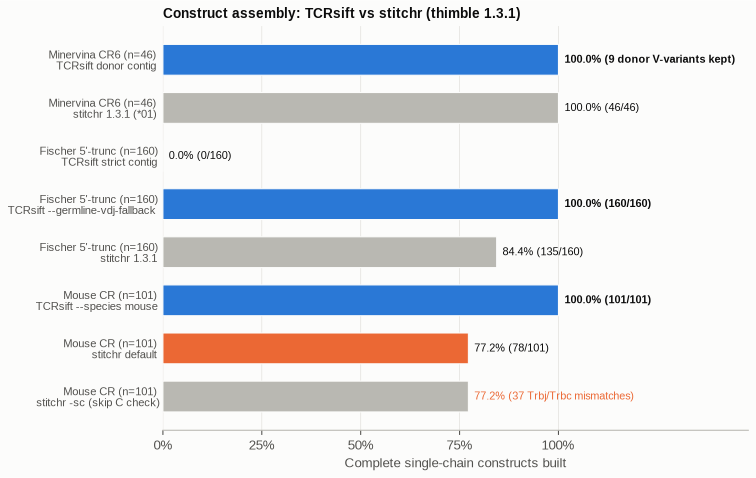
Fraction of complete single-chain TCR constructs built by tcrsift assemble and stitchr (thimble 1.3.1) across human Cell Ranger 6 contigs (Minervina 2022, $n=46$), 5'-truncated human deposits (Fischer 2021, $n=160$), and mouse Cell Ranger shortlists (MC38 and Khatun, $n=101$).
| Cohort | Tool / mode | Clones ($n$) | Complete M... constructs |
Donor V-framework variants kept | Mismatched Trbc shipped |
Contig / build QC flags | Runtime (s) |
|---|---|---|---|---|---|---|---|
| Minervina 2022 human CR6 shortlist | tcrsift_donor_contig |
46 | 46 (100.0%) | 9 (19.6%) | 0 | 0 | 0.90 |
stitchr / thimble 1.3.1 (-s HUMAN) |
46 | 46 (100.0%) | 0 (uses *01) |
0 | 0 | 0.09 | |
| Fischer 2021 human 5'-truncated | tcrsift_donor_contig_only (strict default) |
160 | 0 (0.0%) | 0 | 0 | 0 | 0.94 |
tcrsift_germline_vdj_fallback |
160 | 160 (100.0%) | 33 (partial 5' contigs) | 0 | 28 (raw JSON C-tail flags) | 9.67 | |
stitchr / thimble 1.3.1 (-s HUMAN) |
160 | 135 (84.4%) | 0 | 0 | 25 (unbuilt) | 0.16 | |
| Mouse Cell Ranger shortlists (MC38 + Khatun) | tcrsift_mouse_germline_fallback (--species mouse) |
101 | 101 (100.0%) | 0 | 0 (52 Trbc fixed) |
0 | 2.91 |
stitchr / thimble 1.3.1 (-s MOUSE default) |
101 | 78 (77.2%) | 0 | 0 | 23 (unbuilt) | 0.11 | |
stitchr / thimble 1.3.1 (-s MOUSE -sc skip C check) |
101 | 78 (77.2%) | 0 | 37 (47.4% of built) | 23 (unbuilt) | 0.10 |
- Donor V-region alleles on Cell Ranger 6+ human contigs. Nine of 46 (19.6%) shortlisted human clones in Minervina 2022 carry donor V-region amino-acid differences from IMGT
*01;tcrsiftretains the sequenced donor VDJ, whereasstitchrsubstitutes*01framework residues. - 5'-truncated deposits (Fischer 2021). Strict
tcrsiftrefuses to build incomplete contigs (0/160). Adding--germline-vdj-fallbackbuilds 160 of 160 completeM...single-chain constructs (vs 135/160 = 84.4% institchr), rescuing 33 partial 5' donor contigs, logging 16 germline and constant-allele variants (including 3 donor constant-allele divergences), and flagging 28 clones where unfilteredall_contig_annotations.json.gzreads carry 3' C-region primer or junction errors (single_chain_nt_optimizedremains in-frame for all 160). - Mouse Cell Ranger outputs (
-dvnames andTrbcparity). Defaultstitchr -s MOUSEfails on 23 of 101 (22.8%) mouse candidates due to Ensembl-dvV-gene names (TRAV13-4-dv7,TRAV16d-dv11) and C-gene checks; adding-sc(--skip_c_checks) still fails on the 23-dvclones and ships 37Trbj2+Trbc1orTrbj1+Trbc2chimeras.tcrsift --species mousenormalizes-dvnames and enforcesTrbj1->Trbc1/Trbj2->Trbc2parity (52 Cell Ranger miscalls corrected), building 101 of 101 constructs with 0 validation errors.
Generation probability and publicness: tcrsift k-mer vs OLGA 1.3.0
OLGA (Sethna et al., Bioinformatics 2019; GPLv3) computes exact V(D)J generation probabilities by dynamic programming. tcrsift bundles an Apache-2.0 NumPy k-mer Pgen/Ppost model in the base package.
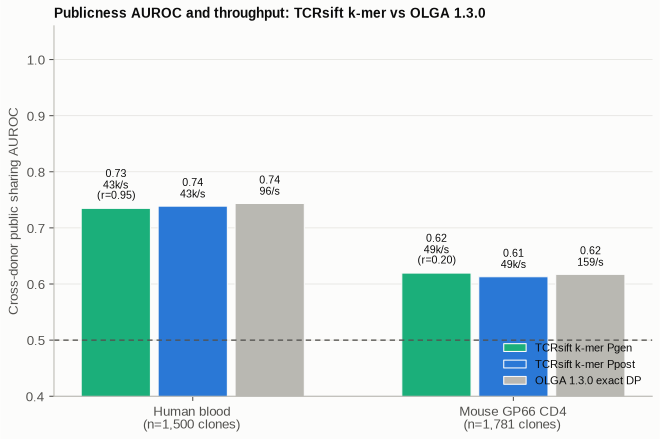
Cross-donor public sharing AUROC, throughput (clones/s), and Pearson correlation with OLGA 1.3.0 on human blood ($n=1{,}500$; 420 public across donors) and mouse GP66 CD4 ($n=1{,}781$; 72 public across mice).
Repertoire (public >=2 donors) |
Model | Pearson $r$ vs OLGA ($\beta$ / $\alpha$) |
Spearman $\rho$ vs OLGA ($\beta$ / $\alpha$) |
Public sharing AUROC (95% CI) | Throughput (clones/s) | Speedup vs OLGA |
|---|---|---|---|---|---|---|
| Human blood ($n = 1{,}500$; 420 public) | tcrsift k-mer pgen_beta |
0.954 / 0.763 | 0.957 / 0.755 | 0.735 (0.704–0.766) | 43,038 / s | 451x |
tcrsift k-mer ppost_beta |
— | — | 0.739 (0.708–0.770) | 43,038 / s | 451x | |
OLGA 1.3.0 exact VDJ pgen_beta |
1.000 | 1.000 | 0.744 (0.712–0.774) | 95.5 / s | 1.0x | |
| Mouse GP66 CD4 ($n = 1{,}781$; 72 public) | tcrsift AA-Markov fallback pgen_beta |
0.198 / 0.224 | 0.235 / 0.208 | 0.620 (0.555–0.680) | 49,069 / s | 308x |
tcrsift AA-Markov fallback ppost_beta |
— | — | 0.613 (0.550–0.674) | 49,069 / s | 308x | |
OLGA 1.3.0 mouse_T_beta exact DP |
1.000 | 1.000 | 0.617 (0.542–0.686) | 159.1 / s | 1.0x |
- Human blood.
tcrsiftk-merpgen_betacorrelates withOLGAat $r = 0.954$ ($\rho = 0.957$), reaches similar cross-donor public sharing AUROC (0.735Pgenand 0.739Ppostvs 0.744OLGA), and runs 451x faster (0.035 s vs 15.71 s). - Mouse fallback. Because
tcrsiftdoes not ship a pre-trained mouse V(D)J k-mer table (tcrsift pgen train --species mousefits one from repertoire data), it logs a fallback notice and scores mouse chains with its gene-agnostic amino-acid Markov model. Correlation withOLGA mouse_T_betais low ($r = 0.198$), though empirical cross-mouse public sharing AUROC across the five Khatun C57BL/6 mice is similar (0.620 vs 0.617).
Multiplexed pMHC multimer calling
On 10x Genomics Healthy Donors 1 and 2 (2,572 expanded ≥2-cell paired α/β CD8 clones stained with 44 viral/cancer dextramers and 6 negative-control dextramers), four callers are compared.
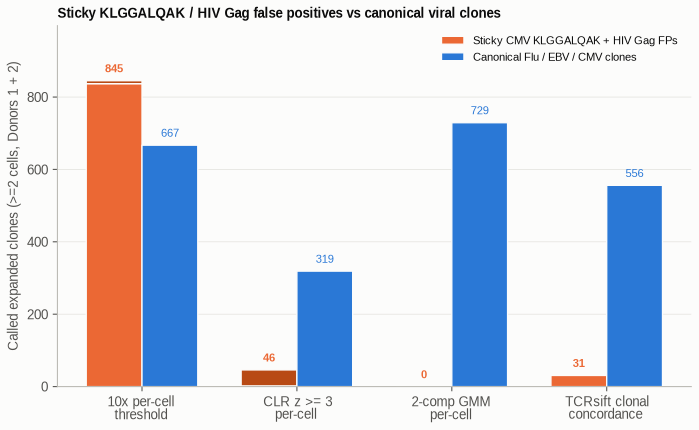
Expanded clone counts (≥2 cells, Donors 1 and 2 combined) assigned to sticky CMV KLGGALQAK or HIV Gag (in HIV-negative donors) versus canonical Influenza, EBV, and CMV multimers across four callers.
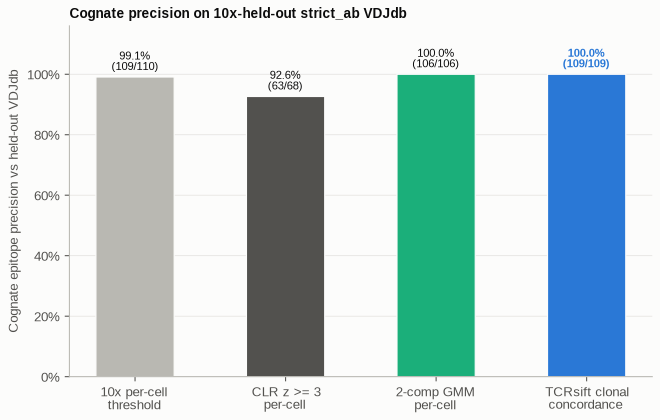
Cognate epitope precision among called clones matching 10x-held-out strict_ab VDJdb (n_concordant / n_matched).
| Multimer caller | Called clones (≥2 cells) | Sticky KLGGALQAK clones |
HIV Gag FP clones | Canonical Flu / EBV / CMV clones | Held-out VDJdb strict_ab matches |
Cognate precision (held-out VDJdb) |
|---|---|---|---|---|---|---|
10x_per_cell_threshold (UMI >= 10, >=5x max(NC, 1) in ≥1 cell) |
1,540 | 837 | 8 | 667 | 110 | 99.1% (109/110) |
clr_z3_per_cell (CLR z >= 3 across 44 pMHCs, UMI >= 5 in ≥1 cell) |
627 | 2 | 44 | 319 | 68 | 92.6% (63/68) |
gmm_bimodal_per_cell (2-comp log1p EM P >= 0.95, UMI >= 10, >5x max(NC, 1) in ≥1 cell) |
729 | 0 | 0 | 729 | 106 | 100.0% (106/106) |
tcrsift_clonal_concordance (UMI >= 10, >=5x max(NC, 1), ≥2 cells & ≥50% concordance) |
605 | 31 | 0 | 556 | 109 | 100.0% (109/109) |
- Per-cell thresholds and CLR.
10x_per_cell_thresholdlabels 837 expanded clones with the stickyKLGGALQAKCMV IE-1 reagent (54.4% of called clones) because single-cell background hits at least one cell in most large clones.clr_z3_per_cellsuppressesKLGGALQAK(whose widespread background raises column mean and SD) but introduces 44 HIV Gag false-positive clones in HIV-negative donors, misses half of canonical Flu/EBV/CMV clones (319 vs 556–729), and lowers held-out VDJdb precision to 92.6% (63/68). - Bimodal GMM vs clonal concordance. Fitting a 2-component Gaussian mixture per multimer (
gmm_bimodal_per_cell) rejects unimodalKLGGALQAK(0 clones) at 100.0% (106/106) held-out VDJdb precision, provided each multimer has a distinct positive mode in the library.tcrsift --call-multimersrequires at least 50% of cells in a clone (and at least 2 cells) to bind the same pMHC, cuttingKLGGALQAKclones by 96.3% (837 to 31) and HIV Gag false positives to 0 while retaining 109 of 109 (100.0%) held-out VDJdb matches without fitting per-library mixture models.
Reproducing
.venv/bin/python -m venv --system-site-packages /tmp/h2h_venv
/tmp/h2h_venv/bin/pip install stitchr==1.3.1 olga==1.3.0
/tmp/h2h_venv/bin/stitchrdl -s HUMAN && /tmp/h2h_venv/bin/stitchrdl -s MOUSE

MPLCONFIGDIR=/tmp/mpl_cache /tmp/h2h_venv/bin/python benchmarks/head_to_head/run.py
MPLCONFIGDIR=/tmp/mpl_cache .venv/bin/python docs/figures/make_overview_benchmark_figures.py
Cohort-specific methods, downloads, and patient-level tables are documented on each benchmark page:
- Benchmark on public TIL data (Meng 2023 PDAC, Chiffelle 2024 melanoma, Caushi 2021 NSCLC, Eberhardt 2021 HPV+ HNSCC, Pulliam 2024 MCC tumor).
- Benchmark on infectious disease and blood (10x Healthy Donors 1 and 2, Minervina 2022 SARS-CoV-2, Fischer 2021 16 h Spike restimulation).
- Benchmark on paired blood-tumor, post-ACT, and CD4+ TILs (Pulliam 2024 MCC blood, Chiffelle
T0vsT30ACT, Veatch 2022 melanoma CD4, Oh 2020 bladder CD4). - Benchmark on murine models (
--species mouse) (MC38 colon adenocarcinoma, Kasmani 2022 NOD IGRP, Khatun 2021 LCMV GP66 CD4).