Benchmark on paired blood-tumor, post-ACT, and CD4+ TILs
This page evaluates three settings not covered by the solid-tumor CD8 TIL benchmark or the infectious-disease blood benchmark (for cross-cohort and baseline comparisons, see the Benchmark overview):
- Circulating antitumor CD8+ T cells in cancer-patient blood (
tcrsift prioritize --context blood-tumor,NeoTCR_PBL, and blood-to-tumor clonal overlap). - Longitudinal melanoma TIL biopsies before (
T0) vs 30 days after (T30) adoptive cell therapy (ACT) (tcrsift prioritize --context solid-tumor). - Human CD4+ TIL prioritization (
tcrsift prioritize --context solid-tumor --tcell-type cd4,NeoTCR4, FACSpre_sorted: CD4coreceptor-dropout rescue, andFOXP3+regulatory T-cell exclusion via--exclude-treg).
Summary
NeoTCR_PBLseparates circulating polyomavirus tumor-specific CD8+ T cells from common antiviral memory T cells in cancer-patient blood. Across 46 multimer-verified peripheral-blood CD8+ clonotypes in Merkel cell carcinoma patients (Pulliam et al. 2024; 32MCPyVantitumor vs 14CMV/EBV/Flucontrol viral clones),NeoTCR_PBLreaches an AUROC of 0.82 (95% CI 0.69 to 0.93; 0.83 on expanded ≥2-cell clones), ahead of general activation panels (AcuteActivation0.71,AIM0.67,Cytolytic0.66) andCirculatingMemory(0.33, which enriches for restingCMV/EBV/Flumemory). Against unlabeled expanded blood clones (21 vs 63),NeoTCR_PBLdrops to 0.62 (0.46 to 0.77). Within the two patients who have sequenced matched tumor hashtag libraries (Z1249andZ1308; 18 tumor-shared α/β blood clones vs 37 blood-only clones), clones shared with the tumor biopsy are enriched for clonal expansion and differentiated cytolytic effector state (clone_size0.83,Differentiated0.79,AntigenExperienced0.72,Cytolytic0.70) rather thanNeoTCR_PBL(0.18), reflecting vascular and bystander effector infiltration alongside antitumor clones.- Pre-infusion (
T0) melanoma biopsies outperform Day-30 post-ACT (T30) biopsies for identifying tumor-reactive clones. Across six melanoma patients with pairedT0andT30biopsies (Chiffelle/Barras et al. 2024),TumorReactiveandNeoTCR8separate autologous tumor-reactive (TR) from non-reactive (NTR) clones atT0(0.74 and 0.70 across 31TRvs 49NTR; shortlist tested precision 62.5%, 10TRof 16), and drop 30 days after lymphodepletion, ex vivo TIL expansion, and high-dose IL-2 (T30AUROC 0.61 and 0.42 across 18TRvs 32NTR; shortlist tested precision 28.6%, 2TRof 7), as systemic ACT shifts infused non-reactive bystander clones toward similar effector and exhausted states. NeoTCR4andTumorReactiveenrich for verified neoantigen-specific human CD4+ TILs, and co-select intratumoralFOXP3+Tregs unless--exclude-tregis enabled. Across 28 experimentally verified neoantigen-specific CD4+ TIL clones in four melanoma patients (Veatch et al. 2022; 1,163 expanded Vβ clones on a 397-gene panel covering 9 of 40NeoTCR4and 8 of 9TumorReactivegenes),NeoTCR4reaches 0.76 (0.67 to 0.83) andTumorReactivereaches 0.73 (0.78 vs non-Treg clones). Without Treg filtering,FOXP3+regulatory clones (≥50%FOXP3+cells) make up 38.1% (61 of 160) of the shortlist; enabling--exclude-tregremoves 100% (61 to 0) ofFOXP3+Treg picks while retaining 100% (9 of 9CD4_neoand 5 of 5CD4_self) of shortlisted tumor-antigen clones. Within PatientX205,CD4_neoand melanoma self-antigenCD4_selfclones (12 vs 13) share the same chronic activation state (TumorReactive0.48,NeoTCR40.62).- Whole-transcriptome FACS-sorted human CD4+ 10x libraries require
pre_sorted: CD4to prevent CD4 mRNA-dropout loss and benefit from cytolytic and Treg-aware filtering. Across seven bladder tumors (Oh et al. 2020; whole-transcriptome 40 of 40NeoTCR4genes), 88.5% ofCD3-gated FACS-sorted CD4+ T cells have zeroCD4UMIs (708 vs 6,144 cells retained); settingpre_sorted: CD4on the sample sheet increases shortlistedCD4CXCL13and cytotoxic (CD4GZMB/CD4GZMK) clones 10-fold (6 to 61).NeoTCR4(0.80) andTumorReactive(0.78) rankCD4CXCL13clones aboveCD4CM/CD4TH17(47 vs 119), whileAntigenExperienced(0.86),Differentiated(0.83), andCytolytic(0.72) separate combinedCD4CXCL13and cytotoxic effectors fromFOXP3+CD4IL2RAHITregs (whereAIMis inverted at 0.16).
All results are from TCRsift 3.33.0 and VDJdb 2026-11-06, generated by
benchmarks/public_blood_cd4/ (how to reproduce; full
ground-truth file and assay provenance in
benchmarks/public_blood_cd4/PROVENANCE.md). None of TCRsift's gene signatures
was trained on any cohort on this page.
Source studies and ground-truth provenance
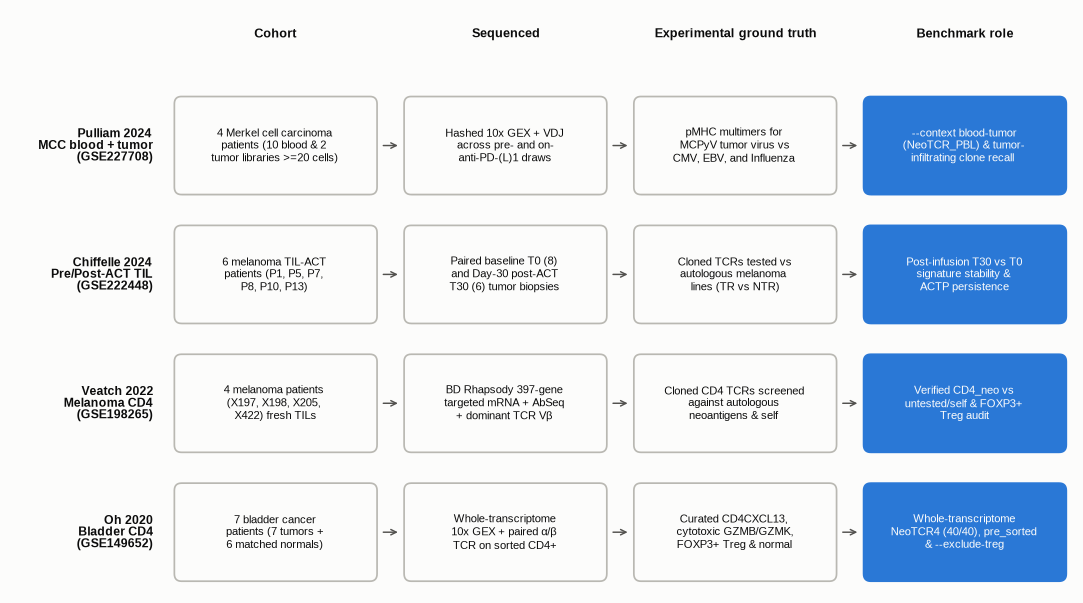
Summary schematic of the four open-access human cancer cohorts evaluated on this page.
| Study | Setting | Raw GEX & VDJ Deposit | Ground-Truth Label Source | Positives | Negatives / Contrasts | How TCRsift ran |
|---|---|---|---|---|---|---|
| Pulliam et al. 2024 | Paired peripheral blood + Merkel cell carcinoma (MCPyV) |
GSE227708 (5 hashed 10x runs across 4 patients: 10 blood & 2 tumor libraries with ≥20 cells; 1,014 retained blood CD8 cells, 548 clones) | Table S4 (mmc5.xlsx multimer calls) + matched autologous tumor VDJ |
MCPyV multimer+ blood clones (32 total, 21 ≥2 cells) and tumor-infiltrating α/β blood clones (18 total / 12 ≥2 cells in Z1249+Z1308) |
CMV/EBV/Flu multimer+ viral control clones (14 total, 5 ≥2 cells) and unlabeled (63 ≥2 cells) or blood-only (37 in Z1249+Z1308) clones |
Default prioritize --context blood-tumor and --context blood |
| Chiffelle / Barras et al. 2024 | Melanoma before (T0) and 30 days after (T30) TIL-ACT |
GSE222448 (6 patients P1, P5, P7, P8, P10, P13: 8 T0 biopsies, 4,933 cells / 3,032 clones; 6 T30 biopsies, 5,595 cells / 2,004 clones) |
Table S3 (mmc3.xlsx, autologous melanoma reactivity yes vs no and ACTP expansion) |
Autologous tumor-reactive TR clones (31 at T0, 18 at T30) |
Autologous tumor-non-reactive NTR clones (49 at T0, 32 at T30) |
Default prioritize --context solid-tumor at T0 and T30 |
| Veatch et al. 2022 | Melanoma intratumoral CD4+ TILs | GSE198265 (4 patients X197, X198, X205, X422; 397-gene BD Rhapsody mRNA + AbSeq + TCR Vβ; 9,705 CD4 cells, 5,121 clones) |
Deposited VDJ annotations (CD4_neo / Neoantigen and CD4_self from autologous APC screening) |
Verified neoantigen-specific CD4_neo clones (28 ≥2 cells) |
Unlabeled ≥2-cell CD4 TILs (1,122 total; 646 non-Treg) and X205 self-antigen CD4_self (13 clones) |
score_by_name, calibrate_signature_background, signature_pass_mask, and select_round_robin (cd4) |
| Oh et al. 2020 | Bladder cancer + matched normal sorted CD4+ T cells | GSE149652 (7 tumors + 6 matched normals; whole-transcriptome 10x GEX + paired α/β TCR; 6,144 retained tumor CD4 cells, 4,755 clones) | Author cellinfo subtypes (CD4CXCL13, CD4GZMB, CD4GZMK, CD4IL2RAHI, CD4CM, CD4TH17) + matched normal VDJ |
CD4CXCL13 (47) + cytotoxic CD4GZMB/CD4GZMK (116; 163 combined ≥2-cell clones) and tumor-exclusive clones (272) |
CD4CM/CD4TH17 bystanders (119), FOXP3+ CD4IL2RAHI Tregs (163), and normal-shared clones (22) |
Default prioritize --context solid-tumor --tcell-type cd4 |
1. Cancer-patient peripheral blood (--context blood-tumor) and post-ACT TIL (T30)
1a. Pulliam 2024: MCPyV antitumor vs CMV/EBV/Flu viral T cells in blood
Pulliam et al. (Cell Reports Medicine 2024)
profiled longitudinal peripheral blood and tumors from Merkel cell carcinoma
patients treated with anti-PD-(L)1, identifying T cells specific for the
oncogenic Merkel cell polyomavirus (MCPyV) alongside bystander CMV, EBV,
and Influenza T cells in the same blood draws (Table S4). Demultiplexing all
five hashed 10x runs (Z1210, Z1249, Z1308, Z1493, Z1493B) recovers 10
peripheral-blood hashtag libraries (≥20 cells) and 2 matched tumor
libraries (Z1249 TD6222 and Z1308 TD7000).
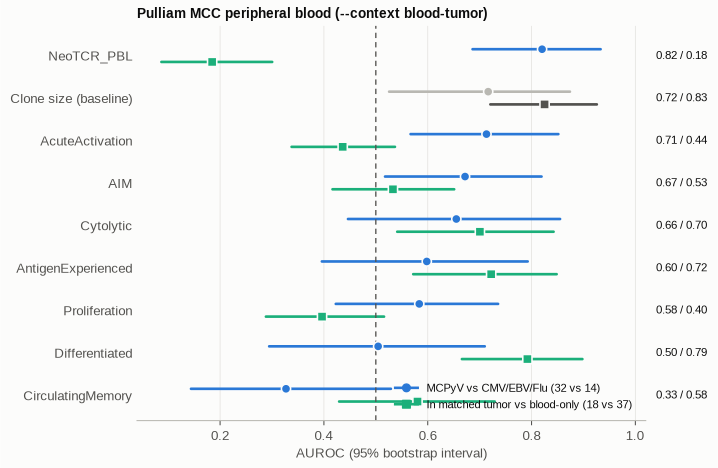
Clone-level AUROC (95% bootstrap CI) in Pulliam 2024 Merkel cell carcinoma peripheral blood comparing MCPyV antitumor vs CMV/EBV/Flu viral control clones (32 vs 14) and matched-tumor α/β clones vs blood-only clones in Z1249 and Z1308 (18 vs 37).
| Signature | MCPyV vs CMV/EBV/Flu (all 32 vs 14) |
MCPyV vs CMV/EBV/Flu (≥2 cells, 21 vs 5) |
MCPyV vs untested blood (≥2 cells, 21 vs 63) |
Matched-tumor α/β vs blood-only in Z1249+Z1308 (18 vs 37) |
|---|---|---|---|---|
NeoTCR_PBL |
0.82 (0.69–0.93) | 0.83 (0.63–0.97) | 0.62 (0.46–0.77) | 0.18 (0.09–0.30) |
AcuteActivation |
0.71 (0.57–0.85) | 0.63 (0.42–0.83) | 0.57 (0.38–0.75) | 0.44 (0.34–0.54) |
AIM |
0.67 (0.52–0.82) | 0.65 (0.44–0.84) | 0.47 (0.30–0.64) | 0.53 (0.42–0.65) |
Cytolytic |
0.66 (0.45–0.85) | 0.79 (0.55–0.96) | 0.47 (0.34–0.60) | 0.70 (0.54–0.84) |
AntigenExperienced |
0.60 (0.40–0.79) | 0.77 (0.57–0.93) | 0.46 (0.32–0.60) | 0.72 (0.57–0.85) |
Proliferation |
0.58 (0.42–0.74) | 0.40 (0.20–0.61) | 0.54 (0.36–0.72) | 0.40 (0.29–0.52) |
Differentiated |
0.50 (0.29–0.71) | 0.68 (0.47–0.87) | 0.37 (0.25–0.51) | 0.79 (0.67–0.90) |
CirculatingMemory |
0.33 (0.14–0.53) | 0.18 (0.00–0.43) | 0.32 (0.20–0.45) | 0.58 (0.43–0.73) |
| Clone size | 0.72 (0.53–0.87) | 0.51 (0.23–0.78) | 0.33 (0.19–0.49) | 0.83 (0.72–0.93) |
NeoTCR_PBLgeneralizes out-of-cohort to virus-driven solid-tumor blood. Although Yossef et al. 2023 derivedNeoTCR_PBLfrom mutated neoantigen-reactive CD8+ PBLs in epithelial cancers, it reaches 0.82 AUROC (0.83 on expanded clones) separating circulatingMCPyVT-antigen-specific clones fromCMV/EBV/Flumemory clones in the same patients, whereas in excised MCC tumors (TIL benchmark)MCPyVTILs did not separate from unlabeled TILs (TumorReactive0.58 on 5 clones).- Why tumor overlap (
in_matched_tumor_ab) enriches for cytolytic effectors (0.79Differentiated) rather thanNeoTCR_PBL(0.18). Restricting to the two patients with sequenced tumor hashtag libraries (Z1249andZ1308, 18 tumor-shared vs 37 blood-only clones), blood clones that also appear in the resected tumor biopsy are expanded and differentiated (clone_size0.83,Differentiated0.79,AntigenExperienced0.72,Cytolytic0.70; at ≥2 cells across 12 vs 2 clones,Differentiatedis 0.79 andNeoTCR_PBL0.46). However, presence in a resected biopsy includes vascular and bystander memory T cells (Z1308blood contains 4CMVclones and 0MCPyVclones), which expressGZMB/PRF1rather thanNeoTCR_PBL. Combining Tier-1NeoTCR_PBLwith Tier-2 effector panels in default--context blood-tumorshortlists 18 candidates across all four patients, capturing 3 of 21 expandedMCPyVclones (2 of 21 under--context blood) and 4 of 12 (33%) expanded tumor-infiltrating α/β clones (1 control viral).
1b. Chiffelle 2024: baseline T0 vs Day-30 post-ACT T30 melanoma biopsies
In six melanoma TIL-ACT patients (P1, P5, P7, P8, P10, P13) biopsied both
before therapy (T0) and 30 days after adoptive TIL transfer (T30), 16 of
18 TR clones and 27 of 32 NTR clones detected at T30 persisted from
T0:
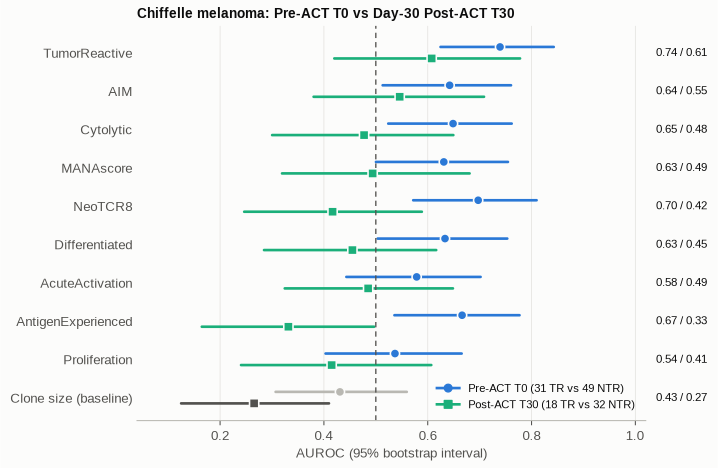
Clone-level AUROC (95% bootstrap CI) separating autologous tumor-reactive (TR) from non-reactive (NTR) CD8+ clones in paired pre-ACT baseline (T0, 31 vs 49) and Day-30 post-ACT (T30, 18 vs 32) melanoma biopsies.
| Timepoint | Retained CD8 cells | Scored clones (≥2 cells) | TR vs NTR scored |
TumorReactive AUROC |
NeoTCR8 AUROC |
Shortlisted (TR / NTR / precision) |
|---|---|---|---|---|---|---|
T0 (pre-ACT baseline) |
4,933 | 3,032 (620) | 31 vs 49 | 0.74 (0.62–0.84) | 0.70 (0.57–0.81) | 118 (10 TR, 6 NTR, 62.5%) |
T30 (Day 30 post-ACT) |
5,595 | 2,004 (484) | 18 vs 32 | 0.61 (0.42–0.78) | 0.42 (0.25–0.59) | 87 (2 TR, 5 NTR, 28.6%) |
Ex vivo TIL expansion followed by lymphodepleting chemotherapy and high-dose
IL-2 compresses the transcriptional contrast between tumor-reactive and non-reactive
clones in post-transfer biopsies. tcrsift prioritize --context solid-tumor
should therefore be run on pre-ACT baseline (T0) tumor biopsies rather
than early post-ACT (T30) biopsies.
2. Human CD4+ TIL prioritization (--tcell-type cd4, NeoTCR4, and Treg overlap)
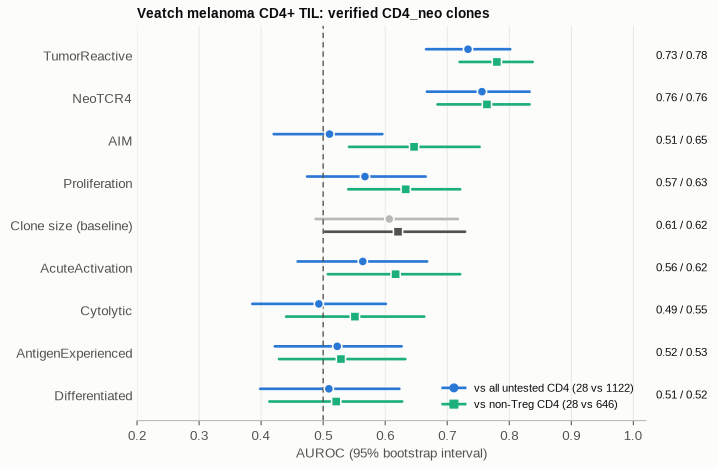
Clone-level AUROC (95% bootstrap CI) for verified neoantigen-specific CD4_neo clones in Veatch 2022 melanoma TILs against all untested CD4 clones (28 vs 1,122) and against non-Treg untested CD4 clones (28 vs 646).
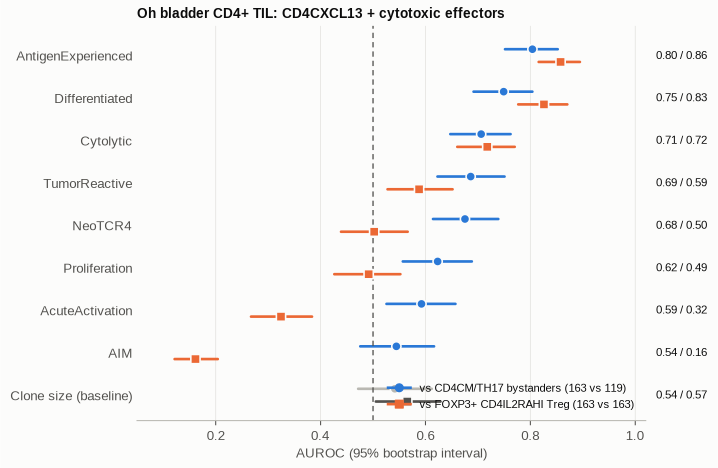
Clone-level AUROC (95% bootstrap CI) in Oh 2020 bladder cancer CD4+ TILs separating CD4CXCL13 and cytotoxic CD4GZMB/CD4GZMK effectors (163 clones) from CD4CM/CD4TH17 bystanders (119) and from FOXP3+ CD4IL2RAHI Tregs (163).
| Signature | Veatch CD4_neo vs all untested (28 vs 1,122) |
Veatch CD4_neo vs non-Treg (28 vs 646) |
Oh CD4CXCL13 vs CD4CM/TH17 (47 vs 119) |
Oh CD4CXCL13 + GZMB/GZMK vs CD4CM/TH17 (163 vs 119) |
Oh effectors vs FOXP3+ CD4IL2RAHI Treg (163 vs 163) |
|---|---|---|---|---|---|
NeoTCR4 |
0.76 (0.67–0.83) | 0.76 (0.68–0.83) | 0.80 (0.72–0.87) | 0.68 (0.61–0.74) | 0.50 (0.44–0.57) |
TumorReactive |
0.73 (0.67–0.80) | 0.78 (0.72–0.84) | 0.78 (0.71–0.85) | 0.69 (0.62–0.75) | 0.59 (0.53–0.65) |
AntigenExperienced |
0.52 (0.42–0.63) | 0.53 (0.43–0.63) | 0.60 (0.50–0.69) | 0.80 (0.75–0.85) | 0.86 (0.82–0.89) |
Differentiated |
0.51 (0.40–0.62) | 0.52 (0.41–0.63) | 0.50 (0.40–0.60) | 0.75 (0.69–0.80) | 0.83 (0.78–0.87) |
Cytolytic |
0.49 (0.39–0.60) | 0.55 (0.44–0.66) | 0.49 (0.39–0.58) | 0.71 (0.65–0.76) | 0.72 (0.66–0.77) |
Proliferation |
0.57 (0.47–0.67) | 0.63 (0.54–0.72) | 0.66 (0.57–0.74) | 0.62 (0.56–0.69) | 0.49 (0.43–0.55) |
AcuteActivation |
0.56 (0.46–0.67) | 0.62 (0.51–0.72) | 0.54 (0.45–0.63) | 0.59 (0.53–0.66) | 0.32 (0.27–0.38) |
AIM |
0.51 (0.42–0.60) | 0.65 (0.54–0.75) | 0.59 (0.50–0.67) | 0.54 (0.48–0.62) | 0.16 (0.12–0.20) |
| Clone size | 0.61 (0.49–0.72) | 0.62 (0.50–0.73) | 0.41 (0.32–0.51) | 0.54 (0.47–0.61) | 0.57 (0.51–0.63) |
Two complementary human CD4+ antitumor states and the Treg confounder
CXCL13+helper/exhausted CD4+ TILs vs cytotoxicGZMB+/GZMK+CD4+ TILs. In melanoma (Veatch 2022), experimentally verified neoantigen-reactiveCD4_neoclones (BRAFV600E,ERAP1,SNRPB,HTATSF1,ITGB5) reside primarily in theCXCL13+ PDCD1+ ENTPD1+follicular-helper/exhausted compartment rather than aPRF1/GZMBcytolytic state (NeoTCR40.76,TumorReactive0.73–0.78, vsCytolytic0.49–0.55). In human bladder cancer (Oh 2020, whole-transcriptome 40 of 40NeoTCR4genes), tumor-reactive CD4+ TILs span bothCD4CXCL13(NeoTCR40.80,TumorReactive0.78) and MHC-II-restrictedCD4GZMB/CD4GZMKcytotoxic clones (AntigenExperienced0.80,Differentiated0.75,Cytolytic0.71). Including both Tier-1 (NeoTCR4,TumorReactive) and Tier-2 (Differentiated,AntigenExperienced,Cytolytic) signatures in--context solid-tumor --tcell-type cd4captures both compartments (61 shortlisted effector clones: 7CD4CXCL13and 54CD4GZMB/CD4GZMK, vs 3 normal-shared clones).- Why intratumoral
FOXP3+Tregs contaminate naive CD4 shortlists. Intratumoral Tregs (CD4IL2RAHI) constitutively expressENTPD1,CTLA4,TIGIT,TNFRSF9(4-1BB), andTNFRSF4(OX40), scoring higher than effector CD4+ TILs onAIM(AUROC 0.16) andAcuteActivation(0.32) and matching them onNeoTCR4(0.50).
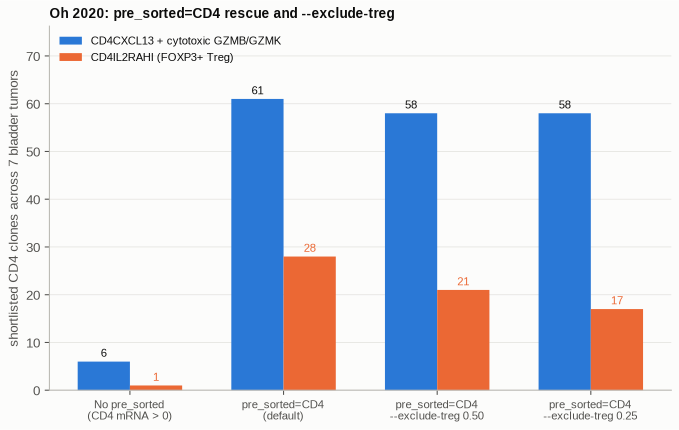
Shortlisted effector (CD4CXCL13 + CD4GZMB/CD4GZMK) and CD4IL2RAHI Treg clone counts across seven Oh 2020 bladder tumors with and without pre_sorted: CD4 and --exclude-treg.
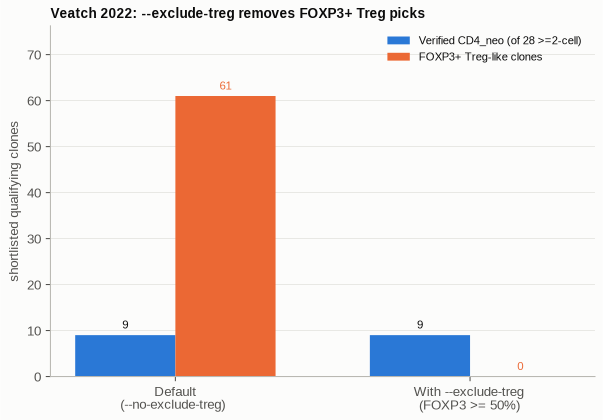
Shortlisted verified CD4_neo and FOXP3+ Treg-like clone counts in Veatch 2022 melanoma CD4+ TILs before and after enabling --exclude-treg.
| Cohort & run configuration | Retained CD4 cells | Expanded (≥2-cell) clones | Total shortlisted | Target effector / CD4_neo shortlisted |
FOXP3+ Treg (CD4IL2RAHI) shortlisted |
|---|---|---|---|---|---|
Oh 2020, without pre_sorted: CD4 (CD4 mRNA > 0 only) |
708 | 44 | 7 | 6 (1 CXCL13, 5 GZMB/K) |
1 |
Oh 2020, pre_sorted: CD4 (default --no-exclude-treg) |
6,144 | 544 | 103 | 61 (7 CXCL13, 54 GZMB/K) |
28 (27.2%) |
Oh 2020, pre_sorted: CD4 --exclude-treg (0.50 default) |
6,144 | 544 | 93 | 58 (6 CXCL13, 52 GZMB/K) |
21 (22.6%) |
Oh 2020, pre_sorted: CD4 --exclude-treg --treg-foxp3-fraction 0.25 |
6,144 | 544 | 88 | 58 (6 CXCL13, 52 GZMB/K) |
17 (19.3%) |
Veatch 2022, default (--no-exclude-treg) |
9,705 | 1,163 | 160 | 9 CD4_neo + 5 CD4_self |
61 (38.1%) |
Veatch 2022, --exclude-treg (0.50 default) |
9,705 | 1,163 | 99 | 9 CD4_neo + 5 CD4_self |
0 (0.0%) |
- Recommendations for human CD4+ runs:
- Set
pre_sorted: CD4on sample-sheet rows derived from FACS-sorted CD4+ T cells so CD4 mRNA dropout (81.4%–96.5% zero-UMI rate across the 13 libraries in Oh 2020; 88.5% overall) does not discard ~90% of sequenced cells. - Pass
--exclude-tregwhen screening for helper or cytotoxic antitumor CD4+ TCRs (--treg-foxp3-fraction 0.5preserves 28 of 28 verifiedCD4_neoclones in Veatch 2022;--treg-foxp3-fraction 0.25removes additional low-depth Treg clones in shallow 10x libraries).
Limitations
- Small labeled blood sample size in Pulliam 2024. Although 10 blood hashtag
libraries are scored, only 32
MCPyVand 14CMV/EBV/Fluclones from Table S4 appear in the blood repertoire (21 vs 5 at ≥2 cells), and matched tumor hashtag libraries were recovered in two of the four patients (Z1249andZ1308). - Targeted 397-gene mRNA panel in Veatch 2022. BD Rhapsody's targeted immune
panel measures 9 of 40
NeoTCR4genes and 8 of 9TumorReactivegenes and reports dominant Vβ chains without paired Vα sequences; whole-transcriptome paired α/βNeoTCR4(40 of 40 genes) is therefore complemented by Oh et al. 2020, whose labels reflect curated transcriptional states and normal-tissue sharing rather than individual neoantigen TCR cloning. - Unvalidated context presets. With
solid-tumor,blood,blood-tumor,--tcell-type cd4, and--species mousebenchmarked across public cohorts, only the exploratorympe(malignant pleural effusion) andheme(hematologic malignancy) presets remain untested against ground-truth specificity labels.
Reproducing
tcrsift data download --db vdjdb
python benchmarks/public_blood_cd4/download.py --data-dir /tmp/tcrsift_bench_blood_cd4
python benchmarks/public_blood_cd4/run.py \
    --data-dir /tmp/tcrsift_bench_blood_cd4 \
    --work-dir /tmp/tcrsift_bench_blood_cd4/runs
python docs/figures/make_blood_cd4_benchmark_figures.py
Sources
- Pulliam T, Jani S, Jing L, et al. Circulating cancer-specific CD8 T cell
frequency is associated with response to PD-1 blockade in Merkel cell
carcinoma. Cell Rep Med 2024
(GSE227708;
PMID:38340723). - Chiffelle J, Barras D, Pétremand R, et al. Tumor-reactive T cell clonotype
dynamics underlying clinical response to TIL therapy in
melanoma. Immunity 2024
(GSE222448;
PMID:39321802). - Veatch JR, Lee SM, Shasha C, et al. Neoantigen-specific CD4+ T cells in human
melanoma have diverse differentiation states and correlate with CD8+ T cell,
macrophage, and B cell
function. Cancer Cell 2022
(GSE198265;
PMID:35413271). - Oh DY, Kwek SS, Raju SS, et al. Intratumoral CD4+ T cells mediate anti-tumor
cytotoxicity in human bladder
cancer. Cell 2020
(GSE149652;
PMID:32497499). - Yossef R, Krishna S, Sindiri S, et al. Phenotypic signatures of circulating
neoantigen-reactive CD8+ T cells in patients with metastatic
cancers. Cancer Cell 2023
(
NeoTCR_PBL). - Lowery FJ, Krishna S, Yossef R, et al. Molecular signatures of antitumor
neoantigen-reactive T cells from metastatic human
cancers. Science 2022
(
NeoTCR4,NeoTCR8).