Benchmark on infectious disease and blood
This page evaluates TCRsift outside solid tumors: peripheral-blood signature
ranking and shortlisting (tcrsift prioritize --context blood), public TCR
database matching (tcrsift annotate), pMHC multimer feature-barcode calling
(tcrsift.multimer), and paired peptide-restimulation scoring
(score_stimulation_response). It covers three public human cohorts spanning
Influenza A, Epstein–Barr virus (EBV), cytomegalovirus (CMV), SARS-CoV-2, and
naive self-antigen (MART-1, encoded by MLANA) T cells across resting blood,
longitudinal vaccination, and overnight peptide stimulation (see also the
Benchmark overview).
Summary
- In resting blood, differentiation signatures separate viral memory from
naive precursors, but not one expanded memory clone from another. Across
all clones (≥1 cell) in 10x Genomics Donors 1 and 2,
Differentiatedreaches an AUROC of 0.84 and 0.94 andAntigenExperiencedreaches 0.83 and 0.92 when separating Influenza, EBV, and CMV memory clones from naiveMART-1(ELAGIGILTV) clones. Once restricted to expanded blood clones (≥2 cells), unlabeled expanded clones are themselves memory T cells against unpanelled antigens, so scores reflect memory subtype rather than antigen specificity (CirculatingMemory0.65 and 0.61 for cleared Influenza M1 vs latent EBV;AIMandProliferation0.45 to 0.53 vs unlabeled expanded clones). - Default
--context bloodcutoffs select a compact effector and memory shortlist and exclude naiveMART-1clones. Runningtcrsift prioritize --context blood(--min-cells 2) qualifies 55 of 743 expanded clones in Donor 1 (15 of 143 viral, 0 of 1 expandedMART-1, 39 of 495 unlabeled memory, plus 1 of 89 stickyKLGGALQAKclones) and 51 of 1,829 expanded clones in Donor 2 (21 of 429 viral, 30 of 1,264 unlabeled). Enabling--exclude-known-viralagainst study-held-out VDJdb removes 78% (7 of 9) of shortlisted Influenza M1 clones in Donor 1 while preserving 100% (39 of 39 and 30 of 30) of unlabeled expanded clones underprioritize's default--database-match strict_ab. - Transient activation and tumor-reactivity modules rise during acute
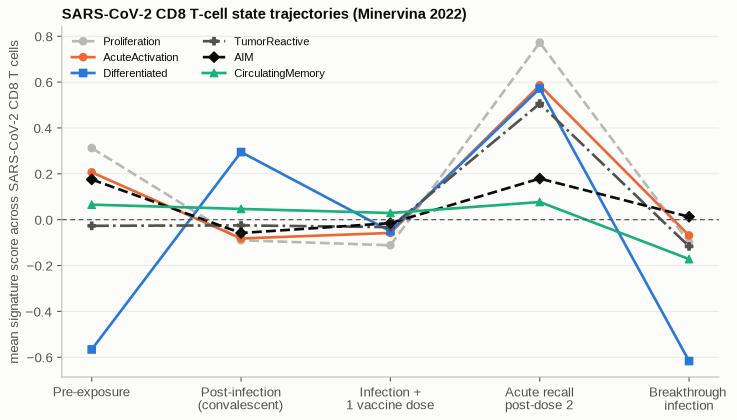
vaccine recall in blood. Across 10,484 paired-TCR SARS-CoV-2-specific CD8 T
cells profiled longitudinally by Minervina et al. 2022,
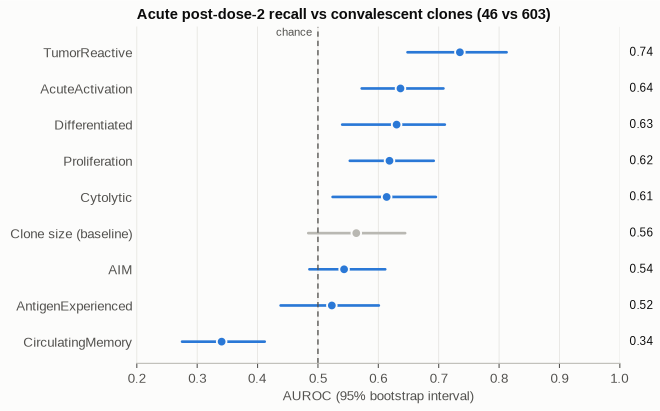
Proliferation,AcuteActivation, andTumorReactivesit near baseline in convalescent blood (−0.09, −0.08, −0.02) and peak after the second mRNA vaccine dose (+0.77, +0.59, +0.51;TumorReactiveAUROC 0.74 for acute post-dose-2 vs convalescent clones). In blood draws collected near vaccination or acute infection,TumorReactivetherefore captures recently restimulated viral T cells alongside tumor-reactive clones. - Overnight (16 h) peptide restimulation requires within-clone transcriptional
delta rather than clonal abundance fold-change. Across 73 persistent
β-clonotypes sequenced in paired unstimulated and 16 h SARS-CoV-2
Spike-stimulated CD3-gated T cells (Fischer et al. 2021), 0 of 73 clones
pass Benjamini–Hochberg FDR < 0.05 by Fisher exact count enrichment because T
cells do not divide multiple times overnight. Comparing expression within the
same clone across paired wells (
score_stimulation_response) identifies 11 persistent clones with effector-cytokine transcript (IFNG,TNF,IL2,CCL4) induction (Δ > 0.5, withΔAIMBroadup to +1.87) despite small abundance changes (log2FC−0.89 to +1.17). - Default
--database-match strict_abinprioritizeprevents false-positive β-chain collisions on private epitopes. Both 10x Dextramer (28,040 records) and Minervina 2022 (PMID:35383307, 891 records) are indexed in VDJdb (vdjdb-2026-11-06: 280,894TRBentries, 200,180 paired α/β), inflating full-database recall. When each queried study is held out,strict_abachieves 100% exact-epitope precision (44 of 44 and 65 of 65) on canonical Influenza/EBV/CMV clones and 92.1% SARS-CoV-2 species precision (35 of 38) on Minervina 2022. Relaxing toab_with_partialraises recall on canonical epitopes (30.6% to 66.7% in Donor 1; 15.2% to 45.9% in Donor 2) at 92.1%–99.0% precision, but on mostly private SARS-CoV-2 clones 50.1% ofab_with_partialmatches (237 of 473; 50.5% underb_only) are false-positive collisions with public Yellow Fever, EBV, CMV, self-antigen, or Influenza β chains (species precision 49.9%, dropping to 28.3% at Levenshtein distance 1). - IMGT germline V+J fallback rescues full-length constructs in 5'-truncated VDJ
deposits. In Fischer et al. 2021 (
GSE171037), where 98.7%–99.7% of called TCR contigs terminate downstream of the V-leader start codon, 0 of 160 paired α/β clones (137 inGT_6, 23 inGT_2) assemble from contig sequences alone; enabling--germline-vdj-fallbackagainst cached IMGT humanV-REGIONandJ-REGIONreferences rescues 160 of 160 (100%) full-length single-chain constructs (33 rescued from 5'-partial contigs on both chains preserving donor framework/CDR3/FR4 codons, and 25 with donor-contig-verified J→C junctions on both chains), settingconstruct_contig_verified = False. - Clonal concordance removes >96% of sticky pMHC multimer calls. Single-cell
dextramer calling calibrated against negative-control multimers matches 10x
Genomics' published calls on 100% of jointly called single-binder cells in
both donors, yet the promiscuous
HLA-A*03:01 KLGGALQAK(CMV IE-1) reagent still tags cells inside 284 and 739 expanded clones (median within-clone concordance 0.24 and 0.25). Requiring ≥50% clonal concordance across ≥2 cells removes 96.5% and 96.1% of stickyKLGGALQAKclones while preserving 90.5%–93.6% of Influenza M1GILGFVFTLclones (median concordance 1.00).
Public TCR databases contain these benchmark cohorts
VDJdb (vdjdb-2026-11-06; 280,894 TRB entries, 200,180 paired α/β)
contains both the 10x Genomics 4-donor dextramer dataset (ISSUE_289.tsv)
and Minervina et al. 2022 (PMID:35383307). Evaluating database lookup or
--exclude-known-viral against full VDJdb is therefore circular:
it measures self-retrieval rather than generalization to new donors.
Sections 1b and 4 report study-held-out VDJdb alongside full VDJdb
(circular, drawn hollow in orange). Only the held-out evaluations
measure out-of-sample performance.
Cohort evaluations are from TCRsift 3.32.0 (with from_contig germline leader
fallback verified in 3.34.0) and VDJdb 2026-11-06, generated by
benchmarks/public_infectious/ (how to reproduce; full
ground-truth file and assay documentation in
benchmarks/public_infectious/PROVENANCE.md).
Source studies and ground-truth provenance
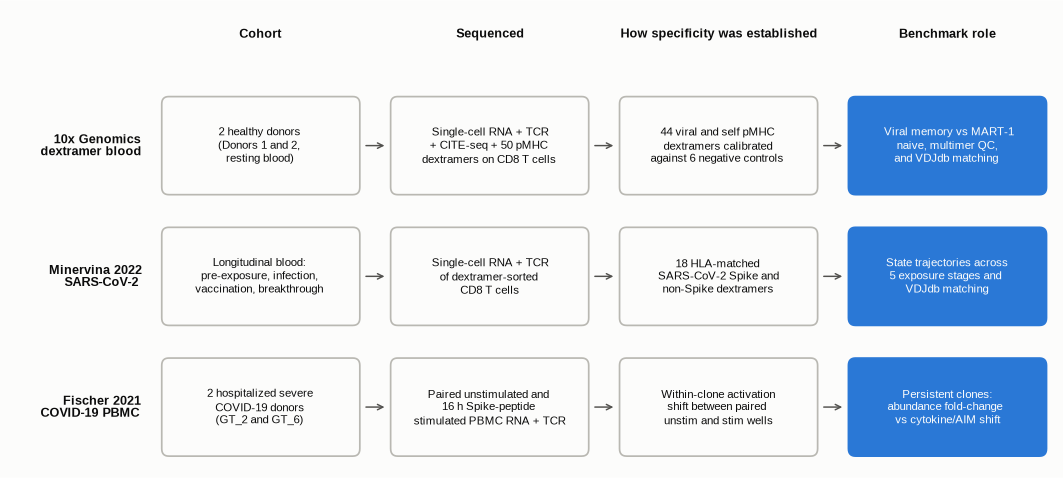
Summary schematic of the three public single-cell cohorts evaluated on this page.
| Study | Setting | Raw GEX & VDJ Deposit | Ground-Truth Label Source | Positives | Negatives / Contrasts | How TCRsift ran |
|---|---|---|---|---|---|---|
| 10x Genomics Multiplexed Dextramer | Healthy resting blood CD8 T cells | 10x Cell Ranger 3.0.2 (*_sc5p_v2_hs_B_T_all_feature_bc_matrix_filtered.h5 + all_contig_annotations.csv for Donors 1 & 2; 63,201 retained cells, 22,873 clones) |
Published binarized_matrix.csv (44 pMHC *_binder calls, single-binder droplets with ≥50% clonal concordance; ≥2 binder cells for expanded-clone sets) + 6 *_NC negative-control multimers + TotalSeq-C CD45RA/CD45RO |
Viral memory: Influenza A M1 (GILGFVFTL), EBV (BMLF1, BZLF1, EBNA-3A/3B, LMP2A), CMV pp65 (NLVPMVATV) |
(A) Naive MART-1 (ELAGIGILTV) precursors (142 and 19 clones; CITE-seq CD45RA+ naive); (B) unlabeled expanded (≥2 cells) blood clones (495 and 1,264); (C) Flu M1 vs EBV expanded clones |
Default prioritize --context blood, extended --min-cells 1 AUROC run, tcrsift.multimer, and match_clonotypes |
| Minervina et al. 2022 | Longitudinal SARS-CoV-2 infection, mRNA vaccination, and breakthrough | Zenodo 6232103 (libs_aggregate_rev.zip: 13,614 retained paired-TCR CD8 cells, 7,317 clones) |
pogorely/COVID_vax_CD8 (cd8_only_dextr_rev_clean.tsv: per-barcode curated dextramer epitope & donor_category) |
Acute post-dose-2 vaccine recall (inf_after_2, 46 expanded clones) and 4,212 curated SARS-CoV-2 Spike/non-Spike clones |
Disjoint resting post-infection convalescent clones (post_inf, 603 expanded clones; shared longitudinal clones excluded) |
Default prioritize --context blood, score_by_name, and match_clonotypes |
| Fischer et al. 2021 | Hospitalized severe COVID-19 PBMC ± 16 h Spike peptide pool | GSE171037 (GSM5216975–GSM5216978 .h5 + .csv.gz + all_contig_annotations.json.gz; 29,184 PBMCs, 27,113 CD3-gated T cells) |
GEO sample well assignment (GT6_unstim vs GT6_covid_stim; GT_unstim vs GT_covid_stim) across 73 persistent CDR3_beta clones (≥2 T cells in both wells) |
Persistent clones inducing effector-cytokine transcripts (IFNG, TNF, IL2, CCL4 Δ > 0.5; 11 clones) after 16 h Spike peptide stimulation |
Persistent bystander clones present at ≥2 T cells in both wells without cytokine or AIM shift | load_samples, phenotype_cells, apply_cd3_gate, and score_stimulation_response |
10x Genomics: 50-dextramer peripheral blood CD8 T cells
- Assay and ground-truth construction. Peripheral blood CD8 T cells from
healthy HLA-typed donors were stained simultaneously with 44 peptide-MHC class
I dextramers, 6 negative-control (
*_NC) dextramers, and TotalSeq-C surface antibodies (CD45RA and CD45RO isoforms of PTPRC, plus CD3 and CD8a), then sequenced by 10x 5' GEX, VDJ, and Feature Barcoding (34,220 GEX-QC cells in Donor 1; 67,789 in Donor 2). Ground-truth clone specificity is assigned from 10x's publishedbinarized_matrix.csvwhen a cell binds a single pMHC reagent and at least 50% of cells in the paired α/β clone share that call (with at least two single-binder cells required in expanded ≥2-cell clone contrasts). - Why
MART-1serves as an internal naive T-cell control.HLA-A*02:01MART-1(ELAGIGILTV) binds a large repertoire of unprimed thymic naive precursors in healthy melanoma-free donors (99.3% singletons in Donor 1, 100% in Donor 2; CITE-seqCLR(CD45RO) - CLR(CD45RA)mean −2.99 and −4.61), providing an antigen-specific naive population sequenced in the same library as antigen-experienced viral memory T cells. The promiscuous reagentA0301_KLGGALQAK_IE-1_CMVis excluded from ground-truth viral positives and analyzed separately in section 5.
Minervina et al. 2022: longitudinal SARS-CoV-2 CD8 T cells
SARS-CoV-2 antigen exposure history shapes phenotypes and specificity of
memory CD8+ T cells, Nature
Immunology 23:781–790 (PMID:35383307).
- Assay and ground-truth construction. Donors were profiled across five
exposure stages: pre-exposure (
naive), convalescent post-infection (post_inf), infection plus one mRNA vaccine dose (inf_after_1), acute recall shortly after a second mRNA dose (inf_after_2), and breakthrough infection (break), using 18 HLA-matched DNA-barcoded SARS-CoV-2 Spike and non-Spike (ORF1ab,N,M,ORF3a) dextramers. Joining the aggregated Cell Ranger GEX + VDJ archive (libs_aggregate_rev.zip) to the authors' curated dextramer table (cd8_only_dextr_rev_clean.tsv) labels 4,212 scored paired α/β clones across 19 epitope groups, led byA01_TTD(HLA-A*01:01 TTDPSFLGRY, 1,800 clones).
Fischer et al. 2021: paired 16 h Spike-stimulated COVID-19 PBMC
Single-cell RNA sequencing reveals ex vivo signatures of SARS-CoV-2-reactive T
cells through 'reverse phenotyping',
Nature Communications 12:4515 (PMID:34301934).
- Assay and 5'-truncated VDJ provenance. PBMCs from hospitalized severe
COVID-19 patients (
GT_2andGT_6from the Gauting cohort) were split into parallel unstimulated control and 16 h SARS-CoV-2 Spike peptide-pool-stimulated wells (GSM5216975–GSM5216978). Because 98.7%–99.7% of called TCR contigs in this Cell Ranger 3 deposit are 5'-incomplete (full_length == False), Cell Ranger recordedproductive == "None"despite completev_geneandj_genealignments and stop-free canonicalC...[FW]CDR3 sequences (whereas frameshift/stop contigs carryproductive == "False"). TCRsift retains validated 5'-partial contigs on load and gates PBMCs to CD3-expressing T cells (≥3 rawCD3D/E/Gcounts) prior to normalization so monocytes, NK cells, and B cells do not bias gene-expression bins.
Signature provenance for --context blood
The blood preset scores seven gene signatures on CD8 T cells (NeoTCR_PBL and
TumorReactive are evaluated alongside them for comparison). None of these
signatures was derived from or fitted to any cohort on this page:
| Signature | Genes | Provenance | Independent of these cohorts? |
|---|---|---|---|
Differentiated |
IFNG, GZMB, PRF1, GNLY, NKG7 up; TCF7, LEF1, CCR7, SELL down |
Effector minus naive/stem contrast fixed on TCRsift's in-vitro expansion pilot (reproducibility map). | Yes |
AntigenExperienced |
IFNG, GZMB, PRF1, GNLY, NKG7 |
Cytotoxic effector pole of Differentiated. |
Yes |
CirculatingMemory |
GZMK, IL7R up; CCR7 down |
Resting circulating effector-memory (GZMK+ / IL7R+, encoding CD127) minus CCR7+ naive contrast. |
Yes |
Cytolytic |
PRF1, GZMB |
Canonical perforin / granzyme B pair (Caushi et al. 2021, Krishna et al. 2020). | Yes |
AcuteActivation |
TNFRSF9, MKI67 |
4-1BB and Ki-67 recent-activation / cycling pair. | Yes |
AIM / AIMBroad |
TNFRSF9, TNFRSF4 (+ CD69, IL2RA, CD40LG in AIMBroad) |
Transcripts encoding surface markers used in activation-induced marker (AIM) sorting assays. | Yes |
Proliferation |
MKI67 |
Ki-67 cell-cycle marker alone. | Yes |
NeoTCR_PBL (comparison) |
151 human genes | Published peripheral-blood neoantigen-reactive CD8 signature from metastatic cancer patients (Yossef et al. 2023; PMID:38039963). |
Yes |
TumorReactive (comparison) |
CXCL13, ENTPD1, PDCD1, LAG3, HAVCR2, TIGIT, TOX, CTLA4, ITGAE |
Solid-tumor chronic antigen / exhaustion panel (Simoni et al. 2018); included here to test cross-firing during acute viral recall in blood. | Yes |
Questions and results
1. What does --context blood separate in resting peripheral blood?
In solid tumors, tcrsift prioritize relies on chronic antigen stimulation
inside the lesion to separate tumor-reactive clones from resting bystanders. In
resting peripheral blood, T cells are not encountering cognate antigen at the
moment of venipuncture. Evaluating prioritize --context blood (alongside
NeoTCR_PBL and TumorReactive) across three contrasts in 10x Donors 1 and 2
shows what blood expression signatures do and do not separate:
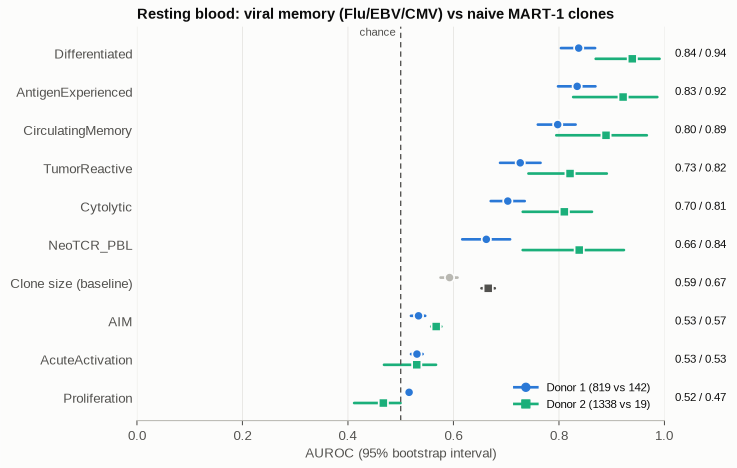
| Contrast | Donor 1 clones (+ vs −) | Donor 2 clones (+ vs −) | Differentiated |
AntigenExperienced |
CirculatingMemory |
Cytolytic |
AIM |
Proliferation |
clone_size |
|---|---|---|---|---|---|---|---|---|---|
Viral memory vs naive MART-1 (≥1 cell) |
819 vs 142 | 1,338 vs 19 | 0.84 / 0.94 | 0.83 / 0.92 | 0.80 / 0.89 | 0.70 / 0.81 | 0.53 / 0.57 | 0.52 / 0.47 | 0.59 / 0.67 |
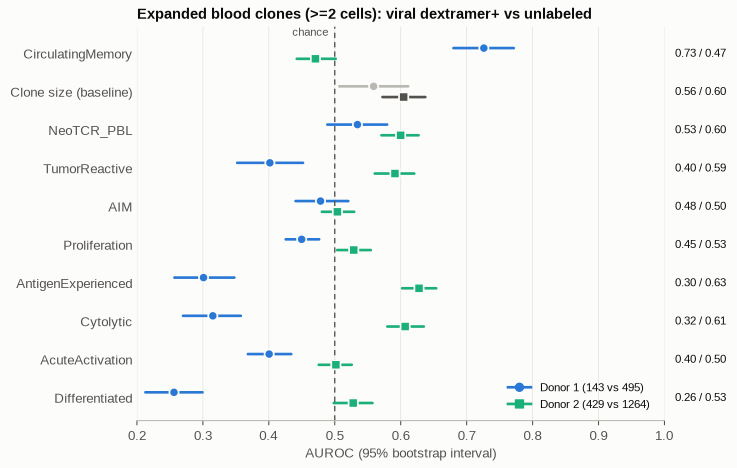
| Expanded viral vs unlabeled expanded (≥2 cells) | 143 vs 495 | 429 vs 1,264 | 0.26 / 0.53 | 0.30 / 0.63 | 0.73 / 0.47 | 0.32 / 0.61 | 0.48 / 0.50 | 0.45 / 0.53 | 0.56 / 0.60 |
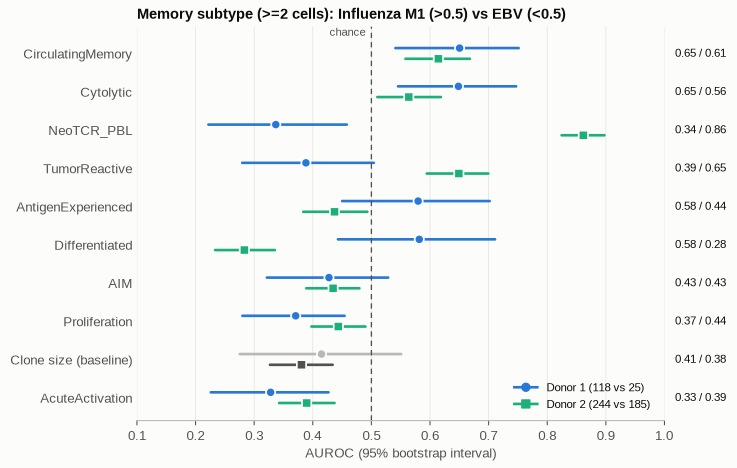
| Influenza M1 vs EBV (≥2 cells; >0.5 favors Flu) | 118 vs 25 | 244 vs 185 | 0.58 / 0.28 | 0.58 / 0.44 | 0.65 / 0.61 | 0.65 / 0.56 | 0.43 / 0.43 | 0.37 / 0.44 | 0.41 / 0.38 |
Values are Donor 1 / Donor 2 AUROCs from benchmarks/public_infectious/results/blood_signature_auroc.csv.
- Antigen-experienced memory vs naive precursors (≥1 cell). Across all
clones,
Differentiated(0.84, 0.94),AntigenExperienced(0.83, 0.92), andCirculatingMemory(0.80, 0.89) separate Influenza, EBV, and CMV pp65 clones fromMART-1(ELAGIGILTV) precursors. Centered log-ratio (CLR) CITE-seq profiles match the transcriptional call:MART-1clones are CD45RA-skewed (CLR(CD45RO) - CLR(CD45RA)mean −2.99 in Donor 1 and −4.61 in Donor 2; 99.3% and 100% 1-cell clones), whereas viral dextramer+ clones shift upward by ~4 CLR units (+0.96 and −0.30). - Expanded viral clones vs unlabeled expanded blood clones (≥2 cells).
Once singletons are removed (
--min-cells
2
, theprioritizedefault), unlabeled expanded clones in healthy blood are themselves memory/TEMRA clones against antigens not represented on the 44-multimer panel. Consequently, ranking depends on which viral memory phenotype dominates each donor: - Donor 1. Because 83% (118 of 143) of expanded viral clones target
cleared Influenza M1 (
GILGFVFTL),CirculatingMemory(GZMK,IL7Rup;CCR7down) reaches 0.73, while cytotoxic TEMRA panels (Differentiated0.26,AntigenExperienced0.30,Cytolytic0.32) score below unlabeled expanded clones. - Donor 2. Because latent EBV clones make up 43% (185 of 429) of expanded
viral clones,
AntigenExperiencedreaches 0.63 andCytolyticreaches 0.61, whileCirculatingMemorysits at 0.47. - Both resting donors. Transient activation (
AIM0.48 and 0.50,AcuteActivation0.40 and 0.50) and cell-cycle (Proliferation0.45 and 0.53) signatures do not enrich for viral clones. - Cleared respiratory virus vs latent herpesvirus. Comparing
expanded Influenza M1 (
GILGFVFTL) against expanded EBV clones showsCirculatingMemoryfavoring Influenza M1 in both donors (0.65 and 0.61), whereasDifferentiatedin Donor 2 (0.28, equivalent to 0.72 in favor of EBV) andAcuteActivation(0.33 and 0.39) skew toward chronically restimulated EBV memory.
1b. What passes the default --context blood cutoffs and enters the shortlist?
Running tcrsift prioritize --context blood at default settings (--min-cells
2, 7-signature blood preset, size-matched 99% background floor, 90th
percentile gate, --max-clones 200, and study-held-out VDJdb) shows how default
selection behaves on blood repertoires (blood_cutoffs_and_shortlist.csv):
| Cohort (≥2-cell clones) | Command variant (held-out VDJdb) | Total shortlisted (eligible) | Viral dextramer+ shortlisted | Influenza M1 shortlisted | EBV shortlisted | Expanded MART-1 shortlisted |
Unlabeled expanded shortlisted |
|---|---|---|---|---|---|---|---|
| 10x Donor 1 (743 clones) | Default (--exclude-known-mart1) |
55 (55) | 15 / 143 (10.5%) | 9 / 118 | 6 / 25 | 0 / 1 | 39 / 495 (7.9%) |
| 10x Donor 1 (743 clones) | + --exclude-known-viral (default strict_ab) |
48 (48) | 8 / 143 (5.6%) | 2 / 118 | 6 / 25 | 0 / 1 | 39 / 495 |
| 10x Donor 1 (743 clones) | + --exclude-known-viral --database-match ab_with_partial |
47 (47) | 8 / 143 (5.6%) | 2 / 118 | 6 / 25 | 0 / 1 | 38 / 495 |
| 10x Donor 2 (1,829 clones) | Default (--exclude-known-mart1) |
51 (51) | 21 / 429 (4.9%) | 7 / 244 | 14 / 185 | 0 / 0 | 30 / 1,264 (2.4%) |
| 10x Donor 2 (1,829 clones) | + --exclude-known-viral (default strict_ab) |
48 (48) | 18 / 429 (4.2%) | 5 / 244 | 13 / 185 | 0 / 0 | 30 / 1,264 |
| 10x Donor 2 (1,829 clones) | + --exclude-known-viral --database-match ab_with_partial |
45 (45) | 16 / 429 (3.7%) | 3 / 244 | 13 / 185 | 0 / 0 | 29 / 1,264 |
| Minervina 2022 (1,501 clones) | Default (--exclude-known-mart1) |
46 (46) | 46 / 1,234 (3.7%) | — | — | — | 0 / 267 |
| Minervina 2022 (1,501 clones) | + --exclude-known-viral (default strict_ab) |
45 (45) | 45 / 1,234 (3.6%) | — | — | — | 0 / 267 |
| Minervina 2022 (1,501 clones) | + --exclude-known-viral --database-match ab_with_partial |
42 (42) | 42 / 1,234 (3.4%) | — | — | — | 0 / 267 |
- No budget saturation in single-sample blood draws. Only 46 to 55
clones clear the size-matched 99% background floor and 90th percentile rank
gate per cohort, well below
--max-clones 200, so every qualifying clone is selected without round-robin truncation. (In Donor 1, the single shortlisted clone outside the viral,MART-1, and unlabeled columns is 1 of 89 expanded clones carrying stickyKLGGALQAK_IE-1_CMVcalls.) --exclude-known-viralremoves canonical public viral clones but misses private viral repertoires. On canonical Influenza M1GILGFVFTLin Donor 1, out-of-sample--exclude-known-viralremoves 7 of 9 shortlisted clones under bothstrict_abandab_with_partial. On mostly private SARS-CoV-2 clones (Minervina 2022), held-outstrict_abflags only 1 of 46 shortlisted clones (46 to 45), whereasab_with_partialdrops 4 (3 via β-only collisions with non-SARS viral entries in VDJdb).
2. How do blood signatures move across acute vaccine recall vs convalescence?
Whereas 10x Donors 1 and 2 were drawn at steady state, Minervina et al. 2022 tracks paired-TCR dextramer-sorted SARS-CoV-2 CD8 T cells (10,484 cells) from pre-exposure through acute post-boost recall:
Exposure stage (donor_category) |
Paired-TCR CD8 cells | Paired clones | Differentiated |
CirculatingMemory |
AcuteActivation |
Proliferation |
AIM |
TumorReactive |
|---|---|---|---|---|---|---|---|---|
naive (pre-exposure) |
566 | 384 | −0.57 | +0.07 | +0.21 | +0.31 | +0.18 | −0.03 |
post_inf (convalescent) |
4,387 | 1,877 | +0.29 | +0.05 | −0.08 | −0.09 | −0.06 | −0.02 |
inf_after_1 (infection + 1 dose) |
2,393 | 1,087 | −0.05 | +0.03 | −0.06 | −0.11 | −0.02 | −0.03 |
inf_after_2 (acute post-dose 2) |
911 | 157 | +0.57 | +0.08 | +0.59 | +0.77 | +0.18 | +0.51 |
break (breakthrough cohort) |
2,227 | 1,328 | −0.62 | −0.17 | −0.07 | −0.10 | +0.01 | −0.12 |
- Transient effector burst after booster vaccination.
Proliferation(+0.77),AcuteActivation(+0.59),Differentiated(+0.57), andAIM(+0.18) rise in theinf_after_2window and return to baseline in convalescent (post_inf) and later breakthrough (break) draws. - Cross-firing of
TumorReactiveon acute viral recall. Across disjoint expanded clones (≥2 cells; 46 acute post-dose-2 vs 603 convalescent),TumorReactiveseparates acutely boosted SARS-CoV-2 clones from resting convalescent SARS-CoV-2 clones with an AUROC of 0.74 (95% CI 0.65 to 0.81), ahead ofAcuteActivation(0.64),Differentiated(0.63), andProliferation(0.62). When prioritizing tumor-reactive clones from blood (--context bloodorblood-tumor), recent vaccination or acute respiratory infection will therefore elevate non-tumor viral clones on activation and exhaustion lists unless matched tumor overlap or--exclude-known-viralis applied.
3. Overnight peptide restimulation: abundance fold-change vs transcriptional shift
In multi-week peptide expansion cultures (tcrsift run), antigen-reactive T
cells divide many times and dominate clone-frequency rankings. In overnight
(16–24 h) activation-induced marker (AIM) or cytokine-transcript scRNA
restimulations, T cells transcribe effector mRNAs without dividing. After gating
PBMCs to CD3-expressing T cells (≥3 raw CD3D/E/G counts), Fischer et al.
2021 tests both signals on persistent β-clonotypes (≥2 T cells in both the
unstimulated control well and the 16 h SARS-CoV-2 Spike-stimulated well):
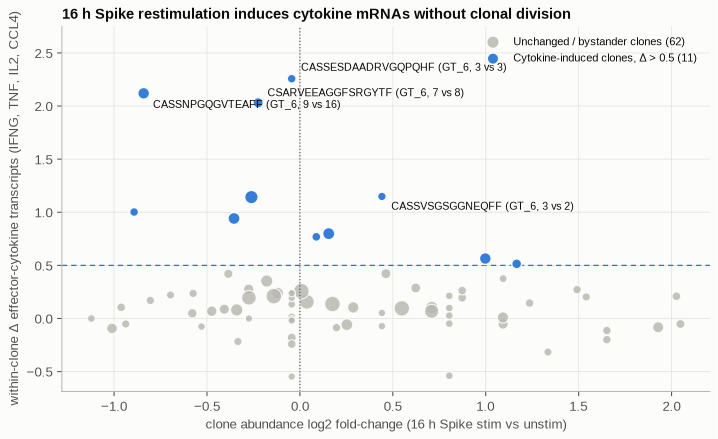
| Donor | Loaded PBMCs / CD3-gated T cells | Evaluated β-clonotypes | Persistent clones (≥2 cells in both wells) | Fisher count-enriched (BH FDR < 0.05) | Cytokine-induced (Δ effector_cytokines > 0.5) |
Top cytokine-induced persistent clone (stim vs unstim cells, log2FC, Δ cytokines, Δ AIMBroad) |
|---|---|---|---|---|---|---|
GT_6 |
12,385 / 11,684 | 2,227 | 58 | 0 | 9 | CASSESDAADRVGQPQHF (3 vs 3, −0.04, +2.26, +1.48); CASSNPGQGVTEAFF (9 vs 16, −0.84, +2.12, +1.87) |
GT_2 |
16,799 / 15,429 | 1,247 | 15 | 0 | 2 | CASIWGAGGQPQHF (4 vs 3, +0.09, +0.77, +0.60); CASSPGQGEGYEQYF (9 vs 3, +1.17, +0.51, −0.01) |
- Count enrichment misses 16 h responders and flags sampling noise. Zero
persistent clones (0 of 73) clear BH FDR < 0.05 by Fisher exact test. The most
count-skewed persistent clone in
GT_6(CASSPFGGGINEQFF, 25 stimulated vs 6 unstimulated cells,log2FC = +1.93, rawp = 0.0006,FDR = 0.088) shows no cytokine or AIM induction (Δ cytokines = −0.08,Δ AIMBroad = −0.10), while the largest bystander clones sit flat in both count and transcription (CASSLLLAAGELFF, 184 vs 158 cells,log2FC = +0.18,Δ cytokines = +0.14;CASSLAYYEQYF, 72 vs 77 cells,log2FC = −0.14,Δ cytokines = +0.21). - Paired transcriptional delta isolates peptide-reactive clones.
score_stimulation_responsecomputes each clone's change in signature or cytokine-transcript expression (IFNG,TNF,IL2,CCL4) between stimulated and control wells (control_samplein the sample sheet), surfacing 11 persistent clones withΔ effector_cytokines > 0.5(up to +2.26 log-normalized units alongsideΔ AIMBroad = +1.87andΔ AIM = +2.47) despite small abundance differences (log2FC−0.89 to +1.17).
4. Public TCR database matching: strictness vs recall and circularity
To evaluate tcrsift annotate and prioritize's database filters against VDJdb
2026-11-06 (280,894 TRB entries; 200,180 paired α/β), we matched
expanded viral and MART-1 clones from 10x Donors 1 and 2 (144 and 429
clones) and curated SARS-CoV-2 clones from Minervina 2022 (4,212 clones) with
--host-species-filter same under four rules, both on full VDJdb
(circular) and after removing all entries originating from the queried study
(independent):
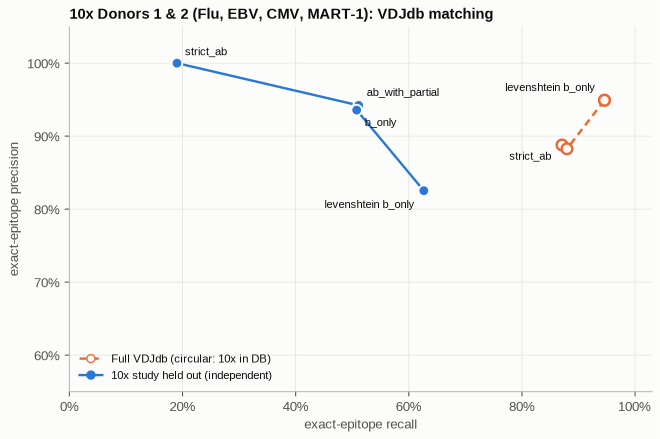
Pooled exact-epitope precision vs recall for 10x Donors 1 and 2 viral and MART-1 clones across matching rules on full VDJdb (circular, orange) and after holding out the 10x Genomics deposit (independent, blue).
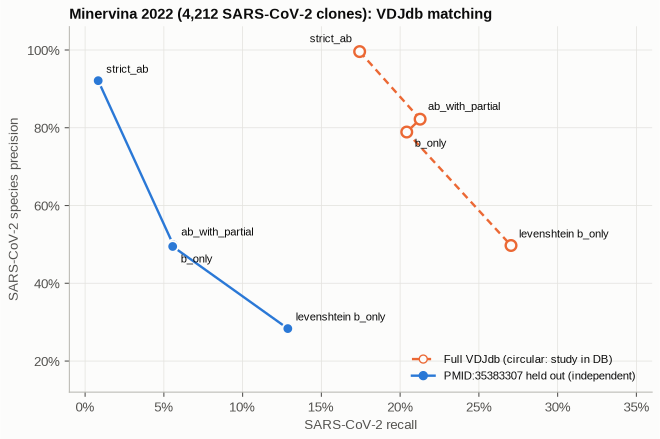
SARS-CoV-2 species precision vs recall across 4,212 Minervina 2022 clones on full VDJdb (circular, orange) and after holding out PMID:35383307 (independent, blue).
| Cohort & VDJdb scope | Rule | Matched clones | Precision (exact epitope) | Recall (exact epitope) | Precision (correct virus) | Recall (correct virus) |
|---|---|---|---|---|---|---|
| 10x Donor 1 (144 clones), full VDJdb (circular) | exact strict_ab |
143 | 97.9% | 97.2% | — | — |
| 10x Donor 1 (144 clones), 10x held out | exact strict_ab |
44 | 100.0% | 30.6% | — | — |
| 10x Donor 1 (144 clones), 10x held out | exact ab_with_partial |
97 | 99.0% | 66.7% | — | — |
| 10x Donor 1 (144 clones), 10x held out | levenshtein b_only |
128 | 90.6% | 80.6% | — | — |
| 10x Donor 2 (429 clones), full VDJdb (circular) | exact strict_ab |
419 | 85.7% | 83.7% | — | — |
| 10x Donor 2 (429 clones), 10x held out | exact strict_ab |
65 | 100.0% | 15.2% | — | — |
| 10x Donor 2 (429 clones), 10x held out | exact ab_with_partial |
214 | 92.1% | 45.9% | — | — |
| 10x Donor 2 (429 clones), 10x held out | levenshtein b_only |
307 | 79.2% | 56.6% | — | — |
| Minervina SARS-CoV-2 (4,212 clones), full VDJdb (circular) | exact strict_ab |
737 | 98.0% | 17.1% | 99.6% | 17.4% |
| Minervina SARS-CoV-2 (4,212 clones), study held out | exact strict_ab |
38 | 78.9% | 0.7% | 92.1% | 0.8% |
| Minervina SARS-CoV-2 (4,212 clones), study held out | exact ab_with_partial |
473 | 44.0% | 4.9% | 49.9% | 5.6% |
| Minervina SARS-CoV-2 (4,212 clones), study held out | levenshtein b_only |
1,912 | 22.6% | 10.3% | 28.3% | 12.9% |
- Study ingestion inflates naive benchmarks. Including the queried study in
VDJdb makes
strict_abappear to recover 83.7%–97.2% of 10x viral clones and 17.4% of Minervina SARS-CoV-2 clones. Removing the queried study dropsstrict_abexact-epitope recall to 15.2%–30.6% on canonical Influenza/EBV/CMV epitopes (at 100.0% precision: 44 of 44 and 65 of 65) and 0.7% exact-epitope recall / 0.8% virus recall (35 of 38 SARS-CoV-2 species precision, 92.1%) on mostly private SARS-CoV-2 epitopes (1,800 of 4,212 targetingHLA-A*01:01 TTDPSFLGRY). - Why
prioritizedefaults tostrict_abwhileannotatedefaults toab_with_partial. Becausetcrsift annotateaccepts both paired α/β andCDR3b_onlytables, it defaults to--database-match ab_with_partial(require both chains when a database entry is α/β-paired, falling back to β-only matching otherwise), whereastcrsift prioritizeoperates exclusively on paired α/β clones and defaults to--database-match strict_ab(since 3.32.0). On frequently studied public epitopes (Influenza M1GILGFVFTL, EBVGLCTLVAMLandRAKFKQLL),ab_with_partialmore than doubles held-out recall (30.6% to 66.7% in Donor 1; 15.2% to 45.9% in Donor 2) while keeping exact-epitope precision at 92.1%–99.0%. On private repertoires such as SARS-CoV-2, however, 50.1% (237 of 473) ofab_with_partialhits (50.5% underb_only) are false-positive β-chain collisions with public Yellow Fever virus (91), EBV (44), CMV (42), human self-antigen (33), or Influenza A (8) entries that share a CDR3β sequence with a different α partner; edit-distance-1b_onlymatching lowers virus precision further to 28.3%. Keepstrict_abwhenever excluding viral receptors on private neoantigen or novel-pathogen repertoires.
5. Multiplexed pMHC multimers: clonal concordance filters sticky reagents
tcrsift.multimer extracts Antibody Capture / Antigen Capture barcode
counts from 10x .h5 or Matrix Market inputs, calls single-cell
binding against negative-control (*_NC) multimers (min_umi=10,
min_nc_ratio=5, min_dominance_ratio=2), and aggregates calls across cells of
each paired α/β clone (summarize_clone_multimer_specificity):
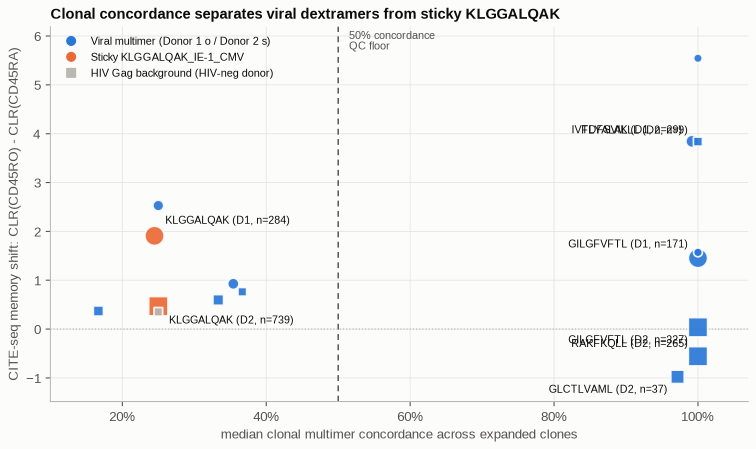
| Donor | Multimer | Expanded clones with any positive cell | Confident clones (≥2 cells & ≥50% concordance) | Retained fraction | Median clone concordance | CLR(CD45RO) − CLR(CD45RA) |
|---|---|---|---|---|---|---|
| Donor 1 | GILGFVFTL_Flu-MP_Influenza |
171 | 160 | 93.6% | 1.00 | +1.45 |
| Donor 1 | IVTDFSVIK_EBNA-3B_EBV |
29 | 17 | 58.6% | 0.99 | +3.84 |
| Donor 1 | GLCTLVAML_BMLF1_EBV |
8 | 7 | 87.5% | 1.00 | +1.57 |
| Donor 1 | FLYALALLL_LMP2A_EBV |
5 | 5 | 100.0% | 1.00 | +5.54 |
| Donor 1 | RAKFKQLL_BZLF1_EBV |
22 | 3 | 13.6% | 0.35 | +0.93 |
| Donor 1 | KLGGALQAK_IE-1_CMV (sticky) |
284 | 10 | 3.5% | 0.24 | +1.91 |
| Donor 2 | GILGFVFTL_Flu-MP_Influenza |
327 | 296 | 90.5% | 1.00 | +0.04 |
| Donor 2 | RAKFKQLL_BZLF1_EBV |
265 | 207 | 78.1% | 1.00 | −0.56 |
| Donor 2 | GLCTLVAML_BMLF1_EBV |
37 | 30 | 81.1% | 0.97 | −0.98 |
| Donor 2 | FLYALALLL_LMP2A_EBV |
9 | 8 | 88.9% | 1.00 | +3.84 |
| Donor 2 | RTLNAWVKV_Gag-protein_HIV (HIV-neg) |
5 | 0 | 0.0% | 0.25 | +0.35 |
| Donor 2 | KLGGALQAK_IE-1_CMV (sticky) |
739 | 29 | 3.9% | 0.25 | +0.47 |
- 100% single-cell agreement with 10x's published calls, while single-cell gates
still pass sticky multimers. Across cells called as single-specificity binders by
both methods,
call_multimer_specificityagrees on the peptide on 100.0% of cells in both Donor 1 and Donor 2. Even so,KLGGALQAK_IE-1_CMVtags isolated cells inside 284 expanded clones in Donor 1 and 739 expanded clones in Donor 2, including clones whose remaining cells concordantly bind Influenza or EBV multimers. - Clonotypic TCR binding is clonally concordant. Because every cell of a
productive α/β clone expresses the same receptor, genuine pMHC binding marks
most cells of the clone (median concordance 0.97–1.00 for Influenza
GILGFVFTL, EBVFLYALALLLandGLCTLVAML, and HLA-matched Donor 2 EBVRAKFKQLL), whereas non-specific surface sticking scatters across large clones (median concordance 0.24–0.25 forKLGGALQAK, 0.25 for HIV Gag in HIV-negative Donor 2, and 0.17–0.37 for mismatched EBV reagents). Requiringmin_specific_cells=2andmin_concordance=0.5removes 96.5% and 96.1% of stickyKLGGALQAKclones and 100% (0 of 5) of HIV Gag false positives without reagent-specific hardcoding.
Scope and limitations
- Resting blood cannot identify cognate antigen without a probe, stimulation,
or paired lesion. In steady-state blood, expression signatures separate
antigen-experienced memory from naive T cells and distinguish memory subtypes
(
GZMK+circulating memory vsGZMB+/CD45RA-re-expressing TEMRA), but cannot tell which pathogen or tumor antigen an expanded memory clone recognizes. - Singleton clones cannot be rescued by clonal multimer concordance. The
min_concordance=0.5,min_specific_cells=2filter requires at least two cells in a clone; singleton binders (such as naiveMART-1precursors) must be evaluated with stricter per-cell UMI and negative-control thresholds or CITE-seq CD45RA/CD45RO gating. - 5'-partial VDJ deposits require germline V+J fallback for construct
assembly. Retaining validated
productive == "None"contigs recovers clonotype tracking and paired expression analysis in 5'-truncated deposits (Fischer 2021, where 98.7%–99.7% of TCR contigs are 5'-incomplete and 0 of 160 paired α/β clones span both leader start codons). Passing--germline-vdj-fallbackagainst cached IMGTV-REGIONandJ-REGIONreferences assembles all 160 paired clones (137 inGT_6, 23 inGT_2), including 33 clones rescued from 5'-partial contigs on both chains (31 + 2) and 25 with donor-contig-verified J→C junctions on both chains (23 + 2), while settingconstruct_contig_verified = Falsebecause N-terminal framework residues on imputed chains come from IMGT germline rather than 5'-complete donor reads. - Other contexts, lineages, and species. Cancer-patient circulating
antitumor blood (
--context blood-tumor), longitudinal post-ACT (T30) biopsies, and human CD4+ TILs (--tcell-type cd4) are evaluated on the paired blood-tumor & CD4+ TIL benchmark page, and murine tumor, autoimmune, and acute viral (GP66:I-AbCD4+) cohorts are evaluated on the murine benchmark page. Thempeandhemecontext presets remain untested against public ground-truth labels.
Reproducing
pip install tcrsift openpyxl
git clone https://github.com/pirl-unc/tcrsift && cd tcrsift
tcrsift data download --db vdjdb
tcrsift data download --group germline

python benchmarks/public_infectious/download.py --data-dir bench_infectious   # ~750 MB download
python benchmarks/public_infectious/run.py --data-dir bench_infectious --work-dir bench_infectious/runs
python docs/figures/make_infectious_benchmark_figures.py
run.py writes the CSV tables and summary.json (including
ground_truth_provenance, tcrsift_version, and vdjdb_release) backing the
figures and summary statistics on this page to
benchmarks/public_infectious/results/. AUROC confidence intervals are 95%
percentile bootstraps over clones (2,000 draws, fixed seed).
Sources
- 10x Genomics. A new way of exploring immunity: linking highly multiplexed antigen recognition to immune repertoire and phenotype (Application Note; Healthy Donors 1 and 2).
- Minervina AA, Pogorelyy MV, Kirk AM, et al. SARS-CoV-2 antigen exposure history shapes phenotypes and specificity of memory CD8+ T cells. Nat Immunol 2022 (Zenodo 6232103).
- Fischer DS, Ansari M, Wagner KI, et al. Single-cell RNA sequencing reveals ex vivo signatures of SARS-CoV-2-reactive T cells through 'reverse phenotyping'. Nat Commun 2021 (GSE171037).
- Yossef R, Krishna S, Sindiri S, et al. Phenotypic signatures of circulating
neoantigen-reactive CD8+ T cells in patients with metastatic
cancers. Cancer Cell 2023
(
NeoTCR_PBL). - Goncharov M, Bagaev D, Shcherbinin D, et al. VDJdb in the pandemic era: a compendium of T cell receptors specific for SARS-CoV-2. Nat Methods 2022.
- Bagaev DV, Vroomans RMA, Samir J, et al. VDJdb in 2019: database extension, new analysis infrastructure and a T-cell receptor motif compendium. Nucleic Acids Res 2020.