Benchmark on murine models (--species mouse)
This page evaluates TCRsift's murine (--species mouse) workflow across three
public 10x Genomics single-cell RNA and paired α/β TCR cohorts (19 libraries)
covering syngeneic solid-tumor and multi-organ clonal tracking, autoimmune
target-organ versus splenic MHC-I tetramer sorting, acute viral MHC-II
tetramer+ CD4 T cells, MusMusculus VDJdb lookup, and mouse Trac / Trbc1 /
Trbc2 construct assembly (see also the Benchmark overview).
Summary
- Murine CD8+ TILs transcribe Ccl3 and Ccl4 rather than Cxcl13, and MGI
signatures separate intratumoral from lymphoid CD8+ clones. Across
11,779 retained CD8+ TILs in syngeneic MC38 colon adenocarcinoma
(
GSE168944), only 0.11% (0.0011) of mouse CD8+ TILs express Cxcl13 > 0, whereas 38.8% (0.3876) express Ccl3 and 73.6% (0.7356) express Ccl4, consistent withMOUSE_SIGNATURES["TumorReactive"]substituting Ccl3/Ccl4 for human CD8-biased CXCL13. Comparing expanded MC38 tumor clones (368) against expanded draining-lymph-node and splenic clones (99), MGITumorReactivereaches 0.99 (0.9939, 95% CI 0.99 to 1.00),AIM0.99 (0.9892),Differentiated0.99 (0.9867),AntigenExperienced0.98,Cytolytic0.98, andAcuteActivation0.97, compared with 0.78 forclone_size. - Peripheral-blood effector signatures in tumor-bearing mice enrich
for tumor-infiltrating clones. In matched MC38 peripheral blood (3,831
retained CD8+ cells; 20 clones with ≥5 matched tumor cells vs 21
blood-only expanded clones),
Differentiated(0.88, 95% CI 0.75 to 0.99),Cytolytic(0.86),CirculatingMemory(0.85), andAntigenExperienced(0.84) distinguish circulating sisters of intratumoral clones from blood-restricted clones, and defaulttcrsift prioritize --species mouse --context bloodcaptures 65.0% (13 of 20) of tumor-infiltrating blood clones vs 14.3% (3 of 21) of blood-only clones. - Target-organ engagement drives
TumorReactive,AIM, andAcuteActivationwithin identical antigen-specific murine TCR clonotypes. Across NOD mouseH-2Kd IGRP206-214 / NRP-V7(KYNKANVFL) tetramer+ CD8+ T cells (Kasmani et al. 2022,GSE200608),AIM(0.97),AcuteActivation(0.97), and MGITumorReactive(0.97) separate pancreatic-isletIGRP+clones (59) from splenicIGRP+clones (75) recognizing the same peptide-MHC, whereasCirculatingMemory(0.15) andclone_size(0.13) peak in the spleen. Across 51 identical sisterCDR3abclones sequenced in both organs, 98.0% (50 of 51) score higher onTumorReactivein islets (mean Δ = +0.56) and 94.1% (48 of 51) score higher onAIM(+1.01) andAcuteActivation(+0.81). Within pancreatic islets (59Islet_TetPosvs 684Islet_TetNeg),TumorReactivereaches 0.71 (0.65 to 0.77), moderated becauseTetNegislet CD8+ cells include clones targeting non-IGRP β-cell autoantigens. - Default
strict_abdatabase matching prevents β-only false positives on murineMusMusculusVDJdb lookups. Full VDJdb (14,008MusMusculusTRBrows) contains 780TRB-only rows ingested from Kasmani et al. (PMID:35667687), producing an apparent 91.4% (498 of 545) circularIGRPrecall underab_with_partial/b_only(0.0% understrict_ab). Holding outPMID:35667687reducesIGRPrecall to 0.0% (0 of 545) while exposing 5.3% (29 of 545) false-positive viral matches underb_onlyand 51.4% (280 of 545) underb_only + levenshtein-1(0.0% under defaultstrict_ab). On independent Day-10 LCMVGP66:I-AbCD4+ T cells (Khatun et al. 2021, 0 VDJdb rows),b_onlymatches 139 of 2,285 clones with 17.3% (24 of 139)LCMVprecision (6.6% at edit distance 1). - IMGT mouse germline V+J fallback and J→C constant-region parity assemble
100% of 5'-partial murine CD8+ and CD4+ candidates (101 of 101) with zero
validation errors. After normalizing Cell Ranger mouse Ensembl
-dvgene names (TRAV13-4-dv7→TRAV13-4/DV7),assemble_full_sequences(..., species="mouse", germline_vdj_fallback=True)builds completeTracandTrbc1/Trbc2constructs for 41 of 41 MC38 CD8+ candidates and 60 of 60 KhatunGP66CD4+ candidates, correcting 52 Cell Ranger murineTrbc1/Trbc2constant-gene miscalls (32 of 41 in MC38 and 20 of 60 in Khatun).
All results are from TCRsift 3.33.0, VDJdb 2026-11-06, and cached IMGT
Mus_musculus V-QUEST germline references, generated by
benchmarks/public_mouse/ (how to reproduce; full ground-truth
file and assay provenance in benchmarks/public_mouse/PROVENANCE.md). None of
TCRsift's gene signatures was trained on any cohort on this page.
Source studies and ground-truth provenance
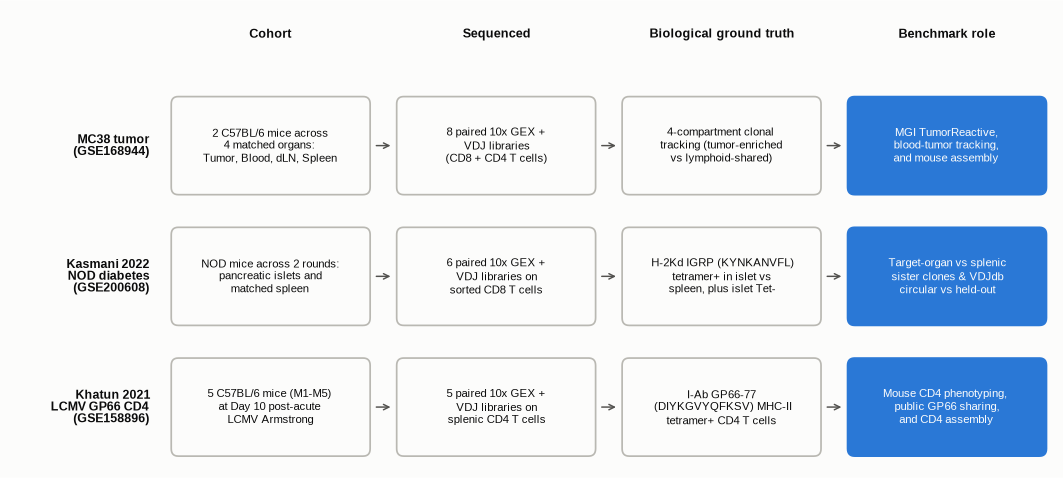
Summary schematic of the three public murine single-cell cohorts evaluated on this page.
| Cohort | Deposit & citation | Strain & compartments | Libraries & retained cells | Ground-truth assay | VDJdb circularity |
|---|---|---|---|---|---|
| MC38 multi-organ | GSE168944 (GSM5172668–675 GEX; GSM5172684–691 VDJ) |
C57BL/6 subcutaneous MC38 colon adenocarcinoma (Mouse01 & Mouse02: Tumor, Blood, dLN, Spleen) |
8 paired GEX+VDJ libraries (11,779 tumor CD8+ cells / 1,763 clones; 3,831 blood CD8+ cells / 3,725 clones) | Exact paired CDR3ab clonal tracking across 4 organs within the same mouse |
Absent from VDJdb; also serves as out-of-strain C57BL/6 specificity control |
Kasmani 2022 (IGRP) |
GSE200608; Kasmani et al., Life Sci Alliance 2022 (PMID:35667687) |
NOD/ShiLtJ autoimmune diabetes pancreatic islets and spleen (Round1 & Round2) |
6 paired GEX+VDJ libraries (13,455 retained CD8+ cells; 545 unique IGRP TetPos paired clones) |
Physical FACS sorting with H-2Kd IGRP206-214 / NRP-V7 (KYNKANVFL) MHC-I tetramers (Islet_TetPos, Islet_TetNeg, Spleen_TetPos) |
Ingested into VDJdb (780 TRB rows for PMID:35667687). Reported both circular (full VDJdb) and independent (PMID:35667687 held out) |
Khatun 2021 (GP66 CD4) |
GSE158896; Khatun et al., J Exp Med 2021 (PMID:33201171) |
C57BL/6 Day-10 acute LCMV Armstrong spleen (M1–M5) |
5 paired GEX+VDJ libraries (11,413 retained CD4+ cells with pre_sorted=CD4; 2,316 paired clones) |
Physical FACS sorting of CD4+ CD44hi I-Ab GP66-77 (DIYKGVYQFKSV) MHC-II tetramer+ T cells across 5 inbred mice |
Independent (0 VDJdb records for PMID:33201171) |
All three GEO deposits distribute pre-Cell Ranger 6 18-column
filtered_contig_annotations.csv files without fwr1_nt–fwr4_nt columns
(and GSE168944 uses 2-column Cell Ranger v2 genes.tsv.gz), exercising both
legacy 10x input normalization and cached IMGT Mus_musculus germline V+J
assembly.
Multi-compartment MC38 tumor, lymphoid, and blood evaluation
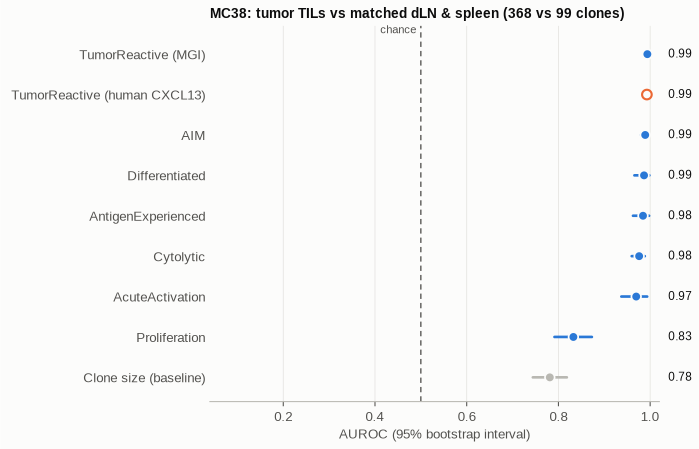
Clone-level AUROC (95% bootstrap CI) separating expanded MC38 tumor CD8+ TIL clones (368) from matched draining-lymph-node and splenic CD8+ clones (99), comparing MGI TumorReactive (Ccl3/Ccl4) with a naive human-ortholog Cxcl13 translation.
Why murine TumorReactive replaces human CXCL13 with Ccl3 / Ccl4
In human CD8+ TILs, CXCL13 is one of the primary single-gene markers of neoantigen-reactive clones. In mice, however, Cxcl13 is predominantly restricted to follicular helper CD4+ and stromal compartments rather than exhausted CD8+ TILs. Measuring raw single-cell detection across all 11,779 retained MC38 CD8+ TILs shows:
Cxcl13> 0 UMI: 0.11% (0.0011) of murine CD8+ TILsCcl3> 0 UMI: 38.8% (0.3876) of murine CD8+ TILsCcl4> 0 UMI: 73.6% (0.7356) of murine CD8+ TILs
MOUSE_SIGNATURES["TumorReactive"] therefore pairs the eight conserved murine
exhaustion and residency orthologs (Entpd1, Pdcd1, Lag3, Havcr2, Tigit,
Tox, Ctla4, Itgae) with Ccl3 and Ccl4. In an ablation comparing MGI
TumorReactive against a naive human ortholog translation retaining Cxcl13
(TumorReactive_HumanCXCL13), both reach 0.99 (0.9939 vs 0.9929)
between tumor and lymphoid organs because the eight shared exhaustion genes
already separate TILs from splenic and lymph-node T cells, while Cxcl13 itself
contributes near-zero signal (0.11% positive cells) and Ccl3/Ccl4 provide
active chemokine dynamic range inside the tumor (0.53 vs 0.51).
Clonal ranking across MC38 anatomical compartments
| Compartment contrast | Positive vs negative clones (≥2 cells) | TumorReactive (MGI) |
Differentiated |
AntigenExperienced |
Cytolytic |
CirculatingMemory |
AcuteActivation |
AIM |
Proliferation |
clone_size |
|---|---|---|---|---|---|---|---|---|---|---|
| Tumor vs dLN/Spleen | 368 tumor vs 99 non-tumor lymphoid | 0.99 (0.99–1.00) | 0.99 (0.97–1.00) | 0.98 (0.96–1.00) | 0.98 (0.96–0.99) | — | 0.97 (0.94–0.99) | 0.99 (0.98–1.00) | 0.83 (0.79–0.87) | 0.78 (0.74–0.82) |
| Within MC38 tumor | 120 tumor-enriched (≥5 cells) vs 3 lymphoid-shared non-enriched | 0.53 (0.01–0.94) | 0.88 (0.71–0.99) | 0.82 (0.52–1.00) | 0.39 (0.13–0.79) | — | 0.23 (0.00–0.61) | 0.12 (0.00–0.33) | 0.40 (0.08–0.95) | 1.00 (by def.) |
| Peripheral blood | 20 tumor-infiltrating (≥5 tumor cells) vs 21 blood-only | — | 0.88 (0.75–0.99) | 0.84 (0.70–0.96) | 0.86 (0.72–0.97) | 0.85 (0.71–0.96) | 0.73 (0.56–0.87) | 0.60 (0.43–0.77) | 0.72 (0.56–0.87) | 0.76 (0.60–0.89) |
Within the subcutaneous MC38 tumor, confidence intervals on the internal
contrast (120 vs 3) are wide because naive C57BL/6 splenic and lymph-node
repertoires are ~99% singletons, while expanding antitumor clones exit
the tumor into the draining lymph node and peripheral blood rather than
behaving as non-enriched bystanders. In peripheral blood, that clonal
egress provides a direct test (20 blood clones with ≥5 matched tumor cells
vs 21 blood-only expanded clones): effector and memory state panels
(Differentiated 0.88, Cytolytic 0.86, CirculatingMemory 0.85)
outperform blood clone_size (0.76).
Running tcrsift prioritize --species mouse at default settings yields:
- MC38 tumor (
--context solid-tumor): 24 shortlisted candidates (7 inMouse01and 17 inMouse02; mean 12 per mouse), capturing 17 of 120 (14.2%) ≥5-cell tumor-enriched clones and 0 of 3 (0.0%) lymphoid-shared non-enriched clones. - MC38 blood (
--context blood): 17 shortlisted candidates across 44 expanded blood clones, capturing 13 of 20 (65.0%) circulating tumor-infiltrating clones vs 3 of 21 (14.3%) blood-only clones (4.5x enrichment).
Autoimmune target-organ vs splenic IGRP tetramer+ CD8+ T cells (Kasmani 2022)
Kasmani et al. sorted CD8+ T cells binding H-2Kd IGRP206-214 / NRP-V7
(KYNKANVFL) MHC-I tetramers from both the pancreatic islets (site of
autoimmune β-cell destruction) and the spleen (circulating lymphoid
reservoir) of pre-diabetic NOD mice, alongside islet tetramer-negative CD8+
T cells (13,455 retained CD8+ cells across two experimental rounds).
Same epitope specificity across target organ vs spleen
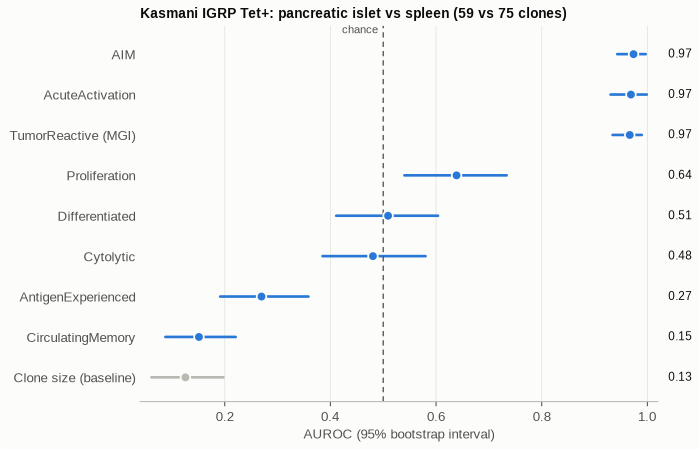
Clone-level AUROC (95% bootstrap CI) separating pancreatic-islet IGRP tetramer+ CD8+ clones (59) from splenic IGRP tetramer+ clones (75) recognizing the same H-2Kd KYNKANVFL peptide-MHC.
| Contrast (≥2-cell clones) | AIM |
AcuteActivation |
TumorReactive (MGI) |
Proliferation |
Differentiated |
Cytolytic |
AntigenExperienced |
CirculatingMemory |
clone_size |
|---|---|---|---|---|---|---|---|---|---|
Islet_TetPos (59) vs Spleen_TetPos (75) |
0.97 (0.94–1.00) | 0.97 (0.93–1.00) | 0.97 (0.93–0.99) | 0.64 (0.54–0.73) | 0.51 (0.41–0.60) | 0.48 (0.39–0.58) | 0.27 (0.19–0.36) | 0.15 (0.09–0.22) | 0.13 (0.06–0.20) |
Islet_TetPos (59) vs Islet_TetNeg (684) |
0.62 (0.56–0.68) | 0.66 (0.61–0.71) | 0.71 (0.65–0.77) | 0.53 (0.46–0.60) | 0.62 (0.55–0.69) | 0.58 (0.50–0.65) | 0.59 (0.52–0.66) | 0.45 (0.38–0.51) | 0.12 (0.05–0.19) |
- Transcriptional state tracks local antigen engagement rather than TCR sequence
alone. Even when every clone recognizes
KYNKANVFL, clones sampled inside the inflamed pancreatic islets score near the top of the distribution onAIM(0.97),AcuteActivation(0.97), and MGITumorReactive(0.97), whereas clones with the same specificity sampled in the spleen score higher onCirculatingMemory(1 − 0.15 = 0.85 in favor of spleen) and reach larger sampledclone_size(0.13). Across 51 identical sisterCDR3abclonotypes sequenced in bothSpleen_TetPosandIslet_TetPosof the same round, 98.0% (50 of 51) upregulateTumorReactiveupon entering the islets (mean Δ = +0.56), 94.1% (48 of 51) upregulateAIM(+1.01) andAcuteActivation(+0.81), and 92.2% (47 of 51) downregulateCirculatingMemory(−0.75). - Within-islet
TetPosvsTetNegreflects multi-autoantigen infiltration. Inside pancreatic islets,TumorReactiveranksIGRPTetPosclones aboveTetNegclones (0.71, vs 0.12 forclone_size), with moderate separation because NOD isletTetNegCD8+ T cells include clones recognizing other β-cell autoantigens (insulinInsB15-23, GAD65, dystrophia myotonica kinase) that undergo local islet TCR engagement alongsideIGRP-specific clones.
Acute viral LCMV GP66:I-Ab murine CD4+ T cells (Khatun 2021)
Khatun et al. FACS-sorted splenic CD4+ CD44hi T cells bound to I-Ab GP66-77
(DIYKGVYQFKSV) MHC class II tetramers at Day 10 after acute LCMV Armstrong
infection across five inbred C57BL/6 mice (M1–M5, GSE158896).
- FACS
pre_sorted: CD4rescue in murine CD4+ sorts. Settingpre_sorted: CD4on the sample sheet retains 11,413Cd3-gated cells (2,316 paired clones; 693 expanded ≥2 cells) compared with 9,046 cells (1,886 clones) under unsorted gating (+26.2% cells and +22.8% clones recovered from Cd4 mRNA dropout while still rejecting anyCd8a/Cd8b1+ contaminant). - Cross-mouse public CD4+ TCR convergence. Across 1,781 unique
CDR3_betasequences in five genetically identical mice responding to the sameGP66-77peptide, 72 (4.0%)CDR3_betachains and 26 exact pairedCDR3abreceptors recur independently in ≥2 mice, showing high private diversity alongside measurable public convergence. - Th1, memory, and Tfh/AIM clonal selection. Running
tcrsift prioritize --species mouse --tcell-type cd4 --context bloodselects 60 candidates (10–16 per mouse acrossM1–M5; mean 12) spanningCirculatingMemory(15),Differentiated(14),AntigenExperienced(8),Cytolytic(8),AcuteActivation(7),Proliferation(4), andAIM(4), capturing both cytolytic/Th1 effectors andAIM+/Tfh-skewed responders. Unlike chronic solid-tumor CD4+ TIL infiltrates (whereFOXP3+Tregs reach 38% of unfiltered shortlists; see paired blood-tumor & CD4+ TIL benchmark), acute viralGP66tetramer+ effectors contain 10.4% (240 of 2,316)Foxp3+Treg-like clones overall and 6.7% (4 of 60) on the shortlist.
MusMusculus VDJdb specificity matching and circularity control
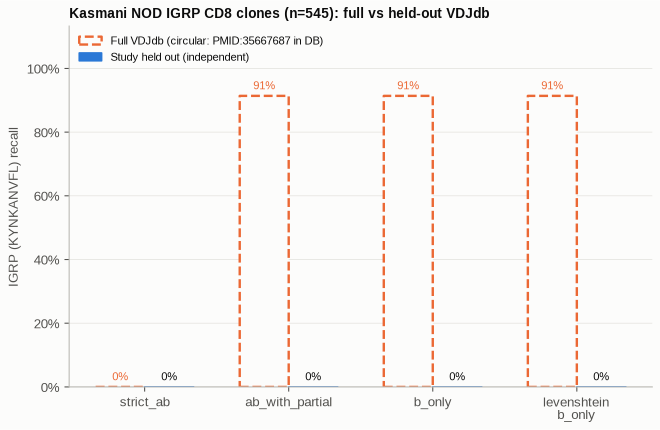
IGRP (KYNKANVFL) recall across 545 Kasmani NOD CD8+ clones on full VDJdb (circular, containing 780 TRB-only rows from PMID:35667687) versus study-held-out VDJdb (independent).
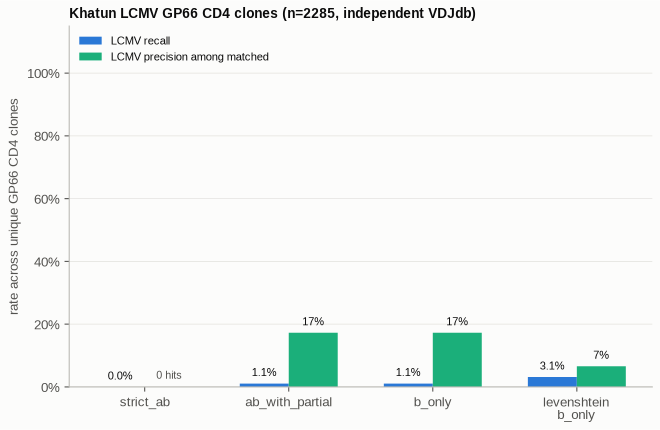
Independent VDJdb LCMV recall and precision among matched clones across 2,285 Khatun Day-10 GP66:I-Ab CD4+ clones (0 rows in VDJdb from PMID:33201171).
vdjdb-2026-11-06 contains 14,008 MusMusculus TRB rows (9,647 paired
α/β rows), pre-filtered via host_species_filter="same" when --species mouse
is active.
Circularity disclosure for Kasmani 2022 (PMID:35667687)
VDJdb 2026-11-06 includes 780 MusMusculus TRB-only rows (0
paired TRA chains) imported from Kasmani et al. (PMID:35667687),
which is VDJdb's sole KYNKANVFL / IGRP deposit. Querying Kasmani clones
against full VDJdb is therefore circular self-retrieval. The table
below reports both full VDJdb (circular) and study-held-out VDJdb
with all PMID:35667687 rows removed (independent), alongside 1,763
out-of-strain C57BL/6 MC38 tumor clones as a false-positive specificity
control.
| Query cohort & database | --database-match |
Query clones | Any VDJdb match | Target (IGRP / LCMV) recall |
Target precision among matched | C57BL/6 MC38 (1,763) any match | C57BL/6 MC38 false IGRP hits |
|---|---|---|---|---|---|---|---|
Kasmani IGRP, Full VDJdb (circular) |
strict_ab (default) |
545 | 0 (0.0%) | 0 (0.0%) | — | 1 (0.06%) | 0 (0.0%) |
Kasmani IGRP, Full VDJdb (circular) |
ab_with_partial / b_only |
545 | 508 (93.2%) | 498 (91.4%) | 98.0% | 138 (7.8%) | 5 (0.28%) |
Kasmani IGRP, Full VDJdb (circular) |
b_only + lev-1 |
545 | 518 (95.0%) | 498 (91.4%) | 96.1% | 977 (55.4%) | 65 (3.7%) |
Kasmani IGRP, Held-out VDJdb (independent) |
strict_ab (default) |
545 | 0 (0.0%) | 0 (0.0%) | — | 1 (0.06%) | 0 |
Kasmani IGRP, Held-out VDJdb (independent) |
ab_with_partial / b_only |
545 | 29 (5.3%) | 0 (0.0%) | 0.0% | 135 (7.7%) | 0 |
Kasmani IGRP, Held-out VDJdb (independent) |
b_only + lev-1 |
545 | 280 (51.4%) | 0 (0.0%) | 0.0% | 954 (54.1%) | 0 |
Khatun GP66 CD4, Full VDJdb (independent) |
strict_ab (default) |
2,285 | 0 (0.0%) | 0 (0.0%) | — | — | — |
Khatun GP66 CD4, Full VDJdb (independent) |
ab_with_partial / b_only |
2,285 | 139 (6.1%) | 24 (1.1%) | 17.3% | — | — |
Khatun GP66 CD4, Full VDJdb (independent) |
b_only + lev-1 |
2,285 | 1,094 (47.9%) | 72 (3.15%) | 6.6% | — | — |
- Why
strict_abis the default. Understrict_ab, false-positive annotation on held-out Kasmani NOD clones is 0.0% (0 of 545) and out-of-strain C57BL/6 MC38 collisions are 1 of 1,763 (0.06%). Relaxing tob_onlycauses 5.3% (29 of 545) of NODIGRPclones and 7.7% (135 of 1,763) of MC38 tumor clones to collide with unrelated viral entries (MCMV,LCMV,InfluenzaA), and Levenshtein-1 β matching raises false positives to 51.4%–55.4% of the repertoire (including 65 C57BL/6 MC38 tumor clones falsely annotated asH-2KdNOD diabetesIGRPunder full VDJdb). - Paired α/β gaps in historical murine VDJdb submissions. Because legacy
murine deposits in VDJdb (including
PMID:35667687forIGRPand most olderI-Ab GP66entries) were sequenced by bulkTRBamplicon without pairedTRAchains,strict_abachieves 0% recall on thoseTRB-only deposits. Users screening against legacyTRB-only murine epitopes can opt into--database-match ab_with_partialfor exploratory annotation while keeping--exclude-known-viraldisabled or paired-strict.
Murine full-length single-chain TCR construct assembly
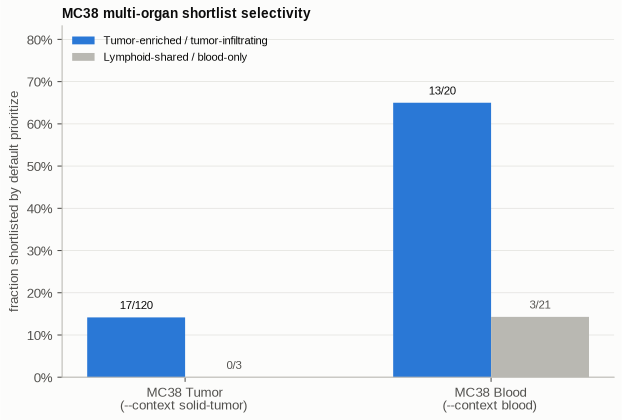
Fraction of tumor-enriched or tumor-infiltrating clones versus lymphoid-shared or blood-only clones shortlisted by default tcrsift prioritize --species mouse in MC38 tumor (--context solid-tumor) and blood (--context blood).
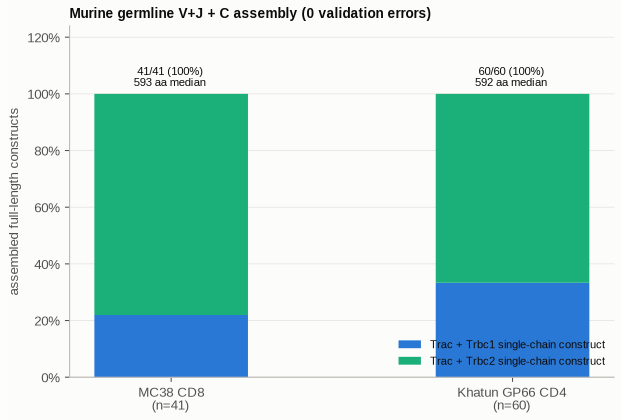
Full-length murine single-chain (leader + VDJ + Trac/Trbc1/Trbc2 linked by T2A) construct assembly across MC38 CD8+ (41) and Khatun GP66 CD4+ (60) shortlisted candidates with zero validation errors.
Because all three GEO datasets provide pre-Cell Ranger 6 VDJ tables lacking
framework nucleotide columns (fwr1_nt–fwr4_nt), full-length
constructs (leader + VDJ + Trac/Trbc1/Trbc2 linked by T2A) were built via
assemble_full_sequences(...,
  species="mouse", germline_vdj_fallback=True)
using cached IMGT Mus_musculus V-QUEST V-REGION and J-REGION references
and checked with validate_sequences(..., species="mouse"):
| Shortlist cohort | Candidates | Complete single-chain constructs | Germline α / β reconstructed | Trbc1 / Trbc2 constructs |
Cell Ranger Trbc miscalls corrected |
Median construct length | Load-bearing validation errors |
|---|---|---|---|---|---|---|---|
| MC38 CD8 (24 tumor + 17 blood) | 41 | 41 (100.0%) | 41 / 41 | 9 Trbc1, 32 Trbc2 |
32 / 41 (78.0%) | 593 aa | 0 |
Khatun GP66 CD4 (M1–M5) |
60 | 60 (100.0%) | 60 / 60 | 20 Trbc1, 40 Trbc2 |
20 / 60 (33.3%) | 592 aa | 0 |
Two murine-specific assembly edge cases uncovered on these cohorts are handled automatically since 3.33.0:
- Cell Ranger mouse Ensembl
-dvV-gene naming (TRAV13-4-dv7). Cell Ranger's mouse Ensembl VDJ reference formats shared α/δ V segments with a lowercase hyphenated-dvsuffix (TRAV13-4-dv7,TRAV6-7-dv9,TRAV16d-dv11), whereas IMGTMus_musculusFASTA headers use uppercase slash notation (TRAV13-4/DV7,TRAV6-7/DV9,TRAV16D/DV11). Normalizing-dvsegments innormalize_vgenerecovered all 7 of 41 MC38 candidates (82.9% → 100.0%) that previously failed α-chain leader andV-REGIONlookup. - Cell Ranger
Trbc1/Trbc2constant-region miscalls. MurineTrbc1andTrbc2share >96% coding identity in their 5' exons, so short 5' VDJ reads often misassignTrbc1toTrbj2-rearranged β chains (32 of 41 in MC38 and 20 of 60 in Khatun). TCRsift enforces genomic J→C locus parity (Trbj1*→Trbc1,Trbj2*→Trbc2) and records every correction inqc_warningswhile settingconstruct_contig_verified = Falseon germline-imputed VDJ chains.
Scope and limitations
- No murine
NeoTCR4/NeoTCR8/MANAscoreequivalents. HumanNeoTCR8,NeoTCR4,NeoTCR_PBL, andMANAscorewere derived on human tumors and rely on primate-biased transcripts (such as human CD8 CXCL13);--species mouseuses MGI-curatedMOUSE_SIGNATURES(TumorReactive,Differentiated,AntigenExperienced,Cytolytic,CirculatingMemory,AcuteActivation,Proliferation,AIM). - Germline fallback imputes framework regions on pre-Cell Ranger 6 deposits.
When
fwr1_nt–fwr4_ntand contig FASTAs are absent from public deposits,--germline-vdj-fallbackreconstructs fullV-REGION+CDR3+J-REGIONsequences from*01IMGT alleles (construct_contig_verified = False). When fullall_contig.fastaor Cell Ranger 6+airr_rearrangement.tsvfiles are available, donor-read VDJ assembly remains preferred to preserve non-*01allelic polymorphisms. - Historical
TRB-only gaps inMusMusculusVDJdb. Only 9,647 of 14,008MusMusculusVDJdb entries include pairedTRAchains;strict_abprioritizes zero false positives over matching legacy β-only records.
Reproducing
pip install tcrsift
git clone https://github.com/pirl-unc/tcrsift && cd tcrsift
tcrsift data download --db vdjdb
tcrsift data download --group germline_mouse

python benchmarks/public_mouse/download.py --data-dir bench_mouse_data
python benchmarks/public_mouse/run.py --data-dir bench_mouse_data --work-dir bench_mouse_data/runs
python docs/figures/make_mouse_benchmark_figures.py
run.py writes the CSV tables (auroc_mouse.csv, vdjdb_mouse_recovery.csv,
shortlist_mc38.csv, mouse_assembly.csv) and summary.json (including
ground_truth_provenance, tcrsift_version, and vdjdb_release) to
benchmarks/public_mouse/results/. AUROC confidence intervals are 95%
percentile bootstraps over clones (2,000 draws, fixed seed).
Sources
- Multi-tissue murine MC38 colon adenocarcinoma single-cell RNA + TCR-seq (GSE168944).
- Kasmani MY, Ciecko AE, Brown AK, Petrova G, Gorski J, Chen YG, Cui W.
Autoreactive CD8 T cells in NOD mice exhibit phenotypic heterogeneity but
restricted TCR gene usage. Life Sci
Alliance 2022
(GSE200608;
PMID:35667687). - Khatun A, Kasmani MY, Zander R, et al. Single-cell lineage mapping of a
diverse virus-specific naive CD4 T cell
repertoire. J Exp Med 2021
(GSE158896;
PMID:33201171). - Goncharov M, Bagaev D, Shcherbinin D, et al. VDJdb in the pandemic era: a compendium of T cell receptors specific for SARS-CoV-2. Nat Methods 2022.
- Bagaev DV, Vroomans RMA, Samir J, et al. VDJdb in 2019: database extension, new analysis infrastructure and a T-cell receptor motif compendium. Nucleic Acids Res 2020.