What supports a CTA?
Explore the measurements, published evidence and unresolved questions behind every released candidate protein.
Release 1.31.0 · Evidence guide dated 6 November 2026 · Full classification funnel
The table contains the 1.31.0 classifications. New literature findings and biological categories are recorded alongside them.
7 November update: All 96 follow-up reviews, the core and supplementary paper sets, and coverage for all 602 CTAs. The new review records normal-expression and identity findings alongside the frozen release.
The 122 outside our nomination-paper collection
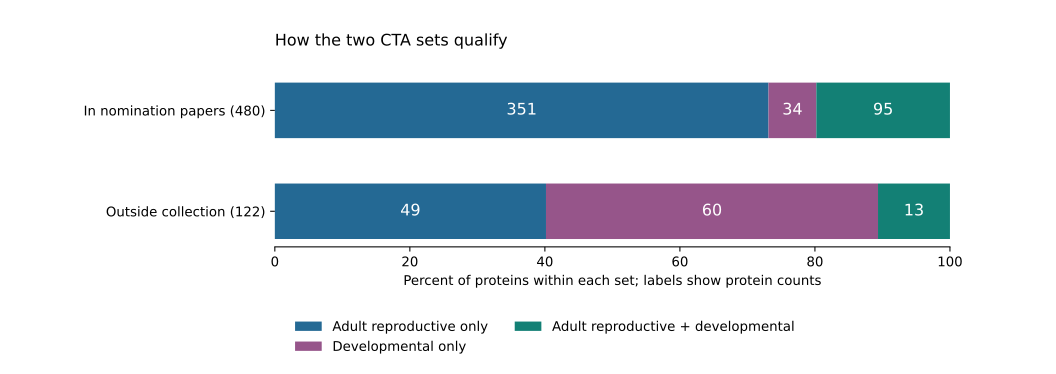
602 CTAs = 480 in the 15 registered nomination papers + 122 outside that collection. The 122 represent 123 loci; PRAMEF25/6 shares one selected reference protein. Several already have cancer-target publications, including TBXT and SEMG2.
Download the admission-route figure (SVG)
What do they have in common?
60 of the 122 qualify through developmental evidence alone, compared with 34 of the 480. Another 49 qualify through adult reproductive evidence alone and 13 through both. The biological categories below distinguish early embryos, oocytes and maternal function, reproductive secretions, testis, placenta and gastrulation.
Are they weaker?
The median maximum tumor RNA is 35.6 TPM for the 122 and 33.5 TPM for the 480. Maximum tumor RNA is below 10 TPM for 23 of 122 and 80 of 480. All 122 pass the reference-coding translation rule. Their released gene-knowledge ledger contains no findings.
These comparisons use each protein’s highest measured tumor RNA. Tumor prevalence and experimental protein detection are separate measurements. The replication flag was calculated for a selected subset, so it is omitted from this comparison.
What did the collection miss?
The search found cancer-target papers, embryo gene-activation studies, oocyte and maternal-effect studies, and reproductive-tract protein studies. It also found normal-cell expression in sensory neurons, osteoblasts and adipose tissue. The linked findings below identify the protein, tissue, experiment and follow-up.
What the focused literature review found
Additional cancer–embryo catalogs
Matching the supplementary tables below found 11 distinct proteins among the 122. These program memberships are separate from the 15-paper nomination collection used in release 1.31.0.
Download matched source rows and source-file hashes
Evidence updates to make
- Curate the normal-cell findings for MRGPRX1, SP7, SEMG2, KLF14 and BTN1A1.
- Add the missing cancer-target publications to the nomination registry.
- Add the embryo, oocyte and reproductive-secretion studies to the gene-level evidence records.
- Record tumor protein, tumor prevalence and proteoform identity where measured.
- Recalculate classifications after curation and publish each changed call with its evidence.
Biological categories of the 602 CTAs
Proteins can have several categories. Each assignment records a publication or a measured tissue, cell population or developmental stage. The table shows the biological categories separately from the admission route and classification.
Download all 602 with biological categories and evidence · Download the category figure · Category definitions and assignment rules
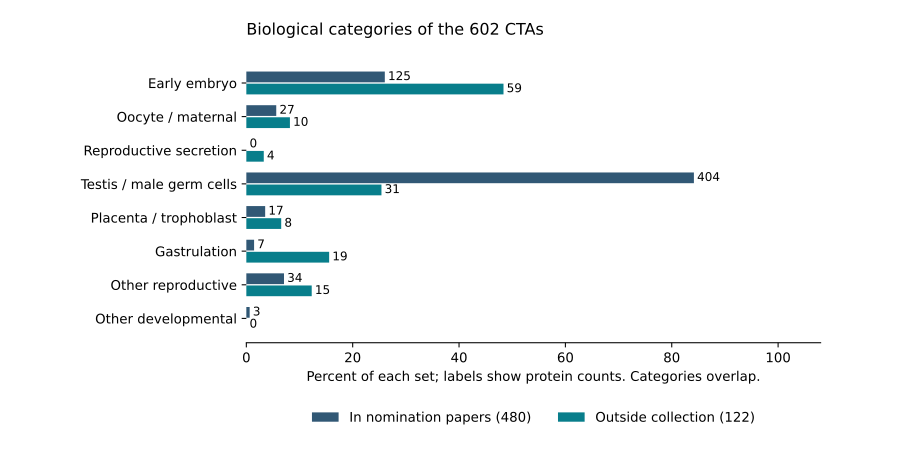
RNA tags use supported values of at least 5 TPM or nTPM. Oocyte tags use oocyte-specific observations; reproductive-secretion tags use publications. Testis bulk RNA receives the testis category. Published animal findings retain their species. Categories overlap, so their counts are not added.
Why only four reproductive secretions? PATE1, WFDC8, RNASE9 and SEMG2 were tagged during the focused literature review. The other CTAs have not been systematically checked against reproductive-secretion catalogs.
Every candidate, every decision-source layer
One row per selected reference protein, retaining every member locus. Values are source summaries in their original units. — means no usable observation or no recorded finding in that source; 0 means measured zero. Open a protein for its category evidence, top five tissue or cell contexts, and linked publications.
RNA columns show the highest supported value in that source, including reproductive contexts; the detail view separates these from other normal tissues. Studies and measurement scales are never pooled into one ranked list. For a shared protein, developmental per-source maxima are left blank when only member-level values are available; the released group-level admission evidence remains in the details.
Choose visible source columns
What the decisions mean
- Checks complete
screened - The release’s required assessment is complete. CTA, Unsafe and Other proteins can all have this status; an assessment can finish with an exclusion.
- No sequence exclusion
allow - The selected protein has a resolved identity, completed assessment and no Unsafe assignment. CTA and Other proteins can receive this role. Other proteins can still fail a separate CTA requirement, such as cancer expression or reproductive/developmental association.
- Unresolved
review - One or more evidence questions remain; the categories below give the reason.
- Exclude
exclude - Retain this sequence as exclusion evidence. An Unsafe occurrence takes precedence over an unresolved or otherwise allowed occurrence.
These labels describe the released checks for the selected protein. They do not mean zero normal expression or clinical safety. Later literature findings appear separately until incorporated into a new assessment.
| Simple review category | What needs resolving |
|---|---|
| Missing measurements | A required normal-tissue measurement or member-locus coverage is missing. |
| Conflicting or uncertain normal evidence | A normal-tissue signal, reagent claim or clinical attribution has not been resolved. |
| Uncertain identity | The gene, locus, transcript or source mapping cannot be assigned confidently. |
| Uncertain translation | The selected record lacks qualifying coding/translation support or has an incomplete or disallowed annotation. |
| Ambiguous sequence | Internal stops, ambiguous residues or non-AA20 characters prevent automatic use of the exact record. |
| Not assessed | The record or isoform has no applicable current decision. An assessed representative does not automatically clear other isoforms. |
Categories can overlap. The table retains the original status, exact qualification reasons and per-layer decisions. An ordinary failure to qualify as a CTA is not automatically a review hold.
RNA limits in plain language
Without usable matching protein staining, the starting upper RNA limits are 4 for Vital, 8 for Protected and 16 for Manageable, in the source’s own TPM or nTPM units. Matching negative immunohistochemistry (IHC) can raise these limits:
| Tissue tier | No usable matching IHC | Approved negative | Supported negative | Enhanced negative |
|---|---|---|---|---|
| Vital | 4 | 8 | 16 | 32 |
| Protected | 8 | 16 | 32 | 64 |
| Manageable | 16 | 32 | 64 | 128 |
The upper limit is inclusive: a value must be above it to trigger this RNA rule. A Vital/Protected exceedance supplies Unsafe evidence. A Manageable exceedance blocks CTA admission; a value above 128 supplies Unsafe evidence. Reviewed product-specific clinical credit can add one doubling within the same cap. These are OncoRef screening thresholds. Corneal CP10K uses separate limits equal to these values divided by 100. Reproductive and Disposable compartments have separate rules.
Data sources and what they contribute
Source names in the candidate table and gate rules link here. Measurement datasets, nomination papers, curated findings and computed rules serve different purposes. The two rare-cell gates use the CELLxGENE panel. Sequence containment is computed from Ensembl coding sequences and released Unsafe assignments. Final classification combines the gates; it is not another measurement.
Why protect these tissues?
Vital, Protected, Manageable and Disposable are OncoRef tissue-protection categories. The registry records human injury, animal depletion, regeneration, treatment and anatomical evidence for each assignment. The RNA thresholds are defined by OncoRef policy.
Whole lung is Vital; mature ciliated airway cells are Protected in the current registry. Their mucociliary role, replacement and injury evidence are assessed separately from alveolar gas exchange and progenitor loss.