What OncoRef calls a CTA
An OncoRef CTA candidate is a reference-resolved protein with supported cancer expression and qualifying reproductive or developmental association that passes the named normal-tissue evidence, coverage and selection rules. CTA admission requires qualifying coding annotation or supported ncORF evidence and a complete, approved MANE Select or Ensembl canonical representative, with any conflicting coding evidence resolved. Every input record is assessed, including those with insufficient translation support.
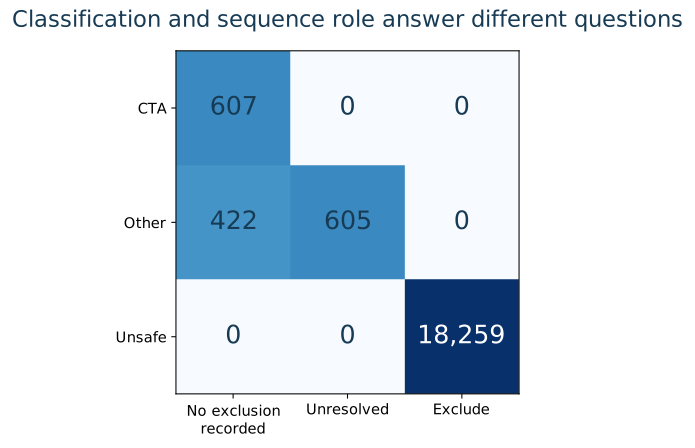
The current human policy produces 607 CTA, 18,259 Unsafe and 1,027 Other proteins. It evaluates 19,893 candidate proteins in the complete inventory, counting identical selected reference sequences together and retaining every member locus. Splice isoforms and post-translational modifications are outside this inventory.
CTA admission combines cancer expression, reproductive or developmental association, translation qualification and normal-tissue assessment. The biological categories identify the tissue, cell population or developmental program associated with each protein.
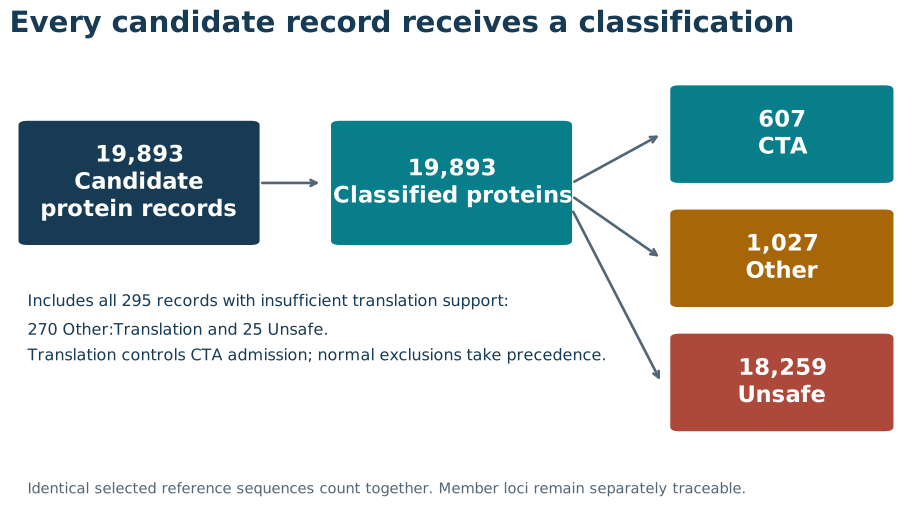
From candidates to CTAs
All 19,893 candidate records enter the same normal-evidence and admission path. The 295 records formerly removed at entry stay visible: 285 have only NMD/CDS-not-defined reference transcripts and 10 have only single-study Ribo-seq support. Translation support is assessed at CTA admission.
CTA admission requires qualifying translation support and the separately qualified exact reference record. Applicable normal exclusion takes precedence and establishes Unsafe; otherwise insufficient translation qualification yields Other:Translation and sequence review. The translation rule accepts qualifying coding annotation and supported noncanonical ORFs.
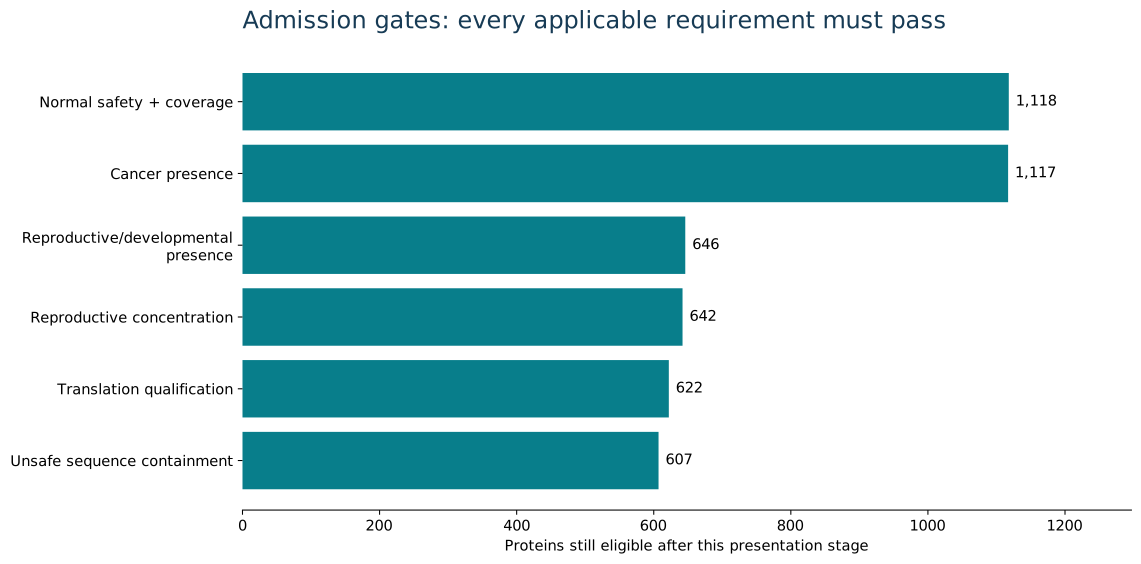
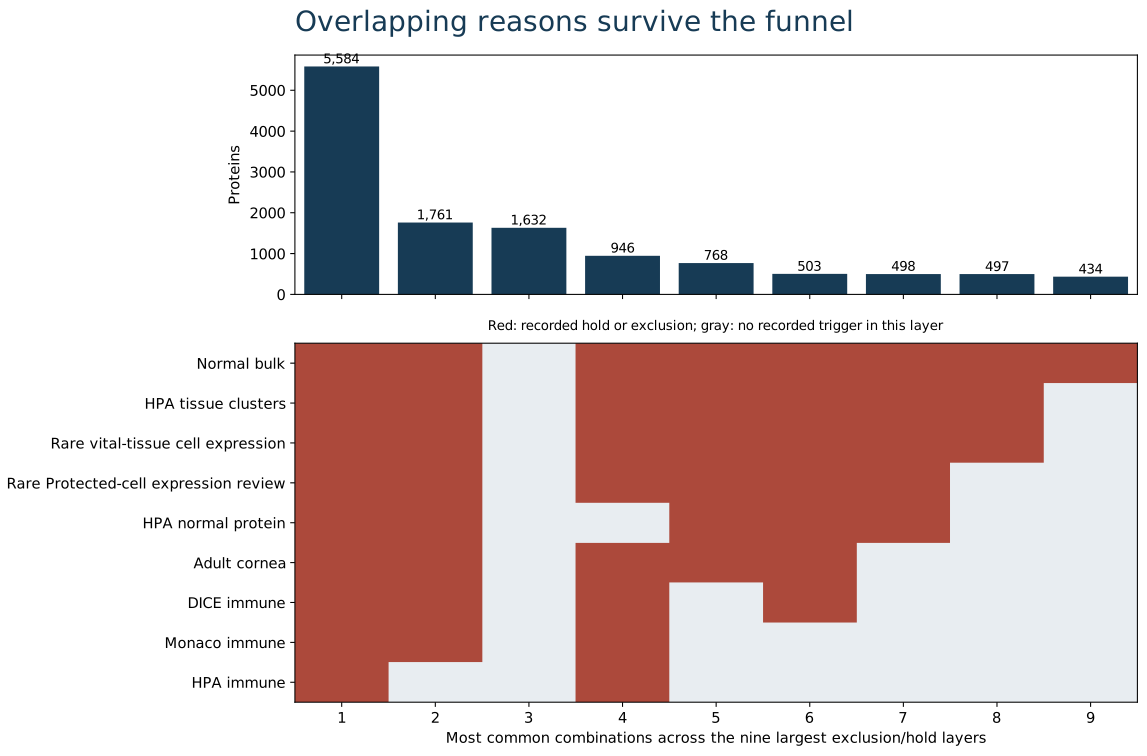
Apply all normal-tissue evidence independently. Accepted exclusion evidence establishes Unsafe. Unresolved findings or missing required coverage prevent admission and require review; they do not establish Unsafe. Every target must also pass reproductive/developmental association, cancer presence, concentration, translation qualification and sequence-containment rules.
The chart uses cumulative counts. Of 1,118 proteins passing normal assessment, cancer presence retains 1,117; reproductive/developmental presence then narrows these to 646. The previous order showed 645 at both gates because every reproductive/developmental survivor already met cancer presence. One compatible positive tumor RNA sample or reviewed tumor protein makes cancer presence a broad gate, not an abundance or prevalence requirement.
Every applicable evidence layer is still evaluated, including after an early exclusion. Unsafe takes precedence. Display order changes neither final classifications nor the priority used to assign Other subtypes.
Published nominations through the funnel
All 15 registered nomination papers appear in the companion funnel. Their union contains 2,514 proteins: 487 finish as CTA, 1,876 as Unsafe and 151 as Other. A protein can occur in several papers, so individual paper rows must not be summed.
The 17,379 candidates without a registered-paper annotation undergo the same assessment and contribute 120 CTAs. Prior nomination is recorded separately from the admission gates. The evidence guide identifies additional publications for proteins outside this registry.
A publication's measured evidence can support reproductive/developmental association, tumor expression, translation or normal-tissue counterevidence when it meets the corresponding evidence rule. A list label alone does not establish those facts. Germ-cell, testis-biased, placental and tumor-vascular lists retain their original scope alongside CTA nominations.
Additional cancer–embryo catalogs: 1.31.0 snapshot
Supplementary-table matching found 11 distinct proteins from the 122 across these two catalogs. These program memberships are separate from the release's 15-paper nomination collection.
Chew et al., 2019 — Table S3: high-confidence DUX4 targets: 4 matches: DUXA, DUXB, LEUTX, PRAMEF25/6. DUX4-induced gene program evaluated in human cancers; target definition also used induced myoblast experiments.
PRAMEF25 matches the historical WI2-2994D6.2 entry by Ensembl ID and is one member of the shared PRAMEF25/6 protein. DUXB matches by symbol; its source Gene ID is also DUXB. The paper reports DUXB expression in healthy tissues.
Smith et al., 2023 — Table S3A: zygotic gene activation and eight-cell-like gene sets: 9 matches: C19orf85, CPHXL, DUXA, LEUTX, MBD3L2B, OR10G3, TAF11L12, ZNF280A, ZNF878. Single-cell RNA sequencing of KLE and SUSA cancer cell lines using published zygotic gene activation and eight-cell-like gene sets.
Exact gene-symbol matches to the 122. Membership records the program evaluated in cancer cells; gene-level measurements and effect sizes need separate extraction. MBD3L2 is not substituted for MBD3L2B, and H3Y is not mapped to H3Y1 in this count.
Gene-set source: Taubenschmid-Stowers et al., 2022: 8C-like cells capture the human zygotic genome activation program in vitro.
Matched source rows, download links and file hashes
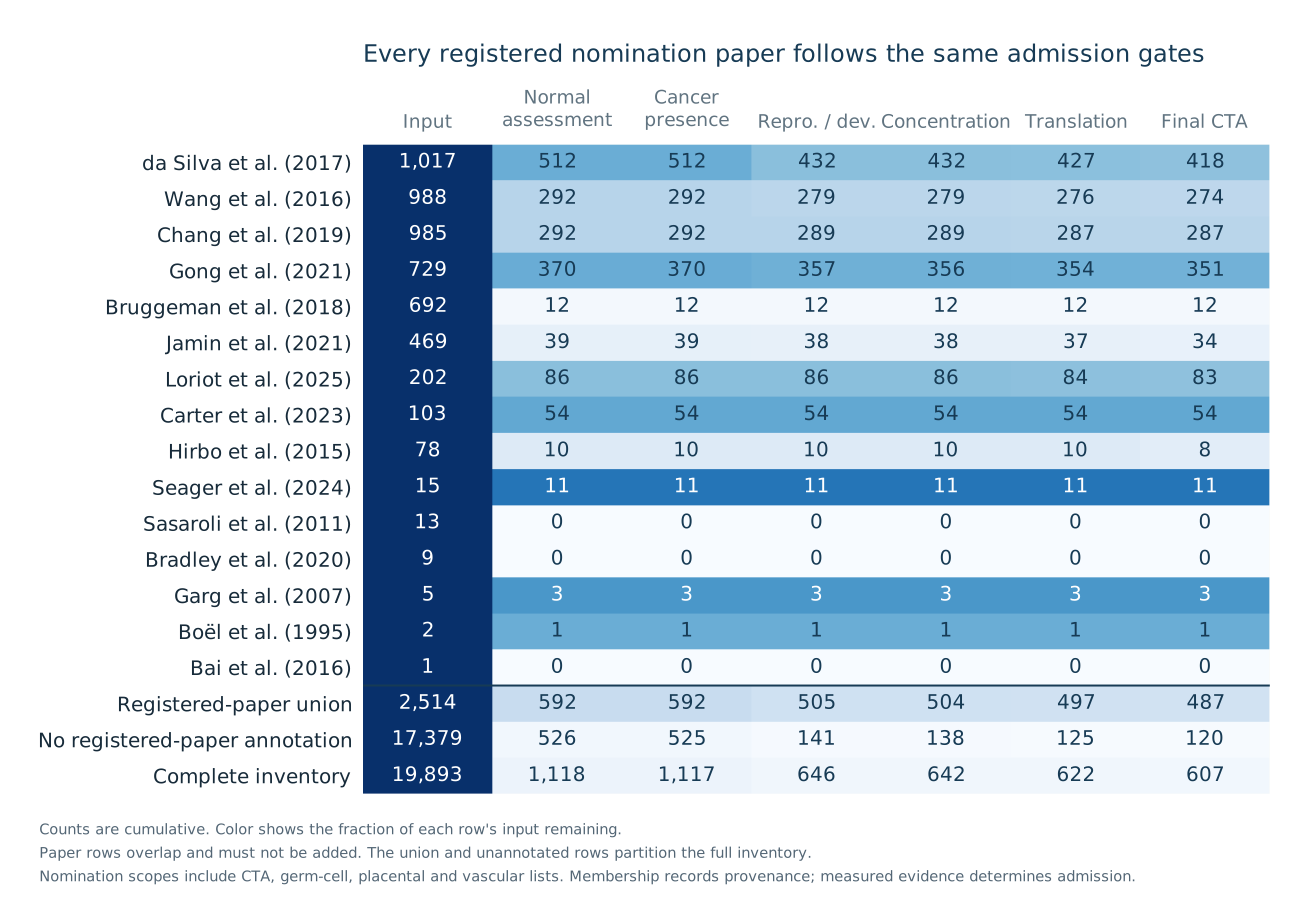
All paper-by-gate counts · Protein memberships
| Paper | Extracted scope |
|---|
| da Silva et al. (2017) | At least 90% normal-tissue RNA attributable to testis; tumor positivity not required; Gene-labelled tumor proteomics; unique-locus peptide assignment is not established; RSEM >1 in at least 10% of samples in a tumor type; RNA nomination |
| Wang et al. (2016) | Cancer-associated RNA nomination; no antigen validation asserted |
| Chang et al. (2019) | Testis-specific coding gene expressed in at least 1% of TGCT; no broad somatic-cancer claim |
| Gong et al. (2021) | Normal reproductive-tissue enrichment; no tumor validation; Placental RNA enrichment; no tumor-antigen validation |
| Bruggeman et al. (2018) | GC RNA nomination across cancer types; no antigen validation asserted; GC RNA nomination; inclusion depends on TGCT under this study's thresholds |
| Jamin et al. (2021) | CT-pattern microarray nomination; tumor upregulation with no corresponding normal-tissue detection; Core CT annotation; underlying microarray probes may recognize several loci |
| Loriot et al. (2025) | Cancer-germline RNA nomination; strict and preferential classes remain distinct |
| Carter et al. (2023) | Final CT-expression set without detectable thymic expression; functional vaccination evidence is not assigned to every gene |
| Hirbo et al. (2015) | HPA v13 placenta-enriched nominations; 30/86 fast-evolving subset retained as metadata; not tumor validation |
| Seager et al. (2024) | Member of the published 17-target CTA profiling panel; includes differentiation antigen MLANA |
| Sasaroli et al. (2011) | Tumor-vascular candidate list; includes secreted and transmembrane proteins; not a CTA-restricted list |
| Bradley et al. (2020) | CPA expression nominations; HLA peptide and antigen-specific T-cell validation for VGLL1 |
| Garg et al. (2007) | Ovarian-cancer RNA/protein expression and patient antibody responses; no HLA presentation or T-cell validation claimed |
| Boël et al. (1995) | Original BAGE tumor-antigen nomination and autologous CTL recognition; contemporary paralog resolution is not inferred |
| Bai et al. (2016) | Ovarian-tumor and vascular expression/function; no normal-tissue exclusivity claim |
Biological categories in the historical 602-CTA snapshot
The historical 1.31.0 literature tables categorize 602 CTAs by early embryo, oocyte and maternal function, reproductive secretion, testis and male germ cells, placenta and trophoblast, and gastrulation. A protein can belong to several categories. Current reference choices and coding holds are listed in the transcript-selection report.
Each tag links to a publication or a supported RNA observation. The detail view records the species, tissue, cell population or developmental stage. Biological categories are separate from the admission route and the CTA, Unsafe or Other classification.
Reproductive secretion currently has four manually annotated proteins: PATE1, WFDC8, RNASE9 and SEMG2. This count reflects the focused literature review; the other CTAs have not been systematically checked against reproductive-secretion catalogs.
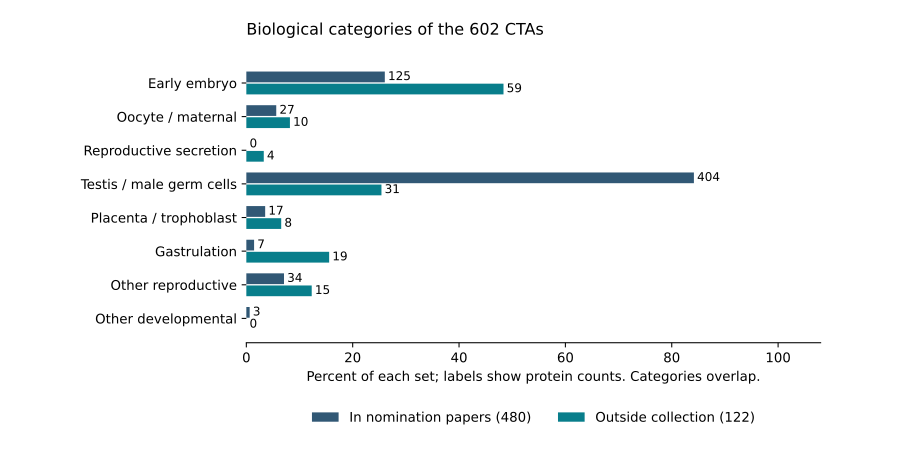
Filter CTAs by biological category and inspect the evidence
Categories overlap; each column counts proteins carrying that tag.
Normal-tissue consequences and expression evidence
Vital, Protected, Manageable and Disposable describe the consequence and tolerability of injury to a specified tissue/cell compartment. Assignments use immediate function, repair capacity, persistent injury, anatomy and inflammatory effects.
The central registry distinguishes 39 bulk tissues and 68 cell populations, with source-linked rationale. A cell-level exception requires resolved tissue and cell identity. An unresolved or mixed label cannot earn a narrower allowance; reproductive/developmental membership is a separate anatomical axis.
The evidence records distinguish RNA, surface protein, peptide-HLA presentation, receptor recognition and tissue injury. Missing measurements and measured zeros have separate values.
- Vital
- Highest protection priority: plausible life-threatening failure, major irreversible neurological/sensory loss, or loss of indispensable regenerative support.
- Protected
- Persistent functional or structural injury is a major concern; compensation is incomplete or direct immune-depletion evidence is insufficient.
- Manageable
- A defined compartment has credible replacement, compensation or supportive-treatment precedent; acute inflammation and persistent recognition still require review.
- Disposable
- Narrow conditional allowance for loss of a specified compartment; does not imply painless, reversible or inflammation-free ablation.
Vital evidence: Engineered T-cell treatment caused fatal cardiac injury in the cited human study. AT2-cell depletion caused lethal pulmonary edema in the cited mouse study. Cardiovascular toxicity and titin cross-reactivity of affinity-enhanced T cells in myeloma and melanoma. Targeted Type 2 Alveolar Cell Depletion: A Dynamic Functional Model for Lung Injury Repair.
Protected evidence: The cited studies document persistent salivary injury, ciliary dysfunction and impaired airway clearance. Sicca Syndrome Associated with Immune Checkpoint Inhibitor Therapy. Lung function from school age to adulthood in primary ciliary dyskinesia. Parent stem cells can serve as niches for their daughter cells.
Manageable evidence: Clinical B-cell depletion is managed with infection monitoring and immunoglobulin replacement when needed. Thyroid hormone replaces thyroid endocrine function. Tisagenlecleucel in Children and Young Adults with B-Cell Lymphoblastic Leukemia. Immune-Related Thyroiditis with Immune Checkpoint Inhibitors.
Disposable evidence: Gallbladder removal is a clinical example of tolerated organ loss. Melanocyte-targeted T cells caused eye and ear injury, so the cutaneous category is restricted to skin. Treatment for Gallstones. Gene therapy with human and mouse T-cell receptors mediates cancer regression and targets normal tissues expressing cognate antigen.
The registry records the evidence for each tissue and cell population. Tissue and cell rationales with references.
Evidence has multiple independent meanings
Checks complete (screened) means the release's required assessment is complete. It describes completion, so CTA, Unsafe and Other proteins can all have this status. No sequence exclusion (allow) means the selected protein has a resolved identity, completed assessment and no Unsafe assignment. This can apply to CTA or Other; CTA admission has additional requirements. These labels describe the released checks, not every tissue, isoform or later publication.
Review completion, interpretation and policy effect are separate. A completed review can retain an unresolved interpretation. A rejected protein claim remains visible with its rationale; rejecting that claim does not prove normal-tissue absence.
All 196 historical findings have linked current dispositions. MAGEC2, LGALS13 and PLCZ1 retain material holds. Each record lists the source, reagent, tissue, developmental stage and unresolved question.
Fatal neurological injury in the MAGE-A3-reactive TCR cohort remains product-specific evidence. The MAGEA12 and EPS8L2 explanations are both retained as unresolved. MAGEA12 remains Unsafe under an independent rare-cell finding. Neither receptor causality nor favorable clinical credit transfers across a gene family.
MAGE-A3-reactive TCR neurological injury report · MAGEA12/EPS8L2 causal re-examination
Translation, identity and downstream sequence use
Translation qualification asks whether the exact selected primary-locus record supports target sequence use. Complete coding annotation, start/stop codons, biotype and sequence integrity are assessed separately from normal-tissue hazard. Qualification applies to the selected primary-locus record.
The verified bundle retains original sequences, every source occurrence, qualification reasons and coverage gaps. It supplies contiguous AA20 segments with original coordinates and never joins across ambiguity, internal stops or different records. Selenocysteine-containing records require review under the AA20 sequence contract.
Across occurrences, exclude takes precedence over review, then allow. Unsafe sequence remains exclusion evidence even in an incomplete record. Allow means no exclusion from the assessed record under this policy. Exact matching does not validate an approximate similarity cutoff or patient-HLA decision. The historical Unsafe plus additional-forbidden assets retain their older policy identity.
Research parameters and coverage limits
Without usable matching protein staining, the upper RNA limits start at 4 for Vital, 8 for Protected and 16 for Manageable tissues, in the source's own TPM or nTPM units. Approved, Supported and Enhanced negative IHC respectively multiply the starting limit by 2, 4 and 8. Reviewed product-specific clinical evidence can add one doubling within the same cap. A value must be above the limit to trigger this RNA rule. Corneal CP10K uses separate limits. These screening thresholds are set by OncoRef policy.
Cancer presence requires one compatible tumor sample above zero or reviewed tumor protein. Reproductive RNA uses a 5-unit criterion with assay-specific support requirements; reliable reproductive IHC and reviewed protein provide separate routes. Adult/placental diffuseness above 10% can block identity, never establish Unsafe.
The rare-cell panel uses a 1% detection screen with cell-support rules. Detection frequency is not abundance. Coverage is limited by sampled organs, donor age, activation states, paralog mapping and assay resolution. Optional panels remain disclosed when missing. A 95% Unsafe 9-mer overlap blocks practical candidate admission, but is not a clinical cross-reactivity validation.
The complete gate table below retains the actual executable rules and source IDs. Human thresholds are not transferred to dog or mouse; their native nominations remain unassessed until supported by a species-specific policy.
Plain-language decision categories and the complete RNA-limit table
Does CTA mean expressed only in cancer?
No. CTA admission requires cancer expression plus qualifying reproductive or developmental association. The CTA total is not a count of proteins absent from all normal tissues, including testis, placenta, embryo and fetus. Passing normal-tissue thresholds is not a claim of zero normal expression.
The current data do support an observed-expression count: 40 cancer-expressed records have complete required bulk coverage and zero stored adult/reproductive RNA summaries. Of these, 22 have developmental measurements and 0 also have zero developmental RNA; 18 lack developmental measurements. Stored zeros are not proof of absent protein, and tiny positive RNA values are not validated protein production.
The separate low-expression screen finds 66 preliminary matches. Independent normal-cell evidence excludes 6 of them. A numerical profile match is not a final cancer-only designation; remaining matches retain explicit review or coverage requirements. The inventory audit lists every record, counterevidence source and measurement gap.
Cancer-specific altered sequences and peptides require a separate analysis from these reference-protein counts. A mutation, fusion or alternative transcript can create a target sequence even when the source gene is normally expressed; evidence for one such sequence cannot establish exclusivity of every product of the gene.
Reproduction and version changes
Selection policy: oncoref.cta-selection.2026-11-08.1. Role policy: oncoref.sequence-roles.2026-11-04.1. Translation policy: oncoref.translation-qualification.2026-11-04.1.
The 1.29.0 comparison remains pinned. The evidence and translation PRs also retain adjacent baselines, separating changes in category, subtype, role, assessment status and reasons. Counts are recalculated from the evidence and rules.
Use the public decision, finding and sequence APIs. The final release receipt binds the decision exports, ontology, curation, qualification, bundle and generated figures. Complete and cached scientific replays must be byte-identical. Historical reports keep their original inputs and policies.
Release 1.35.0 applies MANE-first reference selection, coding-evidence review and recomputed protein identities. Its classifications and sequence roles use the current policy. The 602-protein literature analysis remains a labelled 1.31.0 snapshot.
Complete gate rules
Worked decisions
PRAME · CTA · sequence No sequence exclusion
Checks complete:
Translation: Qualified selected record
unresolved / Context only: The historical blanket primary-stain hold is superseded by the current HPA level/reliability and compartment rules, including prior reagent eligibility. Original raw staining and unresolved specificity remain visible; this policy revision is not new validation of the reagent or evidence of absence. No second historical IHC veto is applied. HPA v23 primary IHC; repeated family profiles are not independent studies
All mapped positive rows, profile notes and reagent summaries reviewed; no independent histology re-read or new experiment; Reliable gene-profile labels do not validate each raw stain. RNA/protein donors are unpaired. Retain observed intensities and identity ambiguity; the decision is a conservative research hold.
accepted / Context only: Reported Low intensity remains a flag without an automatic protein veto under the current policy; retain the observation and source-specific limitations. 33890816; 35973038
Primary 2021 abstract; 2022 normal-tissue methods/results inspected via primary article search excerpts; Full 2021 methods unavailable; abstract-level conservative acceptance, not proven therapeutic injury. IMA203 evidence concerns a selected peptide/HLA/TCR product and is preserved separately.
MAGEC2 · Other:Held · sequence Unresolved
Normal evidence unresolved: Reviewed normal-cell knowledge
Translation: Qualified selected record
unresolved / Unresolved: Material normal-tissue finding remains unresolved; block CTA admission and require sequence review without establishing Unsafe. Negative bulk profiles do not resolve assay identity. HCA587 antigen expression in normal tissues and cancers: correlation with tumor differentiation in hepatocellular carcinoma
Primary abstract rechecked; publisher full text unavailable in this review. Original tissue and antibody controls remain unverified.; Abstract does not settle reagent specificity; no demonstrated target-mediated clinical injury. A neural protein conflict warrants a hold, but the historical antibody result does not establish target-mediated clinical injury or resolve MAGE-family cross-reactivity.
LGALS13 · Other:Held · sequence Unresolved
Normal evidence unresolved: Reviewed normal-cell knowledge
Translation: Qualified selected record
unresolved / Unresolved: Material normal-tissue finding remains unresolved; block CTA admission and require sequence review without establishing Unsafe. Negative bulk profiles do not resolve assay identity. Isolation and sequence analysis of a cDNA encoding human placental tissue protein 13 (PP13)
Primary abstracts rechecked (PMIDs 10527825 and 19497882); original adult/fetal specimen labels, bands and reagent controls not independently re-inspected.; Adult versus fetal samples and original protein bands require full-paper adjudication. Conflicting assay identity is unresolved; neither a proven unsafe classification nor unconditional inclusion is justified by these abstracts alone.
PLCZ1 · Other:Held · sequence Unresolved
Normal evidence unresolved: Reviewed normal-cell knowledge
Translation: Qualified selected record
rejected / Context only: Preserve rejection of the PLCZ1 protein interpretation: the immunostaining measured CFTR. The separately retained qualitative pancreatic RNA finding remains unresolved. Rescuing defective pancreatic secretion in cystic fibrosis by suppression of a newly identified gene
Primary full text: Methods, normal-tissue RT-PCR/Figure 1, and CFTR immunolocalisation. Original isoform mapping and quantitative expression remain unresolved.; Human pancreatic RNA is qualitative, not nTPM. Disease/cell-model functional experiments and mouse measurements do not establish healthy human protein abundance.
unresolved / Unresolved: Material normal-tissue finding remains unresolved; block CTA admission and require sequence review without establishing Unsafe. Negative bulk profiles do not resolve assay identity. Rescuing defective pancreatic secretion in cystic fibrosis by suppression of a newly identified gene
Primary full text: Methods, normal-tissue RT-PCR/Figure 1, and CFTR immunolocalisation. Original isoform mapping and quantitative expression remain unresolved.; Human pancreatic RNA is qualitative, not nTPM. Disease/cell-model functional experiments and mouse measurements do not establish healthy human protein abundance.
MAGEA12 · Unsafe · sequence Exclude
Checks complete: Rare vital-tissue cell expression
Translation: Qualified selected record
SERPINA2 · Other:Translation · sequence Unresolved
Translation unresolved: Translation qualification
Translation: designated translation incomplete | incomplete annotation tag | incomplete start | incomplete stop | noncanonical start residue | nonqualifying transcript biotype
MROH5 · Unsafe · sequence Exclude
Checks complete: Translation qualification; Rare vital-tissue cell expression
Translation: ambiguous or interrupted sequence | designated translation incomplete | nonqualifying transcript biotype
SELENOV · Other:Translation · sequence Unresolved
Translation unresolved: Translation qualification
Translation: ambiguous or interrupted sequence | designated translation incomplete
GDPD4 · Other:Translation · sequence Unresolved
Translation unresolved: Translation qualification
Translation: unresolved translation evidence
SLCO1B3-SLCO1B7 · Other:Translation · sequence Unresolved
Translation unresolved: Translation qualification
Translation: unresolved translation evidence
FRG2 · Other:Translation · sequence Unresolved
Translation unresolved: Translation qualification
Translation: unresolved translation evidence
FRG2B · Other:Translation · sequence Unresolved
Translation unresolved: Translation qualification
Translation: unresolved translation evidence
Explore the catalog
The current transcript table shows classifications, approved defaults, support levels and review reasons for every classified locus. The historical 1.31.0 evidence table retains source-by-source values, top-five tissue and cell contexts, paper links and the original 122-protein literature analysis.
Current classifications and transcript decisions · Historical 1.31.0 evidence table · Historical 122-CTA literature analysis · Data-source guide