Cancer-selective and cancer–testis antigens in OncoRef
Interactive antigen explorer · Multi-species whitepaper · Tissue injury hierarchy · Data & downloads
Jump to: Goals & architecture · Categories · Multi-assay safety · Clinical TCR gold standard · Decision tree, 10× & purity · Published lists · Top tumor targets · Sex-restricted CTAs · Multi-species · Methods · Reproducibility & downloads
Abstract
Selecting endogenous self-encoded proteins for T-cell receptor therapies (TCR-T, soluble ImmTAC bispecifics), cancer vaccines, and antibody–drug conjugates requires answering a coupled safety-and-specificity question: which coding proteins reach high abundance in primary tumors while remaining silent across every vital and protected adult somatic cell population? Historical cancer–testis antigen (CTA) databases conflate legacy RT-PCR and microarray nominations with heterogeneous expression scales, omit single-cell and activated-immune blind spots, and bake patient-specific anatomy (such as male testis or maternal placenta) directly into biological gene labels.
OncoRef formulates target discovery from first principles across three mammalian species—human (Homo sapiens, 19,893 protein-equivalence groups across 20,099 Ensembl 115 coding loci), domestic dog (Canis lupus familiaris, 20,082 groups across 20,199 CanFam3.1 loci), and laboratory mouse (Mus musculus, 21,433 groups across 21,760 GRCm39 loci)—using one species-invariant mathematical rule set parameterized natively per species across all 8/8 canonical screening pillars (oncoref.target-selection.2026-11-26.2). Calibrated against 16 human clinical TCR-T and ImmTAC benchmark regimens, OncoRef flags 6/6 (100%) of severe human clinical specificity toxicities as Unsafe while retaining 5/5 (100%) of potency-proven clinically safe CTAs. Across the human proteome, multi-modal somatic screening excludes 18,249 Unsafe and holds 1,110 Other protein groups, yielding 322 CTA (311/322 = 96.6% with ectopic activation outside homologous source organs), 66 Cancer Antigen only, and 146 Reproductive Antigen only (534 total candidates), partitioned downstream into four mutually exclusive host-physiology classes (222 CTA-M, 48 CTA-P, 12 CTA-F, 40 CTA-MF).
Goals and high-level conceptual architecture
OncoRef's architecture is designed around four foundational principles that separate somatic hazard, technical purity, biological expression identity, and patient-specific clinical context:
- Strict precedence of multi-modal somatic safety (
Stage 1) over tumor expression. No single assay captures every normal-tissue liability: bulk RNA misses1%–5%rare parenchymal cells (such as alveolar type 2 pneumocytes, cortical neurons, or ocular melanocytes), resting whole blood misses cytokine-activated T/NK/macrophage effectors, dropletsnRNA-seqintroduces nuclear pre-mRNA readthrough, and mRNA does not always track stable protein. Every dataset is evaluated in its own native scale (TPM,nTPM,CP10K, donor-replicatedUMI, immunohistochemistry, or quantitativeTMT-iBAQ) against explicit adult tissue-injury ceilings (Vital ≤ 4,Protected ≤ 8,Manageable > 128→ Unsafe). Confirmed Vital or Protected adult somatic expression permanently excludes a protein regardless of how strongly a tumor expresses it. - Explicit technical-purity, sequence-containment, and unscreened-niche guards (
Stage 2). Proteins that clear measured somatic panels can still mislead target selection through three failure modes: (i)≥95%9-mer containment in an Unsafe protein or readthrough translation (Other:Sequence); (ii) unmeasured adult anatomical micro-niches—including monogenic chemosensory GPCRs (OR*,TAS1R*,TAS2R*,VN1R*) expressed at high per-cell abundance inside~0.1%singular olfactory sensory neurons or taste/solitary chemosensory cells diluted1,000×in bulk mucosa (Other:Unscreened tissue); and (iii) genomic-DNA contamination (>2.5%ectopic olfactory receptors≥5 TPM) or host tumor-infiltrating lymphocyte (TIL) RNA in bulk tumor biopsies. OncoRef therefore requires in vivo patient or graft tumor witnesses for CA admission while evaluating pure in vitro cancer cell lines separately as an experimental model reference (cell_line_max_tpm,qualifying_cell_lines). - Orthogonal biological identity (
CA,RA,CTA) with explicit ectopic vs. lineage-retained provenance (Stage 3). Against one shared non-thymic, non-reproductive healthy adult baseline H₀ = max(Normal N, Disposable D, 1 TPM), Cancer Antigens (CA) (≥10 × H₀in in vivo tumors) and Reproductive Antigens (RA) (≥10 × H₀in adult reproductive organs or supported embryo lineages) are defined symmetrically, with CTA = CA ∩ RA. Homologous-organ tumors (SEMG2in prostatePRAD,CSN2in breastBRCA,PRDM14inTGCT) remain genuine biologicalCTAs because they are actionable in patients whose homologous organ is absent or expendable, whiletumor_activation_mode("ectopic","ectopic_and_lineage_retained","lineage_retained") explicitly distinguishes true somatic derepression from tissue-of-origin retention. - Downstream
HostContextanatomy and native cross-species parameterization without orthology transfer. BiologicalCA/RA/CTAlabels never hardcode the sex or reproductive state of a patient; downstreamHostContextprofiles (Protect,Accept loss,Absent) induce a clean 4-way physiological partition ({CTA-M, CTA-P, CTA-F, CTA-MF}). Across human (9606), dog (9615), and mouse (10090), the identical mathematical pipeline executes on each species' verified proteome and comparative anatomy with zero cross-species label borrowing.
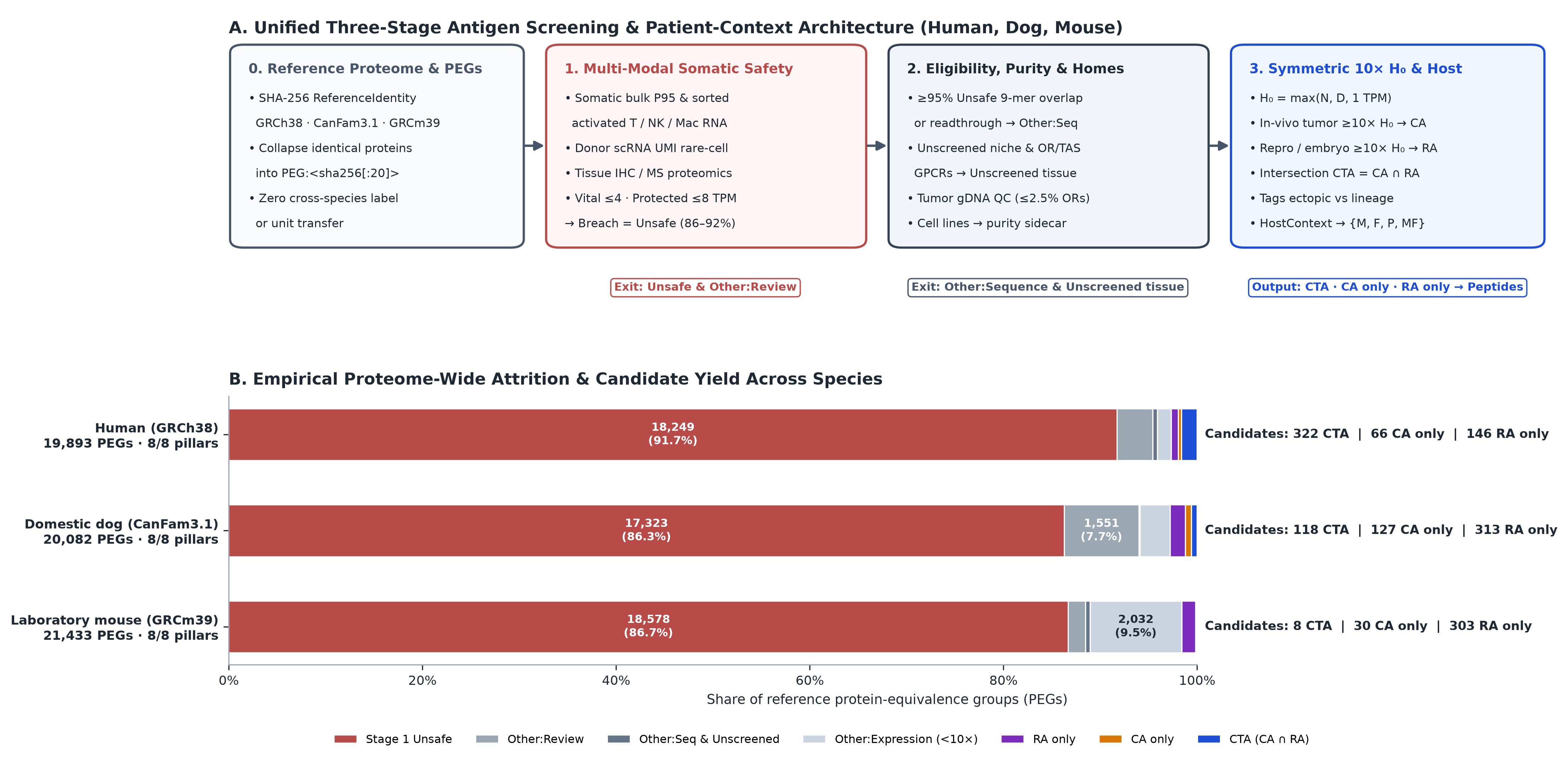
Figure 1. (A) Unified three-stage target-discovery and patient-context architecture shared across human, domestic dog, and laboratory mouse: identical-sequence protein-equivalence grouping (Stage 0), multi-modal somatic/immune safety precedence (Stage 1), sequence/niche/purity eligibility (Stage 2), and symmetric 10 × H₀ in vivo enrichment (Stage 3) followed by HostContext organ protection and PeptideIndex self-proteome subtraction. (B) Empirical proteome-wide attrition across all three evaluated mammalian proteomes (8/8 screening pillars active in every species), showing 86.3%–91.7% Stage 1 somatic Unsafe exclusion and 1.6%–2.8% candidate retention (CA ∪ RA).
Categories
Every protein-equivalence group (PEG) in the coding proteome lands in one of five mutually exclusive categories:
- Unsafe (18,249): confirmed expression in vital, protected, or high-expression manageable adult somatic tissues or sorted/activated immune populations. Normal-tissue safety always takes precedence over tumor expression.
- Other (1,110): kept out of the candidate sets without being confirmed Unsafe—either because required evidence is incomplete or ambiguous (missing normal-tissue coverage or unresolved paralog attribution in single-cell data
Other:Review, or≥95%9-mer overlap with Unsafe proteinsOther:Sequence), or because tumor and reproductive expression do not qualify (below the10×thresholdOther:Expression, or an unscreened adult somatic micro-niche / monogenic chemosensory GPCR without reproductive enrichmentOther:Unscreened tissue). - Cancer Antigens (CA) (388 total; 66
CA only): passes all safety, coverage, sequence, and home-niche screens and reaches ≥10 × H₀ in at least one QC-passing in vivo tumor sample. - Reproductive Antigens (RA) (468 total; 146
RA only): passes the shared safety and eligibility screens and reaches ≥10 × H₀ in an adult reproductive tissue sample or cell-supported early-embryo lineage. - Cancer–Testis Antigens (CTA) (322): the intersection CTA = CA ∩ RA, clearing both in vivo cancer and reproductive/developmental enrichment while remaining silent across healthy somatic organs. The candidate union CA ∪ RA contains 534 protein groups (
322CTA,66CA only,146RA only).
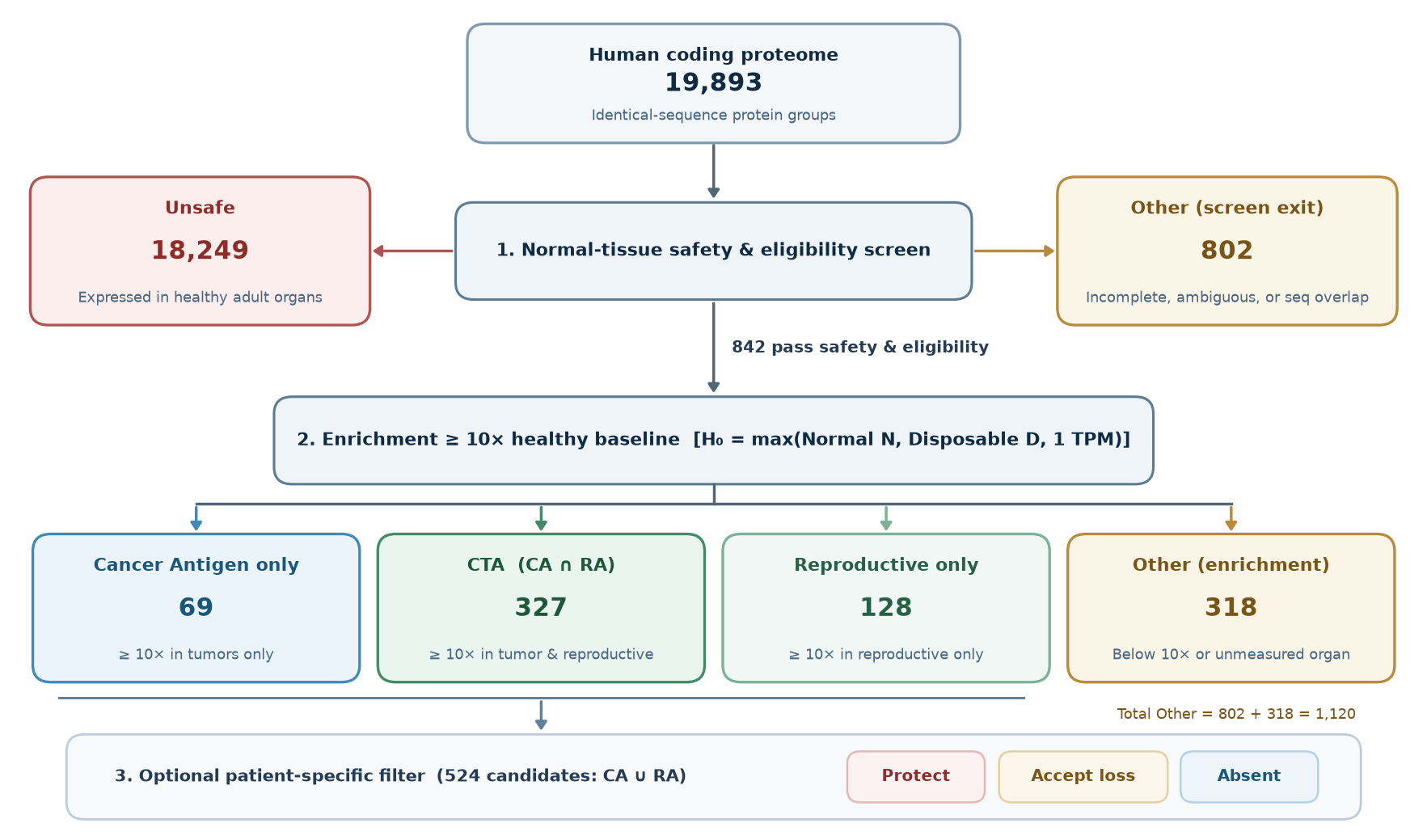
Figure 2.Conceptual set geometry of the five categories. In H₀ = max(Normal N, Disposable D, 1 TPM), N is the protein's highest native donor-P95 TPM across vital, protected, and manageable healthy adult somatic organs and sorted immune subsets, and D is its maximum across non-thymic Disposable organs (appendix, gallbladder, tonsil, cutaneous melanocytes, hair follicles). Biological membership (CA, RA, CTA) is independent of patient anatomy; patient-specific organ protection applies downstream without relabeling biological categories.
[!IMPORTANT] These classifications are expression- and sequence-screening calls, not clinical target certifications. Translation efficiency, proteasomal processing, peptide–MHC presentation, surface topology, and receptor-specific off-target cross-reactivity require direct experimental validation.
Why bulk RNA alone is insufficient
Relying on bulk tissue RNA medians or P95 summaries alone leaves fatal normal-tissue blind spots. OncoRef layers seven complementary normal-tissue modalities so each assay covers the structural blind spots of the others:
- Paired bulk RNA atlases and sorted/activated immune panels. Bulk RNA removes ubiquitously expressed housekeeping genes, but individual atlases differ in organ sampling and postmortem artifacts. Pairing deconvolved GTEx v11 donor P95s (after stoichiometric multiplex-bleed removal) with HPA v23 biopsies and brain subregions prevents single-atlas gaps from reading as silence, while sorted and stimulated leukocyte subsets (
HPA,DICE,Monacoin human;ImmGen,LPS/IL-4BMDM,IL-15/IL-2NK and Treg panels in mouse;GSE225599scRNA + activated-TIL gates in dog) catch effector transcripts diluted in whole blood. - Single-cell clusters and consortium-deduplicated rare-cell UMI atlases. Bulk RNA averages across millions of cells, diluting a transcript expressed at
50 TPMinside1%–3%of a vital cell population (such as alveolar type 2 pneumocytes, cardiac myocytes, ocular melanocytes, or cortical neurons) below1 TPM. Single-cell clusternTPM(HPA, adult corneaGSE155683) and donor-resolvedUMIatlases (CELLxGENE Census+Silettibrain;Tabula Muris;GSE225599) catch these localized risks. Requiring≥2UMIs per cell replicated across independent studies and donors avoids discarding real targets over droplet ambient soup, while intronic nuclearsnRNA-seqreadthrough (PLAC1,DUX4) is separated from genuine cytoplasmic mRNA (MAGEA12). - Normal-tissue protein staining (
IHC) and quantitative proteomics. Steady-state mRNA does not always mirror protein abundance: long-lived structural proteins persist at modest transcript levels, whereas untranslated chromatin leakage (LALBAin spermatids;PRAMEin adrenal fibroblasts) produces4–12 TPMRNA with zero detectable protein. Reliable positive HPA immunohistochemistry (or>25–50 ppmcanine tissue TMT proteomics / murineGXDTS28staining) independently marks a proteinUnsafe, whereas routine negative human IHC provides calibrated headroom (2×Approved,4×Supported,8×Enhanced) above low bulk RNA. - Specialized adult home-tissue panels and monogenic chemosensory GPCR guards. Standard multi-organ atlases omit mineralized bone, dental pulp, hair cortex, olfactory sensory neurons, and taste buds. Integrating SHA-256-pinned adult bone and olfactory panels excludes ceiling-violating proteins (
SP7193 TPMin mandible bone;GFYin94.1%of mature olfactory neurons) asUnsafe, while holding unscreened micro-niches (DSPP) and monogenic chemosensory GPCRs (OR*,TAS1R*,TAS2R*,VN1R*) out ofCA/CTA.
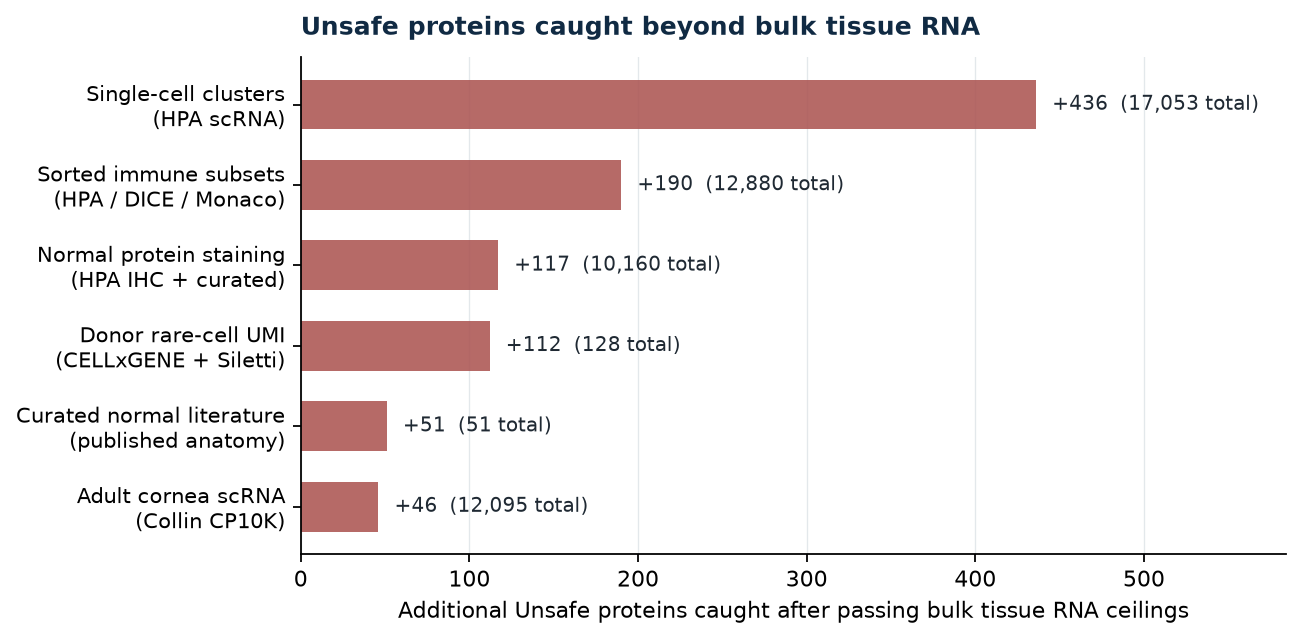
Figure 3. Unsafe proteins passing bulk tissue RNA ceilings that are caught by single-cell clusters, sorted immune subsets, normal IHC, donor-replicated rare-cell UMI counts, curated literature, or adult cornea scRNA. Bulk tissue RNA alone flags 17,507 Unsafe proteins; these six non-bulk modalities catch 742 additional Unsafe proteins (bars overlap where multiple non-bulk assays agree).
Clinical toxicity gold standard: potency-proven TCR-T and TCR-bispecific trials
Healthy-tissue bulk TPM, single-cell nTPM, immunohistochemistry, donor-resolved rare-cell UMI counts, and 1-mismatch peptide-overlap screens are mechanistic proxies—not direct measurements of human T-cell toxicity. The empirical gold standard for intracellular target safety is human clinical experience with peptide–MHC-directed T-cell receptors (TCR-T and soluble ImmTAC bispecifics) targeting endogenous self-encoded proteins in trials that achieved objective anti-tumor responses (ORR > 0%). Requiring confirmed clinical tumor regression (or fulminant in vivo target-cell cytolysis) is essential: when a trial sees 0% ORR (IMA202 against MAGEA1, 0/16 responses), the absence of healthy-organ injury cannot prove the target tissue is antigen-negative, because receptor avidity, cell dose, or engraftment may simply have been insufficient to lyse antigen-bearing cells (oncoref.tcr_trials.gold_standard, oncoref tcr-trials --table benchmark).
Across 16 curated endogenous-protein clinical TCR-T / ImmTAC benchmark entries (14 potency-proven regimens plus 2 segregated 0% ORR or unreadout controls; somatic neoantigens such as KRAS G12D and viral antigens such as HPV16 E6/E7 are excluded because they lack a germline normal-proteome counterpart), OncoRef's 1.0× gate ceiling cleanly separates clinically safe CTAs from lethal or dose-limiting specificity toxicities (download full benchmark CSV):
100%sensitivity to severe human clinical specificity toxicities (6/6flaggedUnsafe,0false-safe misses):- On-target / off-tumor healthy-organ destruction (
4/4Unsafe):CEACAM5(33%ORR →3/3dose-limiting Grade 3 pan-colitis;563×colon enterocyte ceiling),MLANA/ MART-1 (DMF5,30%ORR →70%rash/vitiligo,55%anterior ocular uveitis,50%stria vascularis sensorineural hearing loss;451×ocular melanocyteVitalceiling),PMEL/ gp100 (19%TCR-T ORR →94%rash,25%uveitis,31%hearing loss; solubletebentafuspFDA-approved with>80%rash but minimal uveitis/ototoxicity across the blood–ocular/labyrinthine barrier;889×ocular melanocyte ceiling), andTYR/ tyrosinase (TIL1383I,33%ORR → diffuse vitiligo;75×ocular melanocyte ceiling). Together,MLANA,PMEL, andTYRdirectly validate why OncoRef separatesDisposablecutaneous melanocytes fromVitalocular and inner-ear pigment cells. - Fatal paralog and structural off-target cross-reactivity (
2/2Unsafe):MAGEA3(HLA-A*02:01 / KVAELVHFL,56%ORR →2/9fatal necrotizing leukoencephalopathy) is missed inMAGEA12bulk brain RNA (0.5 nTPM,0.13×) but caught on primaryMAGEA3colonscRNA-seq(13.3×), qPCR-corroborated rare-cell brain RNA onMAGEA12(4.75%≥1-UMI,0.40%≥2-UMI),EPS8L2(46.1×), and1-mismatchpeptide overlap (KVAELVHFL ↔ KMAELVHFL).MAGEA3(HLA-A*01:01 / EVDPIGHLYaffinity-enhanceda3aTCR →2/2fatal cardiogenic shock within 4–5 days) cross-recognized cardiacTTN(ESDPIVAQY,53,894 nTPMcardiomyocytes =13,473×ceiling; primaryMAGEA3itself is alsoUnsafeat13.3×); because4of9residues differ,a3aalso marks the boundary where sequence k-mers end and experimental X-scan / iPSC-cardiomyocyte screening is required for affinity-matured receptors. 100%recall on potency-proven clinically safe CTAs (5/5retained asCTA):NY-ESO-1(58%ORR in Robbins 2015,30%–80%across MRCLS and myeloma,0.06×),MAGEA4(FDA-approvedafami-cel,37%Phase 2 ORR,0.01×),PRAME(IMA203,52.5%u/cORR [28.9%overall /54.5%Ph1b cORR] across40patients without nephrotoxicity or adrenal insufficiency,0.75×),CTAG2(LAGE-1a) (lete-cel,30%pooled /40%standard-LDR MRCLS and80%myeloma ORR without pulmonary or urothelial toxicity,0.78×), andMAGEA10(ADP-A2M10,9.1%ORR,0.30×). Notably, two of the five clinically proven safe CTAs (PRAMEandCTAG2) require OncoRef's multi-modal calibration—matched negative-IHC RNA headroom (PRAMEshifts from3.0×naive RNA to0.75×under negative IHC) and isoform-scoped vascular perfusion clearance (CTAG2ENST00000369585)—to avoid false exclusion.- Conservative gene-level precision frontier (
3tolerated non-CTA regimens flaggedUnsafe):WT1(TTCR-C4,100%post-HCT AML relapse-free survival without podocyte nephrotic syndrome;9.9×mesothelial RNA + podocyte IHCHigh),MAGEA3(HLA-DPB1*04:016F9CD4 TCR-T,24%ORR without CNS/cardiac toxicity;13.3×colonscRNA), andAFP(ADP-A2AFP,9.5%HCC ORR without autoimmune hepatitis;98×renal proximal tubulescRNA) were clinically tolerated for their specific(peptide, HLA)complexes—reflecting immunoproteasome-dependent differential processing (WT1RMFPNAPYL), MHC-II restriction, or sub-threshold parenchymal pMHC density. Gene-level screening intentionally remainsUnsafeon these proteins because epitope-specific processing escape cannot be generalized across other peptides or surface-targeted modalities. - Segregated non-potent or unreadout controls (
2entries excluded from safety calibration):MAGEA1(IMA202,0/16 = 0% ORR) andCT83/ KK-LC-1 (ongoing Phase 1NCT05035407/NCT05483491) are retained asCTA-Msolely on independent multi-assay somatic silence (0.00×and0.33×), never credited as clinically cleared.
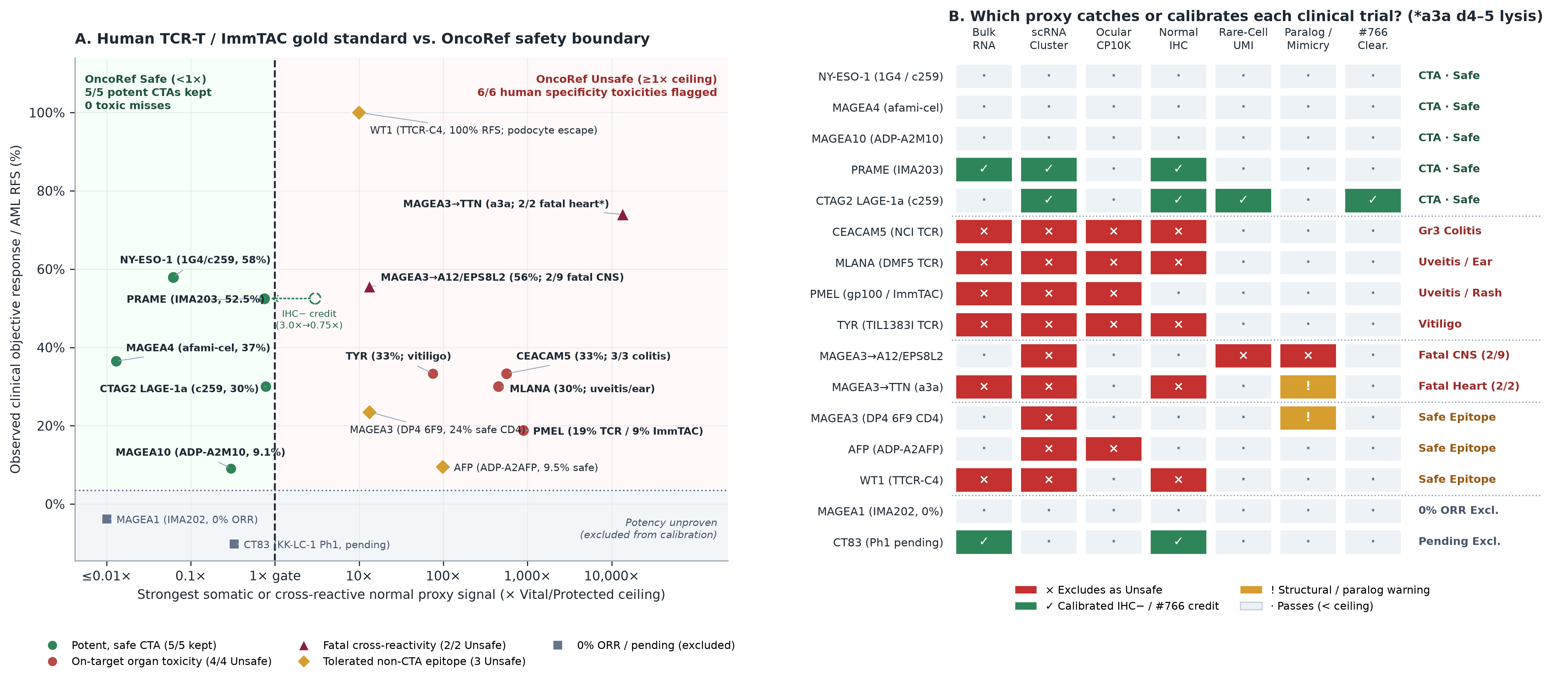
Figure 4. (A) Observed clinical objective response rate (or post-HCT AML relapse-free protection) versus strongest somatic or cross-reactive normal proxy signal (in multiples of OncoRef's Vital/Protected gate ceiling) across all 16 curated endogenous-protein TCR-T and ImmTAC regimens (1.0× vertical dashed line = OncoRef Unsafe boundary; gray band below 3.5% = 0% ORR / unreadout trials excluded from safety calibration). (B) Multi-assay proxy attribution matrix showing which screening layer catches each toxic target (×) or calibrates each clinically validated CTA (✓).
Full 16-regimen clinical TCR-T & ImmTAC gold-standard calibration table (download CSV)
Download the complete machine-readable benchmark: clinical-tcr-gold-standard.csv.
| Target (cross-hit) | Product · HLA · peptide | Potency (n, response) | Observed human clinical toxicity | OncoRef call & strongest proxy signal | Stratum |
|---|---|---|---|---|---|
| NY-ESO-1 | 1G4-a95:LY / lete-cel (c259) · HLA-A*02:01;HLA-A*02:05;HLA-A*02:06 · SLLMWITQC (Robbins et al. Clin Cancer Res 2015) |
n=38, 57.9% ORR | Conditioning cytopenias and manageable CRS; zero attributed somatic solid-organ destruction (2 GBS cases across c259 program, 1 confounded day-161 cardiac arrest in MRCLS; separate TBI-1301 TCR had 1 steroid-responsive Gr3 lung infiltrate at 33% ORR) | CTA · white matter (0.5 nTPM vs 8 ceiling; N=0.84 TPM spleen) (0.062×) |
Potent, safe CTA |
| CTAG2 | lete-cel / NY-ESO-1-LAGE-1a c259 · HLA-A*02:01;HLA-A*02:05;HLA-A*02:06 · SLLMWITQC (D'Angelo et al. JCO 2025) |
n=20, 30% ORR | Conditioning cytopenias and CRS; zero pulmonary or urothelial toxicity despite first-pass IV lung perfusion | CTA · bronchus basal cells (24.9 nTPM vs 32 Enhanced IHC- ceiling; lung AT2 4.29% rare-cell cleared for LAGE-1a) (0.778×) |
Potent, safe CTA |
| MAGEA4 | afami-cel / c1032 (TECELRA; FDA-approved) · HLA-A*02:01;HLA-A*02:02;HLA-A*02:03;HLA-A*02:06 · GVYDGREHTV (D'Angelo et al. Lancet 2024) |
n=52, 36.5% ORR | Conditioning cytopenias and CRS (71% any-grade, 2% Gr>=3); zero MAGE-A4-directed solid-organ injury (0 treatment-related deaths in SPEARHEAD-1; 1 MAGE-A4-negative marrow aplasia and 1 stroke in Phase 1) | CTA · small intestine (0.1 nTPM vs 8 ceiling; N=2.95 TPM lymph node) (0.013×) |
Potent, safe CTA |
| PRAME | anzu-cel / IMA203 (plus brenetafusp ImmTAC) · HLA-A*02:01 · SLLQHLIGL (Wermke et al. Nat Med 2025) |
n=40, 52.5% ORR | Conditioning cytopenias and mostly Gr1-2 CRS (1 reversible CRS-associated Gr4 transaminitis); zero clinical nephrotoxicity, adrenal insufficiency, or post-infusion treatment-related deaths | CTA · heart fibroblasts (12.0 nTPM vs 16 Supported IHC- ceiling; adrenal bulk N=10.93 TPM with negative IHC) (0.75×) |
Potent, safe CTA |
| MAGEA10 | ADP-A2M10 / c796 SPEAR T-cells · HLA-A*02:01;HLA-A*02:06 · GLYDGMEHL (Blumenschein et al. J Immunother Cancer 2022) |
n=11, 9.1% ORR | CRS (27%; 1 resolved Gr4 CRS with Gr2 delirium) and 1 day-98 aplastic anemia death post-second lymphodepletion; zero MAGE-A10 solid-organ toxicity | CTA · white matter (2.4 nTPM vs 8 ceiling; N=2.20 TPM) (0.3×) |
Potent, safe CTA |
| CEACAM5 | NCI murine anti-CEA(691-699) TCR-T · HLA-A*02:01 · IMIGVLVGV (Parkhurst et al. Mol Ther 2011) |
n=3, 33.3% ORR | 3/3 (100%) dose-limiting Grade 3 inflammatory pan-colitis from T-cell destruction of normal colonic mucosa (trial halted) | Unsafe · colon distal enterocytes (4503.2 nTPM vs 8 Protected ceiling; bulk 949 nTPM; IHC High) (562.9×) |
On-target organ toxicity |
| MLANA | NCI DMF5 anti-MART-1 TCR-T (plus DMF4) · HLA-A*02:01 · AAGIGILTV (Johnson et al. Blood 2009) |
n=20, 30% ORR | Severe on-target melanocyte destruction: erythematous skin rash/vitiligo (14/20, 70%), anterior ocular uveitis (11/20, 55%), and inner-ear sensorineural hearing loss/vestibular dysfunction (10/20, 50%) | Unsafe · ocular melanocytes (18.05 CP10K vs 0.04 Vital ceiling; skin 110 nTPM) (451.343×) |
On-target organ toxicity |
| PMEL | NCI murine anti-gp100(154) TCR-T & tebentafusp (KIMMTRAK) · HLA-A*02:01 · KTWGQYWQV;YLEPGPVTA (Johnson et al. Blood 2009) |
n=16, 18.8% ORR | gp100 TCR-T: skin rash/vitiligo (15/16, 94%), ocular uveitis (4/16, 25%), hearing loss (5/16, 31%); tebentafusp ImmTAC: >80% rash/pruritus (~21% Gr3) + vitiligo with minimal uveitis/ototoxicity | Unsafe · ocular melanocytes (35.56 CP10K vs 0.04 Vital ceiling; skin 112 nTPM) (889.104×) |
On-target organ toxicity |
| TYR | TIL1383I CD8-independent anti-tyrosinase TCR-T · HLA-A*02:01 · YMDGTMSQV (Moore et al. Cancer Immunol Immunother 2018) |
n=3, 33.3% ORR | Progressive diffuse on-target vitiligo (cutaneous melanocyte destruction); ocular/uveal melanocyte risk flagged | Unsafe · ocular melanocytes (3.01 CP10K vs 0.04 Vital ceiling; skin melanocyte scRNA/IHC) (75.25×) |
On-target organ toxicity |
MAGEA3 (→ MAGEA12;EPS8L2) |
NCI murine anti-MAGE-A3(112-120) TCR-T · HLA-A*02:01 · KVAELVHFL (Morgan et al. J Immunother 2013) |
n=9, 55.6% ORR | 3/9 severe neurotoxicity and 2/9 (22%) FATAL necrotizing leukoencephalopathy / coma from cross-recognition of brain MAGEA12 (1-mm KMAELVHFL) and/or EPS8L2 (2-mm SAAELVHFL) | Unsafe · MAGEA3 colon scRNA (53.1/4=13.3x); MAGEA12 rare brain RNA (4.75% >=1-UMI & 0.40% >=2-UMI qPCR-confirmed; bulk brain 0.5 nTPM); EPS8L2 46.1x (13.275×) |
Fatal cross-reactivity |
MAGEA3 (→ TTN) |
Affinity-enhanced anti-MAGE-A3 a3a TCR-T · HLA-A*01:01 · EVDPIGHLY (Linette et al. Sci Transl Med 2013) |
n=2, lethal d4–5 lysis | 2/2 (100%) FATAL cardiogenic shock and myocardial T-cell necrosis within 4-5 days via 4-mismatch mimicry of cardiac titin (TTN ESDPIVAQY) | Unsafe · MAGEA3 colon scRNA (13.3x) & off-target TTN cardiomyocytes (53893.6 nTPM vs 4 Vital ceiling) (13473.4×) |
Fatal cross-reactivity |
| MAGEA3 | NCI 6F9 patient-Treg-derived CD4+ TCR-T · HLA-DPB1*04:01 · KKLLTQHFVQENYLEY (Lu et al. JCO 2017) |
n=17, 23.5% ORR | Transient febrile CRS; zero neurotoxicity, cardiotoxicity, colitis, or treatment-related deaths | Unsafe · colon undifferentiated cells (53.1 nTPM vs 4 Vital ceiling) (13.275×) |
Tolerated non-CTA epitope |
| AFP | ADP-A2AFP SPEAR TCR-T · HLA-A*02:01 · FMNKFIYEI (Meyer & Sangro et al. J Hepatol 2025) |
n=21, 9.5% ORR | Manageable CRS and cytopenias; no primary off-tumor autoimmune hepatitis or clinical nephrotoxicity | Unsafe · kidney proximal tubular cells (393.0 nTPM vs 4 Vital ceiling; adult cornea 0.052 CP10K) (98.25×) |
Tolerated non-CTA epitope |
| WT1 | TTCR-C4 EBV-specific CD8+ TCR-T · HLA-A*02:01 · RMFPNAPYL (Chapuis et al. Nat Med 2019) |
n=12, 100% RFS (44 mo) | Zero glomerular podocyte nephrotoxicity (no proteinuria/nephrotic syndrome) and zero mesothelial serositis (pleuritis/pericarditis) | Unsafe · mesothelial cells (79.3 nTPM vs 8 Protected ceiling) + glomerular podocyte IHC High (9.912×) |
Tolerated non-CTA epitope |
| MAGEA1 | IMA202 · HLA-A*02:01 · KVLEYVIKV (Wermke et al. J Immunother Cancer 2024) |
n=16, 0% ORR | Cytopenias and Gr1-2 CRS without solid-organ toxicity; 0% ORR precludes inferring in vivo cytolytic organ safety | CTA · intermediate monocyte (0.0 nTPM vs 16 ceiling; N=0.21 TPM) (0×) |
Excluded (0% ORR / pending) |
| CT83 | NCI / Rutgers anti-KK-LC-1 TCR-T · HLA-A*01:01 · NTDNNLAVY (Marcinkowski et al. J Immunother Cancer 2019 (preclinical)) |
Phase 1 pending | Pending peer-reviewed clinical readout | CTA · salivary gland (2.6 nTPM vs 8 ceiling; N=8.60 TPM cleared by negative IHC & Marcinkowski 2019 RNAscope) (0.325×) |
Excluded (0% ORR / pending) |
Decision tree, attrition, and the 10× enrichment rule
Every protein group traverses a deterministic decision tree with strict precedence—normal-tissue safety first (Stage 1), then coverage, sequence, and home-niche eligibility (Stage 2), and finally symmetric 10× enrichment in in vivo tumors and reproductive/embryonic compartments (Stage 3)—narrowing 19,893 protein groups to 846 safety- and coverage-eligible proteins and 534 retained candidates (CA ∪ RA).
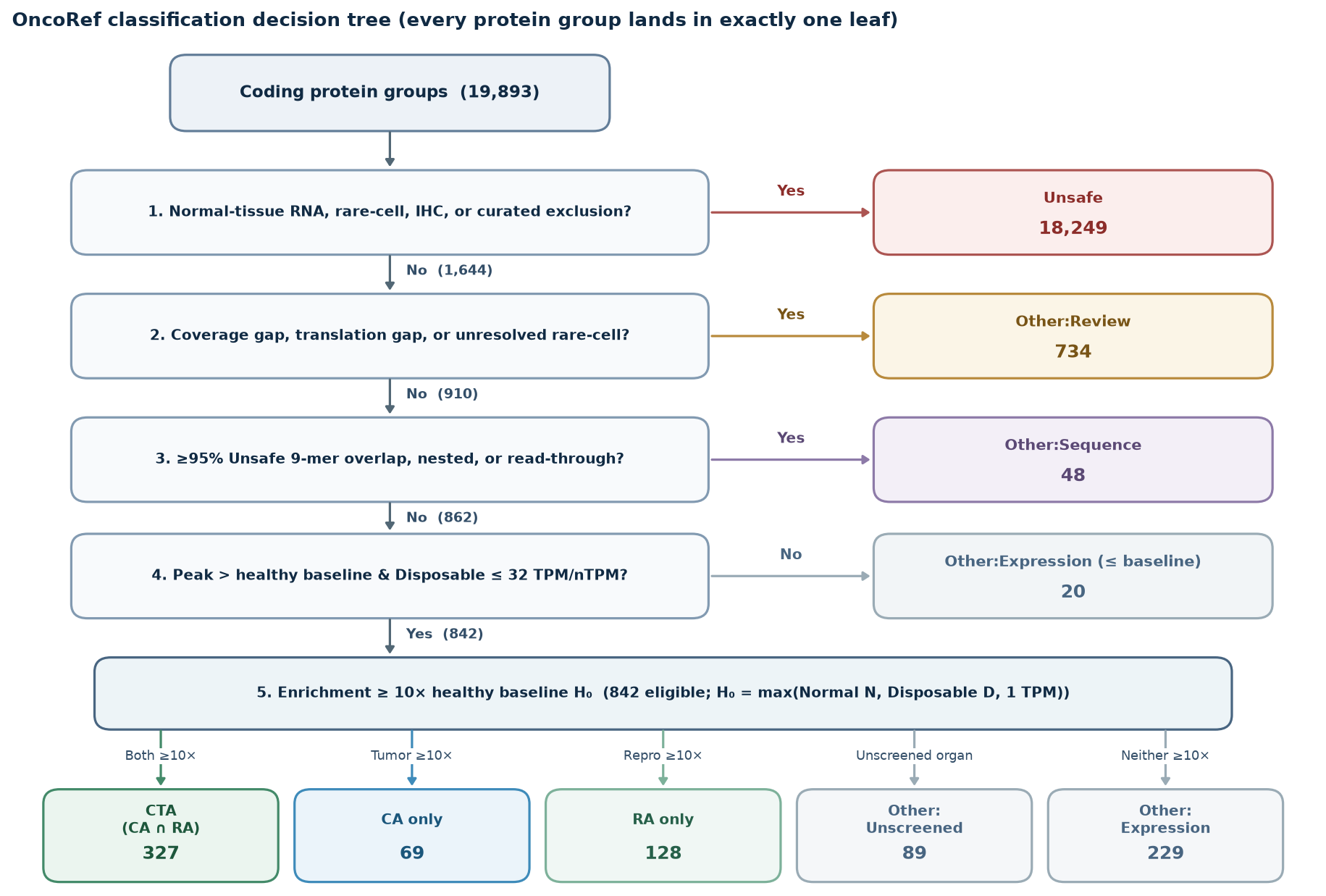
Figure 5. Exact classification decision tree showing every binary gate, precedence order, and historical baseline leaf count across the coding proteome.
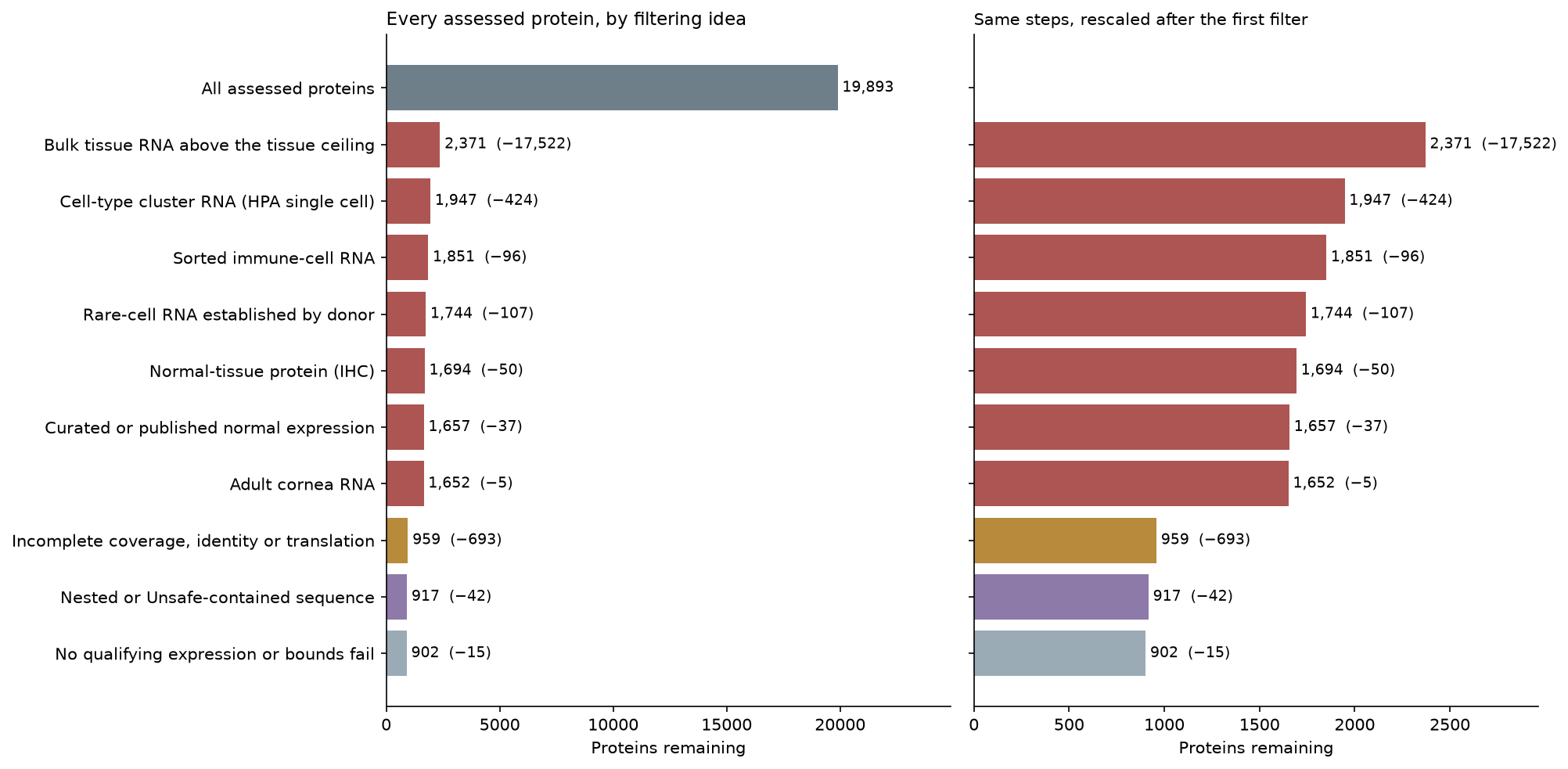
Figure 6. Sequential attrition across screening gates, assigning each excluded protein once at its first failing gate. The broken x-axis above 3,000 keeps post-bulk filters readable. Baseline step counts (CSV).
Both enrichment routes apply the identical threshold—≥10× above H₀ = max(Normal N, Disposable D, 1 TPM)—across 921 protein groups with complete healthy-panel TPM (846 shared-eligible groups plus 75 ineligible Other groups with complete bulk panels). Points above the dotted line in Other clear the fold cutoff numerically while remaining held for locus-specific single-cell attribution or unscreened anatomical sub-niches (TBATA, DSPP, CAGE1, OR8K5).
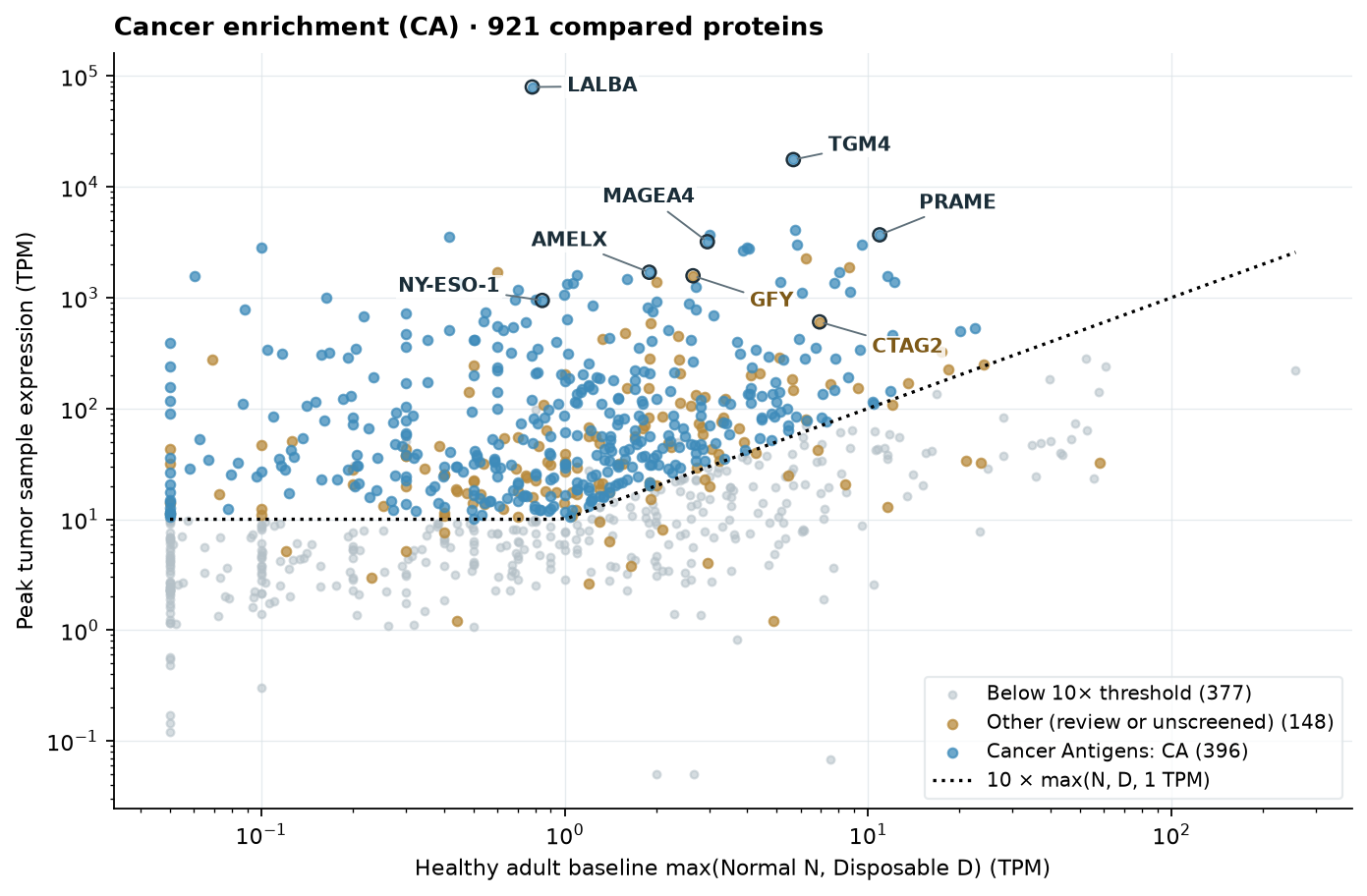
Figure 7. Cancer enrichment (CA) across compared protein groups (values below 0.05 TPM clipped to the axis floor).
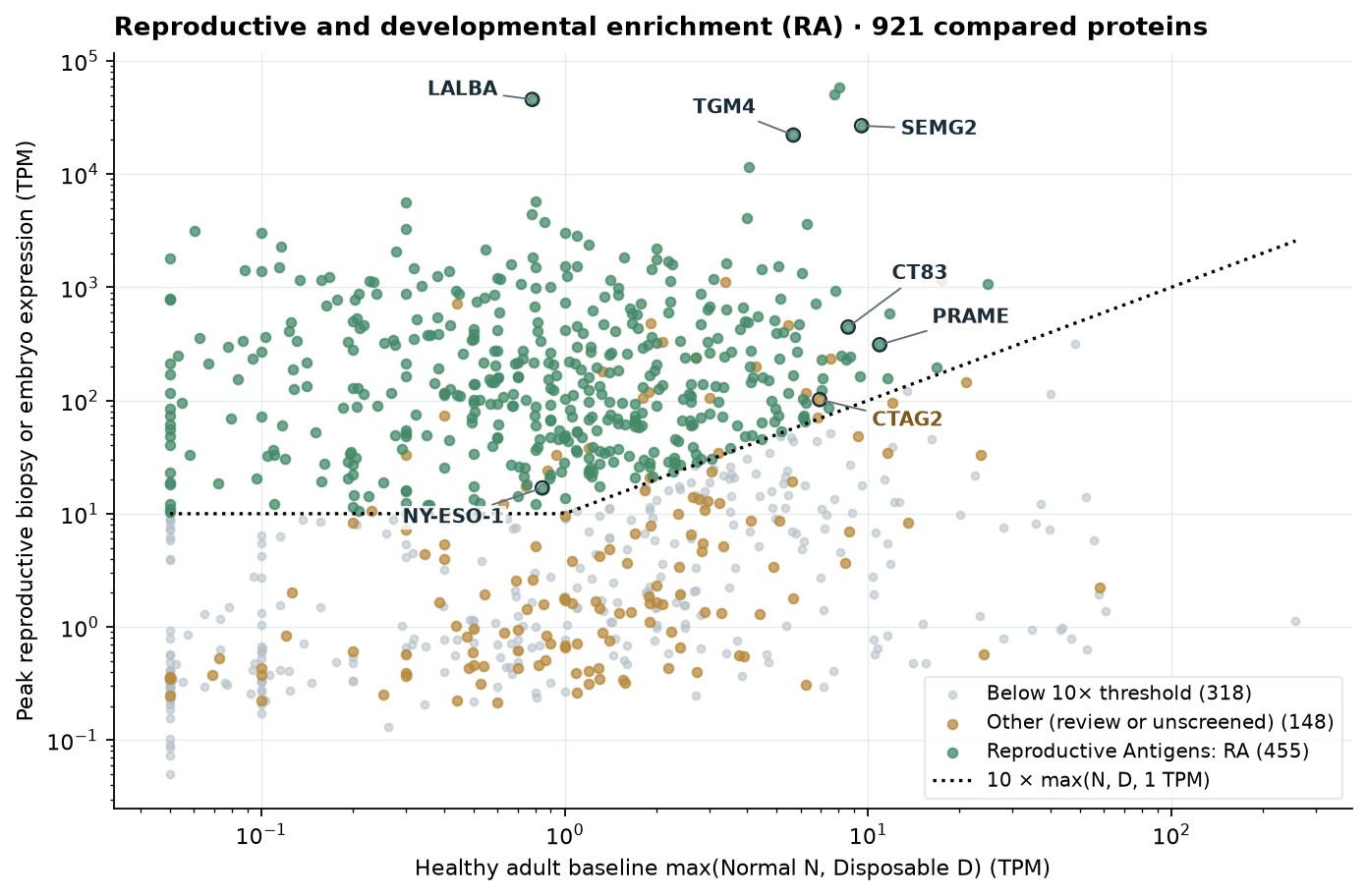
Figure 8. Reproductive and developmental enrichment (RA) against the identical healthy adult baseline (values below 0.05 TPM clipped to the axis floor).
Exclusive category and locus counts across the current oncoref.target-selection.2026-11-26.2 catalog:
| Exclusive category | Protein records | Member loci |
|---|---|---|
| CTA | 322 | 354 |
| Cancer Antigen only | 66 | 72 |
| Other:Expression | 285 | 292 |
| Other:Review | 731 | 732 |
| Other:Sequence | 48 | 50 |
| Other:Unscreened tissue | 46 | 46 |
| Reproductive Antigen only | 146 | 147 |
| Unsafe | 18,249 | 18,406 |
Ectopic derepression, cell-line TIL separation, and the chemosensory GPCR guard
Interrogating CA and CTA across all three mammalian proteomes resolves three fundamental biological questions about how tumor selectivity arises and how technical false positives enter bulk RNA-seq catalogs:
- Ectopic somatic derepression vs. homologous lineage retention (
tumor_activation_mode) — and whatCA onlyproteins actually do. When a reproductive protein reaches≥10 × H₀in a tumor of its own tissue of origin (SEMG2in prostatePRAD,CSN2in luminalBRCA,PRDM14andKHDC3Lin germ-cellTGCT,Pbsn/Sbpin murineBMPC_PRAD), the tumor is retaining lineage differentiation rather than ectopically reactivating a silent germline program. OncoRef keeps homologous-organ witnesses insideCTA—because a patient who lacks or can accept loss of prostate, resting mammary tissue, or testis can genuinely target those proteins—while recordingtumor_activation_modeacross all qualifying tumor cohorts: - Among the 322 human CTAs, 311 (
96.6%) exhibit confirmed ectopic activation outside any homologous reproductive/mammary organ (214 pure"ectopic"such asMAGEA4,CT83,DUX4,PLAC1,XAGE1A/B+ 97"ectopic_and_lineage_retained"such asNY-ESO-1,PRAME,CTAG2,LALBA,CSN2), whereas 11 (SEMG2,KHDC3L,PRDM14,CST9L,TRIM60,ACTL7A,TEX44,CIMIP4,TPD52L3,TMEM202,GOLGA6D) are pure"lineage_retained"(114/118=96.6%ectopic in dog;6/8=75.0%ectopic in mouse). - What are the 66 human Cancer Antigen only proteins (
CA \ RA)? Once monogenic chemosensory GPCRs are removed,CA onlyis not mysterious "cancer-exclusive" dark matter—it comprises five concrete somatic-silent biological classes: (a) Disposable cutaneous/follicular lineage differentiation retained in melanoma or skin/squamous tumors (PMELandMLANAanalogues areUnsafevia ocular melanocytes, whereas hair-shaftKRTAP20-3,KRTAP21-2,KRTAP21-3,KRTAP6-2and cutaneousTYRP1-free lineage genes sit inDisposableskin follicles≤32 TPM); (b) Fetal/neural-crest/neuroendocrine transcription factors & hormones expressed in mid/late fetal organs outside preimplantation/gastrulation embryos and reactivated in neuroblastoma, SCLC, medullary/neuroendocrine, or fusion sarcomas (FOXR2-like neural/oncofetal factors,CHRNA9,FGF3/4/19amplicon drivers); (c) Primate Y-linked or subtelomeric multicopy genes below10×in bulk testis due to spermatid dilution (BPY2/B/CincSCC); and (d) Lineage-restricted secretory proteins in disposable or narrow mucosal niches (66ectopic,0homologous). - Separating in vivo tumor witnesses from pure in vitro cancer cell lines exposes host
TILinfiltrate artifacts. Bulk in vivo tumor biopsies and syngeneic grafts mix malignant cells with activated host tumor-infiltrating lymphocytes (TILs), NK cells, and macrophages, whereas pure in vitro cancer cell lines lack host stroma but undergo culture-induced epigenetic drift (CLBL-1,4T1,P815). Requiring in vivo tumor≥10 × H₀forCA/CTAwhile tracking pure cell lines (12canine lines,9murine lines) incell_line_max_tpmimmediately separates cancer-cell-intrinsic CTAs (Hmga2,Tex19.1,Wfdc13,Pramel13at20–764 TPMin both in vivo tumors and pure lines) from activated hostLAK/NKcytolytic granzymes (Gzmd,Gzme,Gzmf,Gzmg), which spike to443–2,138 TPMinside in vivoMC38/CT26/B16F10grafts (expressed in endometrial/decidual uNK cells andIL-2/IL-12/IL-18-activated host NK TILs) yet measure0.05–2.26 TPMin pure culturedMC38,CT26,B16-F10,4T1, andEO771cells (Unsafeunder OncoRef's activated-NK immune gate). - Cross-species monogenic chemosensory GPCR harmonization (
0 CA / 0 CTAacross all three mammals). Mammals express400–1,500olfactory, trace-amine, taste, and vomeronasal GPCRs (OR*,TAAR*,TAS1R*,TAS2R*,VN1R*in human;COR*/OR*/TAAR*/TAS*in dog;Olfr*/Or*/Taar*/Tas*/Vmn*r*in mouse) under monogenic singular-neuron choice: each receptor is expressed at100–500 TPMinside~0.1%of mature olfactory sensory neurons or solitary chemosensory cells, which dilutes~1,000×to<0.5 TPMin whole-mucosa bulk RNA and escapes medium-depthscRNA-seqper-gene cell counts while carrying real cranial-nerve I / airway chemosensory risk and frequent tumorgDNA/pervasive-transcription noise. Harmonizing human with dog and mouse (include_chemosensory_gpcr_guard=True) marks all non-Unsafemonogenic chemosensory GPCRs without dedicated receptor-level clearance ashome_tissue_unmeasured = True—holding29humanCA onlyGPCRs (OR8K5,TAS1R2,OR7C2,OR13C9,OR2D2,OR52E2→46totalOther:Unscreened tissue) and moving3humanCTAORs (OR1N1→RA-F-only,OR4M2→RA-M-only,OR10J1→RA-M-only) out ofCTA, resulting in0unvalidated chemosensory GPCRs inCAorCTAacross human, dog, and mouse.
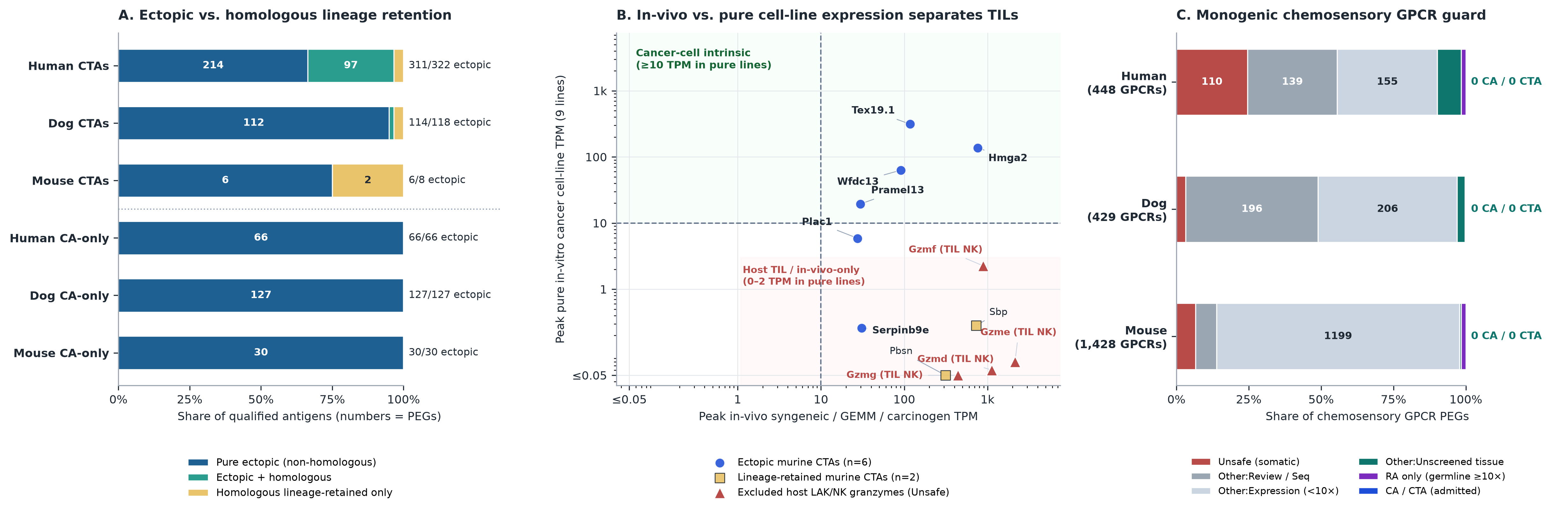
Figure 9. (A) Breakdown of CTA and CA only candidates across human, dog, and mouse by tumor_activation_mode (ectopic, ectopic_and_lineage_retained, lineage_retained), showing 75%–97% ectopic activation across CTAs in all three mammals. (B) Peak in vivo murine graft/GEMM TPM versus pure in vitro cancer cell-line TPM (9 murine lines), separating cancer-cell-intrinsic CTAs from excluded host LAK/NK TIL granzymes (Gzmd–g, red triangles). (C) Uniform disposition of monogenic chemosensory GPCRs across human, dog, and mouse, leaving 0 CA/CTA chemosensory GPCRs in every species.
Published CTA, oncofetal, and placental lists
OncoRef maps 149 curated papers across four antigen families: classical CTA / cancer–germline catalogs, oncofetal / DUX4 / early-embryo programs, placental and reproductive catalogs, and focused single-gene or tumor-vasculature studies. Literature citations are provenance metadata; a published nomination never overrides normal-tissue expression.
Retention tracks how strictly each paper screened healthy tissues. Focused modern CTA and DUX4 studies (Seager et al. 2024, Chew et al. 2019, Carter et al. 2023, Loriot et al. 2025) retain 34%–67% CTAs, whereas broad germ-cell, microarray, ZGA, and cancer–placenta lists (Bruggeman et al. 2018, Smith et al. 2023, Jamin et al. 2021, Bradley et al. 2020) are 92%–100% Unsafe under modern adult somatic screening.
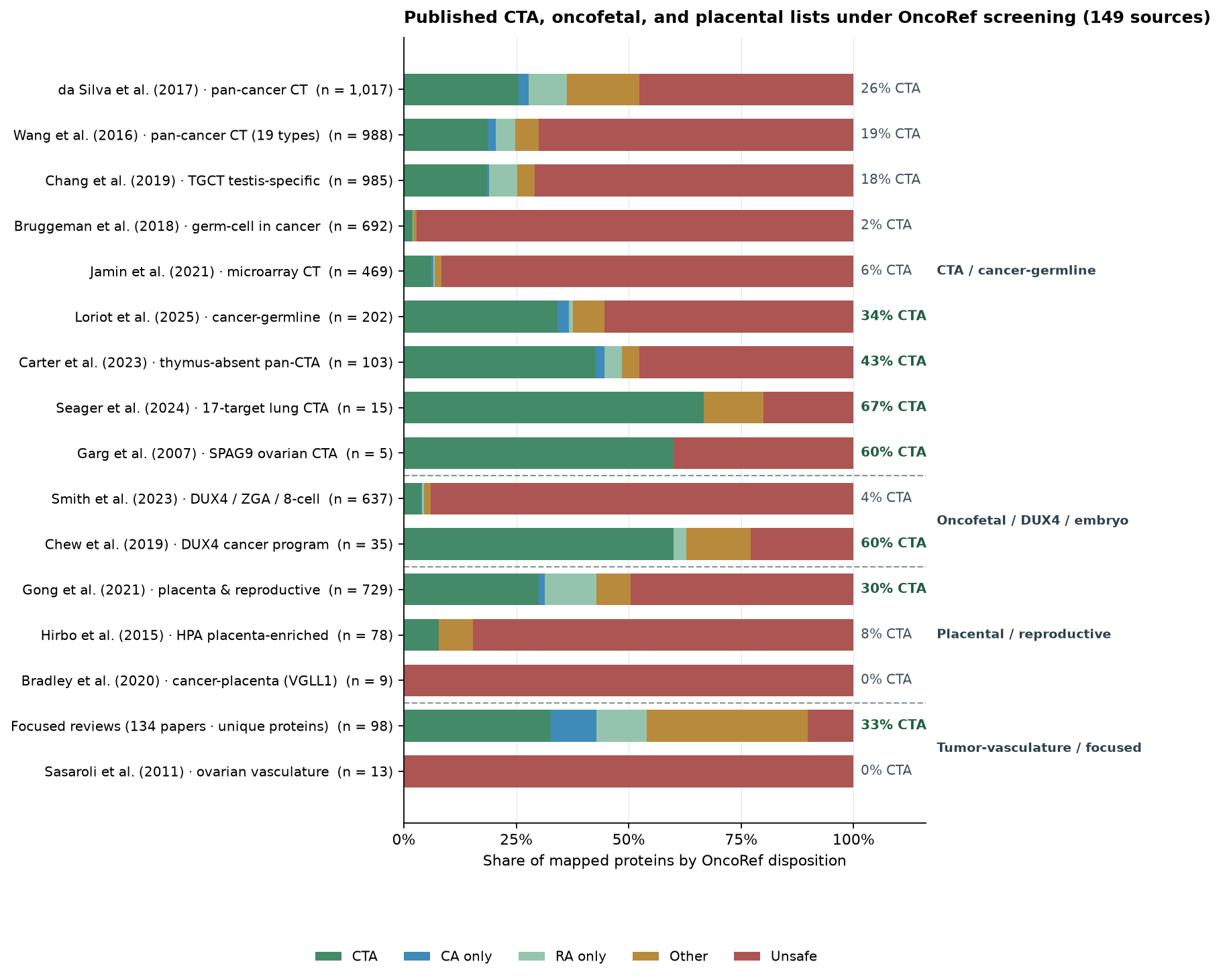
Figure 10. Share of mapped protein groups (n shown per study) retained as CTA, CA only, or RA only versus assigned to Other or Unsafe. Full 149-source table (CSV).
Of 2,233 published CTA or oncofetal nominations, 364 survive into the candidate union (CA ∪ RA)—including 245 of our 322 CTAs—while 77 CTAs are newly identified by the expression rules and 1,869 nominations fail normal-tissue, eligibility, or enrichment screens.
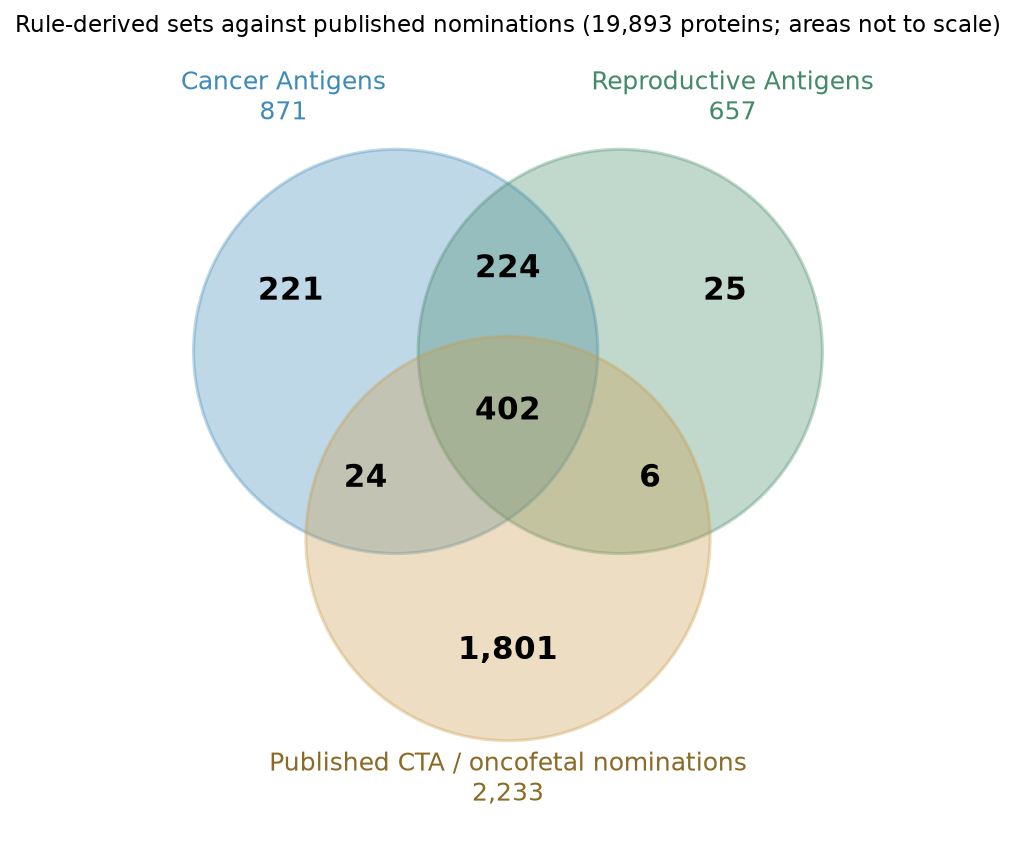
Figure 11. Overlap between rule-derived Cancer Antigens (388), Reproductive Antigens (468), and published CTA/oncofetal nominations (2,233).
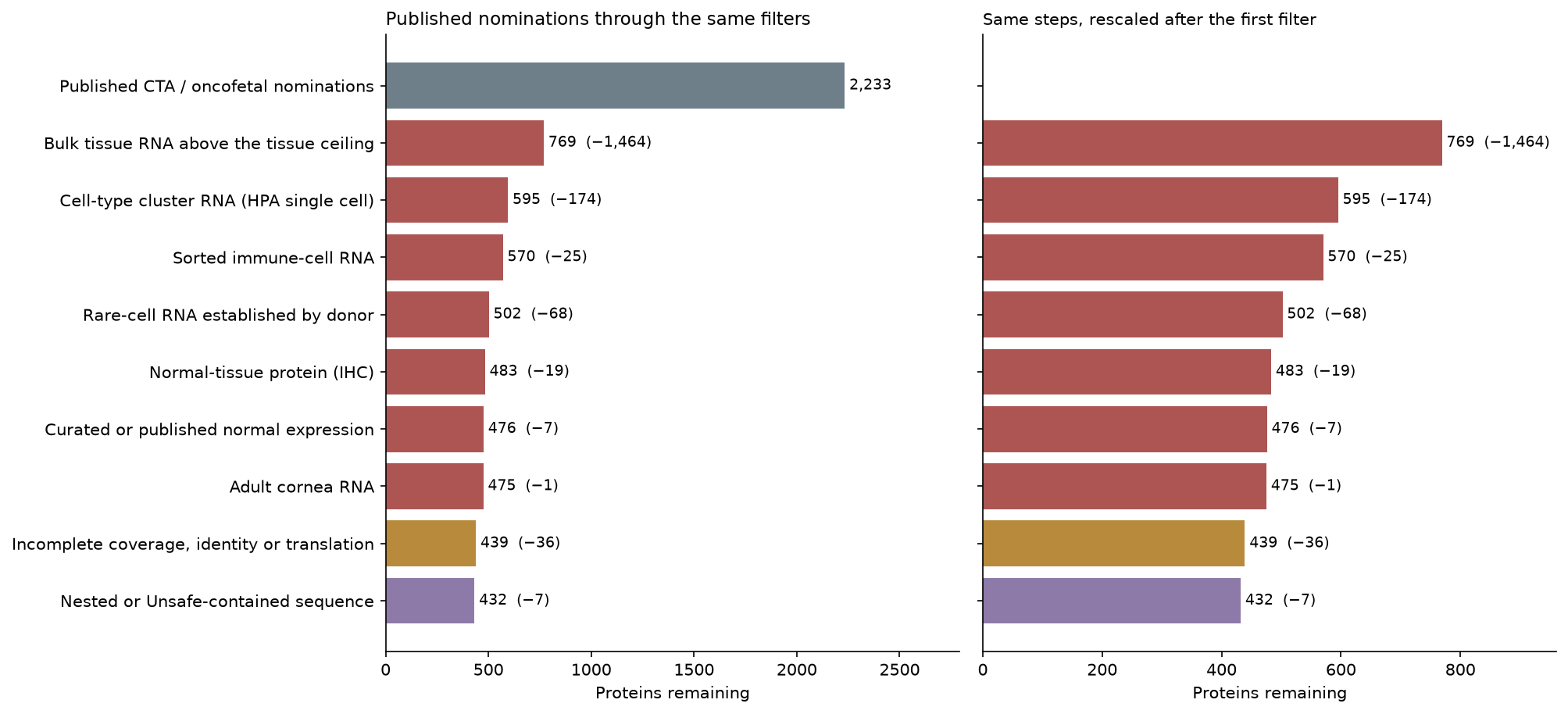
Figure 12. Sequential attrition of 2,233 published CTA/oncofetal nominations through the same gates, leaving 364 candidates. Baseline step counts (CSV).
Most-nominated individual proteins
Across 2,238 studied protein groups (2,233 with a CTA nomination paper plus 5 clinical or familiar reference entries), below are the top ten by distinct curated CTA papers plus five familiar clinical anchors (NY-ESO-1, PRAME, CT83, CTAG2, CAGE1):
| Protein | CTA papers | Catalog | N TPM · site | RA peak TPM · context | Tumor TPM · cohort |
|---|---|---|---|---|---|
| MAGEA3 | 8 | Unsafe | NR | NR | NR |
| MAGEA4 | 8 | CTA | 2.95 · lymph node | 327.97 · 4-day embryo | 3,201.68 · SCLC |
| DCAF4L2 | 7 | CTA | 0.12 · substantia nigra | 59.96 · testis | 310.77 · NEC_LUNG_LARGECELL |
| MAGEA1 | 7 | CTA | 0.21 · spleen | 31.36 · testis | 346.43 · SCLC |
| MAGEA12 | 7 | Unsafe | NR | NR | NR |
| MAGEB2 | 7 | Unsafe | NR | NR | NR |
| CT83 | 6 | CTA | 8.6 · minor salivary gland | 445.31 · testis | 193.17 · CESC |
| CTCFL | 6 | Unsafe | NR | NR | NR |
| DPPA2 | 6 | CTA | 0.94 · naive B cells | 167.76 · 7-day epiblast | 398.83 · RT |
| GAGE1 | 6 | CTA | 0.7 · retina | 165.18 · 5-day trophectoderm | 1,181.9 · SKCM |
| PRAME | 6 | CTA | 10.93 · adrenal gland | 310.91 · testis | 3,692.46 · SCLC |
| NY-ESO-1 | 5 | CTA | 0.84 · spleen | 16.88 · testis | 944.32 · SARC_SYN |
| CAGE1 | 3 | Other:Review | 0.94 · stimulated CD4 T cells | 32.98 · testis | 17.4 · T_ALL |
| CTAG2 | 3 | CTA | 6.92 · urinary bladder | 101.92 · testis | 604.33 · OV |
N and the reproductive peak may come from different assays or donors (full context table). NR ("not run") marks proteins excluded as Unsafe in Stage 1 before native-TPM comparison (MAGEA3, MAGEA12, MAGEB2, CTCFL); tumor or testis libraries may still contain those transcripts.
Studied proteins in Other or Unsafe
Of 58 protein groups in the familiar or clinical reference panels, 28 land in Other or Unsafe. Neither label predicts clinical toxicity for a specific therapeutic product; each records the strongest normal-tissue or rare-cell finding observed across the healthy adult panels:
| Studied protein | Category | Excluding or review gate | Strongest measured normal signal |
|---|---|---|---|
| MAGEA3 | Unsafe | Single-cell clusters (HPA) | colon, undifferentiated cells · 53.1 nTPM (ceiling 4) |
| MAGEA12 | Unsafe | Donor rare-cell RNA (qPCR-confirmed) | brain, pericyte · 0.40% of cells (≥2 molecules) |
| CTCFL | Unsafe | Bulk tissue RNA | white matter, bulk · 15 nTPM (ceiling 4) |
| DDX43 | Unsafe | Normal IHC + Single-cell clusters (HPA) + Sorted immune RNA + Donor rare-cell RNA | blood, NK · 21.09 TPM (ceiling 8) |
| SPA17 | Unsafe | Normal IHC + Bulk tissue RNA + Single-cell clusters (HPA) + Adult cornea scRNA + Donor rare-cell RNA | lung, ciliated cells · 345.8 nTPM (ceiling 8) |
| CLDN6 | Unsafe | Bulk tissue RNA + Single-cell clusters (HPA) | pancreas, ductal cells · 64.8 nTPM (ceiling 8) |
| DAZL | Unsafe | Confounder rejected (eye astrocyte) | eye, astrocyte · 5.86% of cells (≥2 molecules) |
| POTEC | Other:Review | Donor rare-cell RNA (replicated, paralog-ambiguous) | eye, corneal endothelial cell · 12.07% of cells (≥2 molecules) |
| CAGE1 | Other:Review | Donor rare-cell RNA (replicated, paralog-ambiguous) | brain, dopaminergic neuron · 3.29% of cells (≥2 molecules) |
Peak tumor expression and edge cases
Across the 534 candidate union, 155 protein groups reach ≥100 TPM in at least one QC-passing tumor sample, 29 reach ≥1,000 TPM, and 134 have ≥10 known independent patients crossing the 10× cutoff. Median peak tumor expression is 71.47 TPM for CTA and 44.13 TPM for CA only.
Each table below ranks the top ten protein groups in its category by peak QC-passing tumor TPM (all 534 candidates); Unsafe proteins (18,249) exit in Stage 1 before tumor comparison. Because Tumor fold divides by max(N, D, 1 TPM), fold equals Tumor TPM whenever both N and D are below 1 TPM (LALBA, SCGB1D4, VCY/1B). In Other, high tumor peaks (TBATA, DSPP, CAGE1, OR8K5) reflect unresolved single-cell or unscreened sensory/anatomical sub-niche holds rather than low expression. Peak TPM measures single-library abundance, not the fraction of malignant cells expressing the protein.
CTA
Top 10 of 322 groups by peak tumor sample TPM.
| Rank | Protein | Peak cohort | Tumor TPM | N TPM | Reproductive peak TPM | Tumor fold | Known patients at 10× |
|---|---|---|---|---|---|---|---|
| 1 | CSN2 | BRCA | 99,761.81 | 2.99 | 28,460.4 | 33,398.2 | 23 |
| 2 | LALBA | BRCA | 79,700.44 | 0.78 | 45,625.2 | 79,700.44 | 25 |
| 3 | TGM4 | PRAD | 17,629.45 | 5.67 | 22,106.5 | 3,107.11 | 94 |
| 4 | XAGE1A/B | BRCA | 4,068.64 | 5.74 | 362.73 | 709.23 | 988 |
| 5 | SPANXA1/2 | ESCA | 3,700.06 | 3 | 77.07 | 1,233.35 | 61 |
| 6 | PRAME | SCLC | 3,692.46 | 10.93 | 310.91 | 337.97 | 1,206 |
| 7 | SCGB1D4 | UCEC | 3,576.17 | 0.42 | 1,383.54 | 3,576.17 | 49 |
| 8 | MAGEA4 | SCLC | 3,201.68 | 2.95 | 327.97 | 1,083.95 | 745 |
| 9 | RLN1 | PRAD | 3,039.25 | 5.85 | 268.82 | 519.47 | 127 |
| 10 | SEMG2 | PRAD | 3,033.78 | 9.52 | 26,737.9 | 318.52 | 7 |
CA only
Top 10 of 66 groups by peak tumor sample TPM.
| Rank | Protein | Peak cohort | Tumor TPM | N TPM | Reproductive peak TPM | Tumor fold | Known patients at 10× |
|---|---|---|---|---|---|---|---|
| 1 | AMELX | RT | 1,696.17 | 1.9 | 1.53 | 892.72 | 30 |
| 2 | HOXC12 | WILMS | 1,559.28 | 11.6 | 1.35 | 134.47 | 9 |
| 3 | RPS4Y2 | B_ALL | 1,394.88 | 12.19 | 9.96 | 114.4 | 49 |
| 4 | GALP | SARC_DSRCT | 1,332.56 | 1.02 | 0.85 | 1,308.13 | 22 |
| 5 | ZACN | SCLC | 526.62 | 22.49 | 9.23 | 23.41 | 1 |
| 6 | IL36B | SARC_UPS | 498.45 | 20.17 | 7.04 | 24.71 | 1 |
| 7 | SRMS | NET_RECTAL | 463.74 | 12.05 | 27.14 | 38.47 | 0 |
| 8 | CSAG3 | LUSC | 336.48 | 4.27 | 5.79 | 78.72 | 401 |
| 9 | DBX1 | SCLC | 297.51 | 0.78 | 1.47 | 297.51 | 74 |
| 10 | HOXD12 | NBL | 279.91 | 6.2 | 8.44 | 45.12 | 15 |
RA only
Top 10 of 146 groups by peak tumor sample TPM.
| Rank | Protein | Peak cohort | Tumor TPM | N TPM | Reproductive peak TPM | Tumor fold | Known patients at 10× |
|---|---|---|---|---|---|---|---|
| 1 | STPG3 | NEC_MERKEL | 136.45 | 16.79 | 196.89 | 8.13 | 0 |
| 2 | OR1N1 | OV | 98.33 | 1 | 12.16 | 98.16 | 12 |
| 3 | PABPN1L | T_ALL | 53.93 | 11.77 | 940.84 | 4.58 | 0 |
| 4 | OR51C1 | PRAD | 50 | 2.37 | 43.5 | 21.08 | 8 |
| 5 | TMEM262 | NEC_LUNG_LARGECELL | 47.43 | 7.03 | 123.95 | 6.74 | 0 |
| 6 | TOMM20L | T_ALL | 46.57 | 6.16 | 73.76 | 7.57 | 0 |
| 7 | ZNF878 | B_ALL | 39.39 | 3.94 | 48.31 | 10 | 0 |
| 8 | RSPH6A | THCA | 37.92 | 11.62 | 157.75 | 3.26 | 0 |
| 9 | CAPZA3 | GBC | 35.6 | 4.46 | 1,435.97 | 7.99 | 0 |
| 10 | ADIG | THCA | 33.82 | 7.04 | 229.73 | 4.8 | 0 |
Other
Top 10 of 387 groups with complete baseline TPM (out of 1,110 total Other groups).
| Rank | Protein | Peak cohort | Tumor TPM | N TPM | Reproductive peak TPM | Tumor fold | Known patients at 10× |
|---|---|---|---|---|---|---|---|
| 1 | TBATA | THYM | 2,250.3 | 6.26 | 116.44 | 359.45 | 101 |
| 2 | KRT9 | PCPG | 1,865.83 | 8.65 | 7.03 | 215.65 | 16 |
| 3 | DSPP | HEPB | 1,695.58 | 0.6 | 0.17 | 1,695.58 | 1 |
| 4 | RIPPLY3 | RT | 450.15 | 2.36 | 10.02 | 190.41 | 29 |
| 5 | VCX3B | BRCA | 420.74 | 1.33 | 181.54 | 316.01 | 87 |
| 6 | PSG3 | LUAD | 326.38 | 17.41 | 1,155.62 | 18.74 | 1 |
| 7 | GSX2 | LAML_ELNint | 287.56 | 5.09 | 8.6 | 56.48 | 8 |
| 8 | RGPD3 | T_ALL | 284.71 | 1.91 | 20.78 | 149.32 | 43 |
| 9 | LCE3C | HNSC | 284.56 | 4.57 | 11.48 | 5.43 | 0 |
| 10 | OR8K5 | STAD | 277.03 | 0.59 | 0.32 | 277.03 | 3 |
Worked edge cases
CTAG2 (LAGE-1) → CTA (isoform-scoped clinical pMHC clearance). In peripheral bulk TPM, CTAG2 clears both enrichment rules: its highest peripheral reference is urinary bladder at 6.92 TPM (10× cutoff 69.25 TPM), testis reaches 101.92 TPM (14.72×), and ovarian cancer reaches 604.33 TPM across 375 known patients at 10×. In donor-resolved single-cell atlases, lung (alveolar type 2 cells) and brain (cortical glutamatergic neurons) pass the multi-study donor-replication screen while sharing 50.9% of transcript 31-mers across the closed Xq28 CTAG1A/CTAG1B/CTAG2 cluster (0.0% external Unsafe 31-mer overlap):
| Organ | Strongest population | Independent studies | Donor IDs with signal (linked where known) | Cells with ≥2 molecules in top donor | Grading |
|---|---|---|---|---|---|
| lung | pulmonary alveolar type 2 cell | 2 | 3 | 166/3,865 (4.29%) | unresolved |
| brain | L5 extratelencephalic projecting glutamatergic cortical neuron | 2 | 2 | 70/2,201 (3.18%) | unresolved |
Under oncoref.clinical_organ_clearance (clinical organ-clearance audit), adoptive lete-cel (c259, HLA-A*02:01 / SLLMWITQC) TCR-T infusions across synovial sarcoma, MRCLS, NSCLC, and myeloma cohorts without on-target pulmonary or urothelial injury clear lung and urinary bladder specifically for ENST00000369585 (LAGE-1a, 180 aa), while Xq28 31-mer attribution (0.15 TPM bulk brain) resolves the cortical nuclear signal—restoring CTAG2 to CTA. Because ENST00000247306 (LAGE-1b, 210 aa) lacks SLLMWITQC and a separate heart review recorded a confounded day-161 cardiac event (heart review), CTAG2 carries clinical_clearance_scope = "epitope" and clinical_unverified_isoforms = ["ENST00000247306"] for downstream epitope selection.
PLAC1 & DUX4 → CTA (nuclear snRNA-seq spillover + closed D4Z4 repeat equivalence). Intron-inclusive cortical snRNA-seq flags PLAC1 across a 197.7 kb non-coding 5'-UTR intron 5.2 kb downstream of somatic PABIR2 (54.1 TPM), yet cytoplasmic polyA bulk brain RNA is 0.0051 TPM, somatic IHC is 0/4, and MS immunopeptidomics is strictly CANCER_ONLY—clearing PLAC1 (152.6 TPM Wilms tumor, 187.0 TPM placenta) to CTA (CTA-M) with rare_cell_status = "nuclear_only", whereas negative-control MAGEA12 (0.30 TPM bulk brain, fatal neurotoxicity precedent) stays Unsafe (nuclear spillover audit). Symmetrically summing DUX4 with all 20 primary-assembly D4Z4 DUX4L* repeat units confirms 0.00 TPM donor P95 in GTEx Skeletal Muscle (FSHD locus) and Skin, advancing cleavage-stage DUX4 to CTA (CTA-P, repeat-family audit).
GFY (Goofy), SP7, KRTAP* & monogenic chemosensory GPCRs (adult unmeasured-home panels, 2.5% OR gDNA QC & GPCR guard). GFY (1,575.56 TPM in RT) and SP7 (590.49 TPM in SARC_OS) previously sat in Other:Unscreened tissue because olfactory epithelium and mineralized bone are absent from GTEx/HPA bulk panels. Integrating SHA-256-pinned adult human olfactory (GFY: 94.1% of mature olfactory sensory neurons, >300 TPM) and mandible bone (SP7: 193.0 TPM donor P95 vs. 4.0 TPM Vital ceiling) panels—paired with hair-bearing GTEx skin P99 ≤ 0.50 TPM / max < 4.0 TPM bounds across 1,405 leg/suprapubic biopsies, a ≤ 2.5% olfactory-receptor ≥ 5 TPM genomic-DNA ceiling across tumor libraries (92 gDNA-contaminated tumor samples excluded), and the cross-species monogenic chemosensory GPCR guard—reclassifies 5 ceiling-violating proteins (GFY, SP7, PANX3, BPIFB3, GLYATL3) to Unsafe, admits Disposable hair-shaft keratins (KRTAP20-3, KRTAP21-2, KRTAP21-3, KRTAP6-2 → CA only; KRTAP20-4 → CTA-M), holds monogenic chemosensory GPCRs (OR8K5, TAS1R2, OR7C2, OR13C9, OR2D2 → Other:Unscreened tissue; reproductive-positive OR10J1, OR1N1, OR4M2 → Reproductive Antigen only), and keeps unmeasured anatomical sub-niches (DSPP odontoblast process, CALHM3 type II taste cells) in Other:Unscreened tissue.
Tissue injury tiers, patient profiles, and sex-restricted CTAs
OncoRef separates three tissue-policy questions: anatomical role (healthy baseline vs. RA-qualifying reproductive/embryonic tissue vs. thymic), adult injury tier (clinical consequence of sustained organ or cell-type loss), and patient-specific organ protection (downstream anatomy and tolerance via --profile). A tissue can qualify RA while retaining a protective rating—adult testis qualifies RA while carrying a Protected injury tier, and breast biopsies are split into lactating versus resting mammary via a coordinated milk-program signature (LALBA, CSN1S1, CSN2, CSN3).
| Adult injury tier | Policy interpretation | Examples |
|---|---|---|
| Vital | Loss threatens life, essential repair, or major sensory/neurological function | Heart, neurons, corneal endothelium, ocular melanocytes |
| Protected | Persistent loss is consequential and clinical compensation is poorly established | Salivary gland, whole skin, adult testis, ovary |
| Manageable | Defined loss has an established precedent for clinical compensation or replacement | Thyroid, mature B cells |
| Disposable | A narrow compartment carries a specific loss allowance | Cutaneous melanocytes, hair follicles, gallbladder, adult whole thymus |
Bulk measurements inherit the organ tier; permissive cell-type exceptions require resolved cell identity, and mixed populations keep the more protective tier (organ and cell hierarchy, tissue tier policy). Adult whole thymus is rated Disposable under the organ-loss hierarchy, but because medullary thymic epithelial cells (mTECs) promiscuously express tissue-restricted antigens during central tolerance (human mTEC study), bulk thymus sits in the thymic scope and is excluded from both enrichment denominators (N and D), while independent normal-expression and protein screens still apply (thymectomy cohort).
Biological membership versus patient-specific filtering
Biological CTA, CA, and RA labels record where a protein is expressed, not what a particular patient can safely lose. Default biological sets leave reproductive tissues unprotected until you opt in. Downstream patient profiles (female-patient, male-patient, lactation, pregnancy, or custom overrides) mark each compartment as Protect, Accept loss, or Absent (rules and limits). Protecting testis narrows the 322 biological CTAs to 74 retained candidates; pregnancy leaves 0 retained (140 unresolved due to incomplete developmental coverage, 182 excluded by expression in a protected organ).
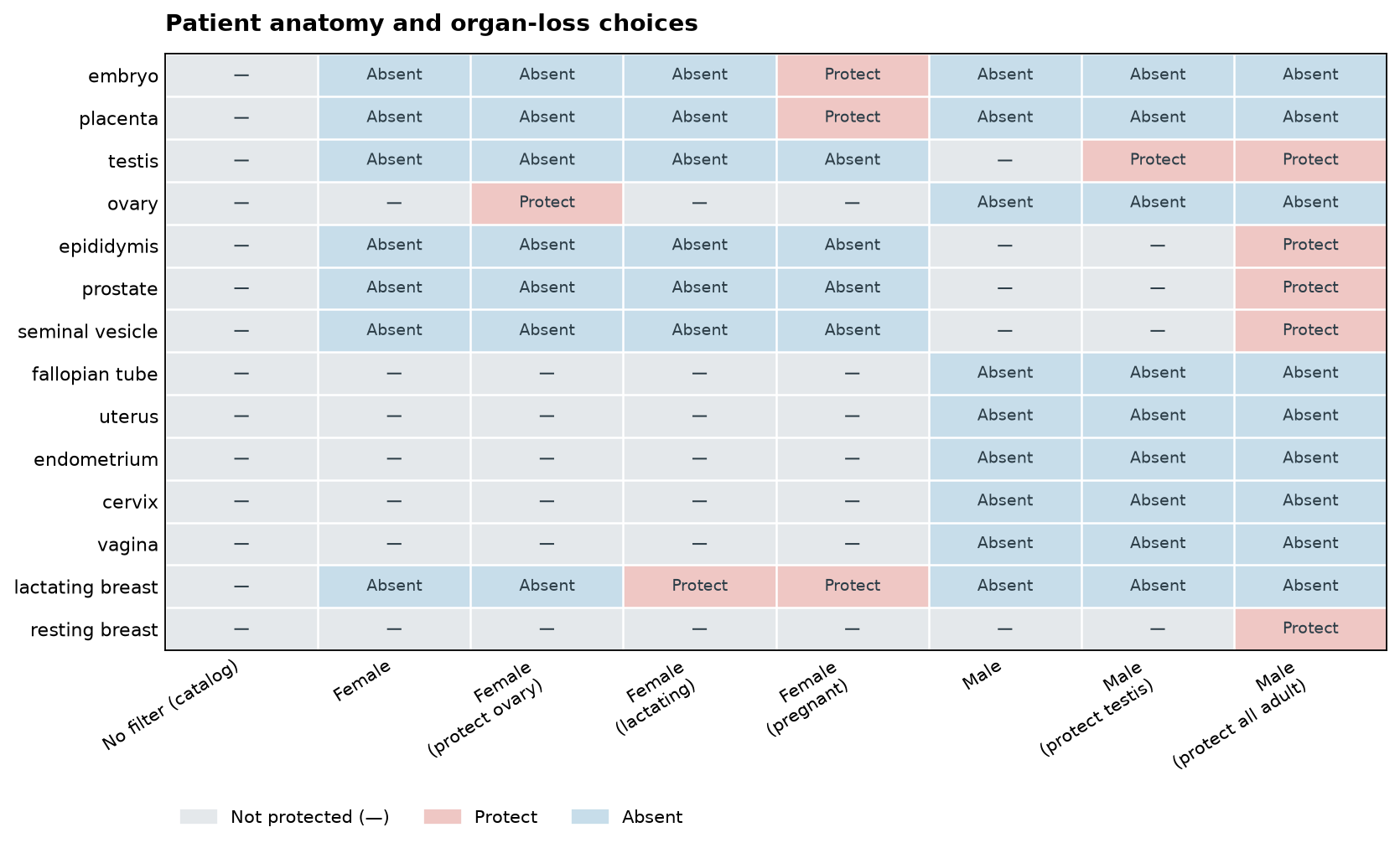
Figure 13. Compartment choices (Protect, Accept loss, Absent, or unprotected) across standard patient profiles.
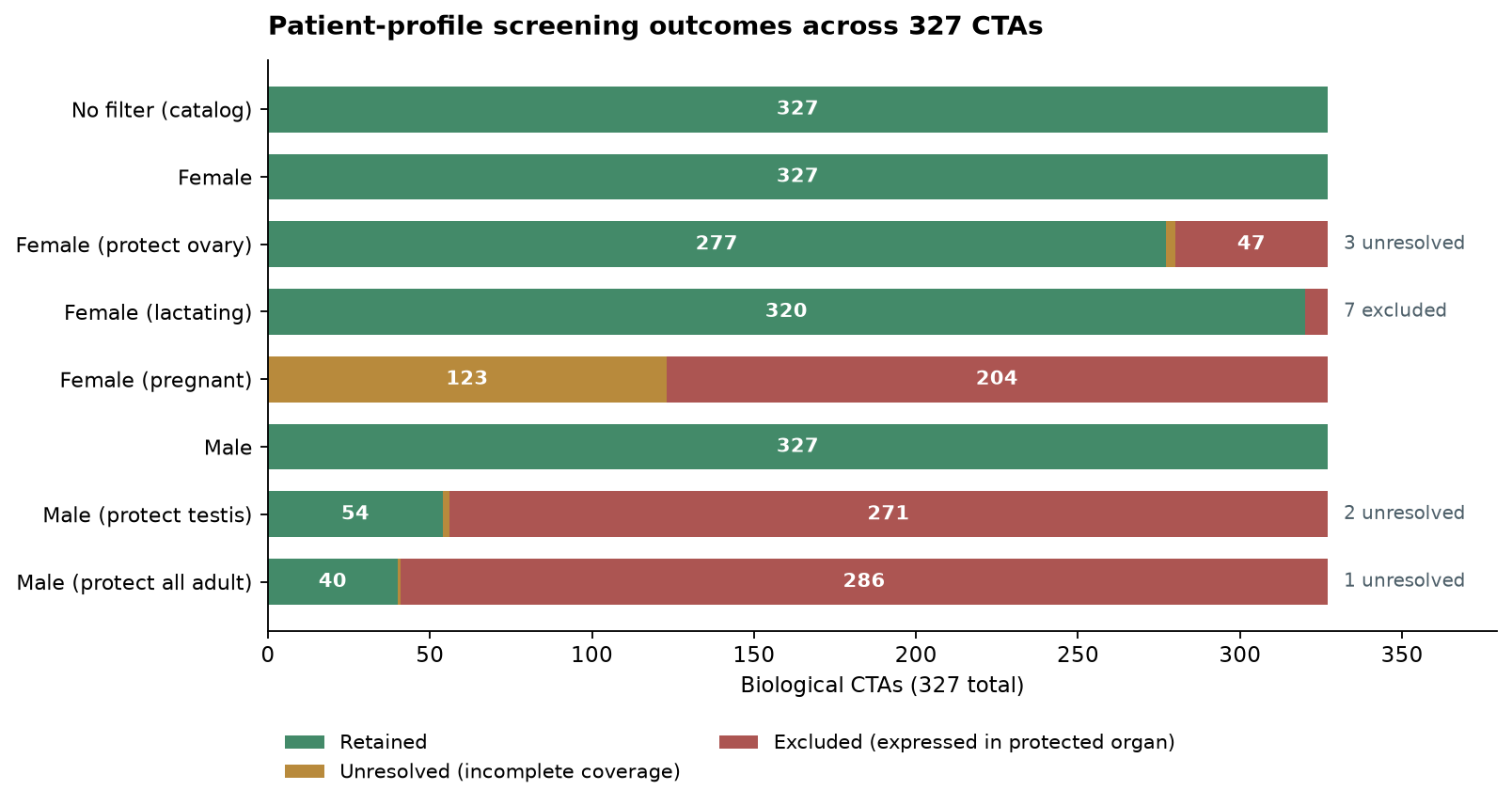
Figure 14. Downstream screening outcomes across biological CTAs under each patient profile. Filtering a candidate out for one patient narrows the target list and expands the peptide-subtraction background without relabeling its biological CTA identity.
Sex-restricted reproductive antigens and cross-sex CTAs
Because male and female reproductive organs are anatomically distinct, an antigen restricted to one sex's reproductive tract has no normal target organ in non-pregnant, non-lactating patients of the opposite sex. Crucially, HostContext (oncoref.host_context) uses the same Protected + negative-IHC calibration as Stage 1 somatic safety (8.0 TPM / 8.0 nTPM base ceiling, raised 2× to 16.0 TPM / 16.0 nTPM in human compartments where routine IHC is not_detected)—empirically anchored by the Clinical TCR Gold Standard (IMA203 on PRAME at 10.93 TPM adrenal / 12.0 nTPM heart fibroblasts with negative IHC and 0 organ toxicity at 52.5% ORR). Every Reproductive Antigen (468 RAs) and Cancer–Testis Antigen (322 CTAs) belongs to one of four mutually exclusive host-physiology classes (RA-M / CTA-M, RA-P / CTA-P, RA-F / CTA-F, RA-MF / CTA-MF, with RA-{M,P,F,MF}-only denoting RA \ CA rows):
| Sex-restriction class | All RAs (RA-*) |
CTAs (CTA-*) |
RA-only (RA-*-only) |
Adult host-protection criterion | Representative proteins |
|---|---|---|---|---|---|
| Male-restricted | RA-M (MRA): 342 |
CTA-M: 222 |
RA-M-only: 120 |
Clears all non-pregnant, non-lactating female adult organs (ovary, female tract, XX resting_breast < 8; < 16 with IHC−) |
NY-ESO-1, MAGEA4, XAGE1A/B, VCY/1B, CT83, SEMG2, PLAC1, XAGE3, DKKL1, SYCP1, KRTAP20-4 |
| Pregnancy / peripartum-only | RA-P (PRA/RA-E): 60 |
CTA-P (CTA-E): 48 |
RA-P-only: 12 |
Clears all non-pregnant, non-lactating adult reproductive and resting-mammary organs in both sexes (< 8; < 16 with IHC−) |
DUX4, ERVV-1, ERVV-2, LGALS16, BTN1A1, CER1, LEUTX, PSG7 (RA-P-only), NLRP8 (RA-P-only) |
| Female-restricted | RA-F (FRA): 18 |
CTA-F: 12 |
RA-F-only: 6 |
Clears all male adult organs (testis, epididymis, prostate, seminal vesicle, non-secretory XY resting_breast < 8; < 16 with IHC−) |
CSN2, LALBA, ZP4, DPPA3, CPSF4L, IZUMO1R, ACCSL, TBXT, KHDC3L, ZAR1L, VRTN, PRR23E, BMP15 (RA-F-only), WEE2 (RA-F-only), PABPN1L (RA-F-only) |
| Shared male & female | RA-MF (SRA): 48 |
CTA-MF: 40 |
RA-MF-only: 8 |
≥ 8 TPM/nTPM (or ≥ 16 with IHC−, or positive IHC) in adult organs of both sexes |
PRAME, SCGB1D4, CTAG2, MOS, ACTL8, NLRP4, OOSP2, SPO11, DMRTC2, PIWIL3, FOXR1, NLRP13 (RA-MF-only) |
- Male-Restricted (
RA-M,342RAs ·CTA-M,222CTAs ·RA-M-only,120— non-pregnant female-safe): expressed in male reproductive organs (testis,epididymis,prostate,seminal vesicle) and cleanly clearing every non-pregnant, non-lactating female adult reproductive and mammary organ (XAGE1A/B,SPANXA1/2,MAGEA4,NY-ESO-1,VCY/1B,PRM1,SPATA19,CT83,ODF1,ADAM2,DKKL1,SYCP1,GAGE2A,PAGE1,KRTAP20-4, plus male-accessory/prostate targets such asSEMG2,PRR23D1/2,SPAG11A,POTEH,EDDM3B). Because 336 of 514 (65.4%) GTExBreast_Mammary_Tissuebiopsies come from geneticallyXYmale cadavers and ~60% ofXXGTEx donors are postmenopausal (ages 50–79), OncoRef stratifies femaleHostContextexposures across reproductive-ageXXwomen (ages 20–49,gtex.donor_age()), integrates stage-replicated adult human folliculogenesis/oocyte RNA-seq (GSE107746,128QC-passing libraries across primordial-to-antral oocytes and primordial-to-preovulatory granulosa cells,oncoref.reproductive_age_female), and backfills GTEx-v11-missingvagina/uterusmeasurements (TSSK2→RA-M-only, leaving0human CTAs or RAs unresolved for missing female-tract coverage). - Pregnancy / Peripartum-Only (
RA-P,60RAs ·CTA-P,48CTAs ·RA-P-only,12— adult-absent across non-pregnant, non-lactating men & women): expressed inembryo,placenta, orlactating_breast(lactating_mammary) and silent (< 8TPM/nTPM;< 16withIHC−) across every adult male and non-pregnant, non-lactating adult female reproductive and resting-mammary organ (DUX4,ERVV-1,ERVV-2,LGALS16,BTN1A1,MBD3L2,SSU72L2,TRIM48,TRIM43B,CER1,LEUTX). Embryogenesis, placentation, and postpartum lactation represent a single physiological peripartum continuum absent from non-pregnant, non-lactating adult hosts; for the12CTAs (13RAs; out of16total peripartum CTAs /19RAs) active inplacentaorlactating_breastthat also express in adult testis (PLAC1,XAGE3,MAGEA4/8/10) or resting female breast (LALBA,CSN2),HostContext(pregnant=True,lactating=True) andperipartum_antigen_ids()enforce organ-level peripartum exclusions without breaking disjointness of the 4-way partition. - Female-Restricted (
RA-F,18RAs ·CTA-F,12CTAs ·RA-F-only,6— male-safe): expressed in non-pregnant adult female reproductive or resting-mammary compartments (ovary/adult oocytes, female tract,XX resting_breast, alongside lactation/embryo peaks) while cleanly clearing all male adult reproductive organs and non-secretoryXY resting_breastunder the calibratedProtected+IHC−gate (CSN2,LALBA,ZP4,DPPA3,CPSF4L,IZUMO1R,ACCSL,TBXT,KHDC3L,ZAR1L,VRTN,PRR23E). - Shared Male & Female (
RA-MF,48RAs ·CTA-MF,40CTAs ·RA-MF-only,8): exceed the calibratedHostContextceiling (≥8 TPM/nTPM,≥16withnot_detectedIHC, or positive IHC) in adult reproductive or resting-mammary organs of both sexes (PRAME,SCGB1D4,CTAG2,MOS,ACTL8,NLRP4,OOSP2,DMRTC2,CIMIP2A,CBY2,SPO11,PIWIL3,FOXR1).
The cross-sex asymmetry remains stark even after rescuing adult female oocyte expression: 270 of 322 CTAs (CTA-M + CTA-P, 83.9%) clear every adult female organ in non-pregnant, non-lactating women, whereas 60 (CTA-F + CTA-P, 18.6%) belong to the male-safe CTA-F + CTA-P sets, with CTA-M outnumbering CTA-F by 18.5 to 1 (222 vs. 12) and RA-M outnumbering RA-F by 19.0 to 1 (342 vs. 18) (download full sex-restricted table).
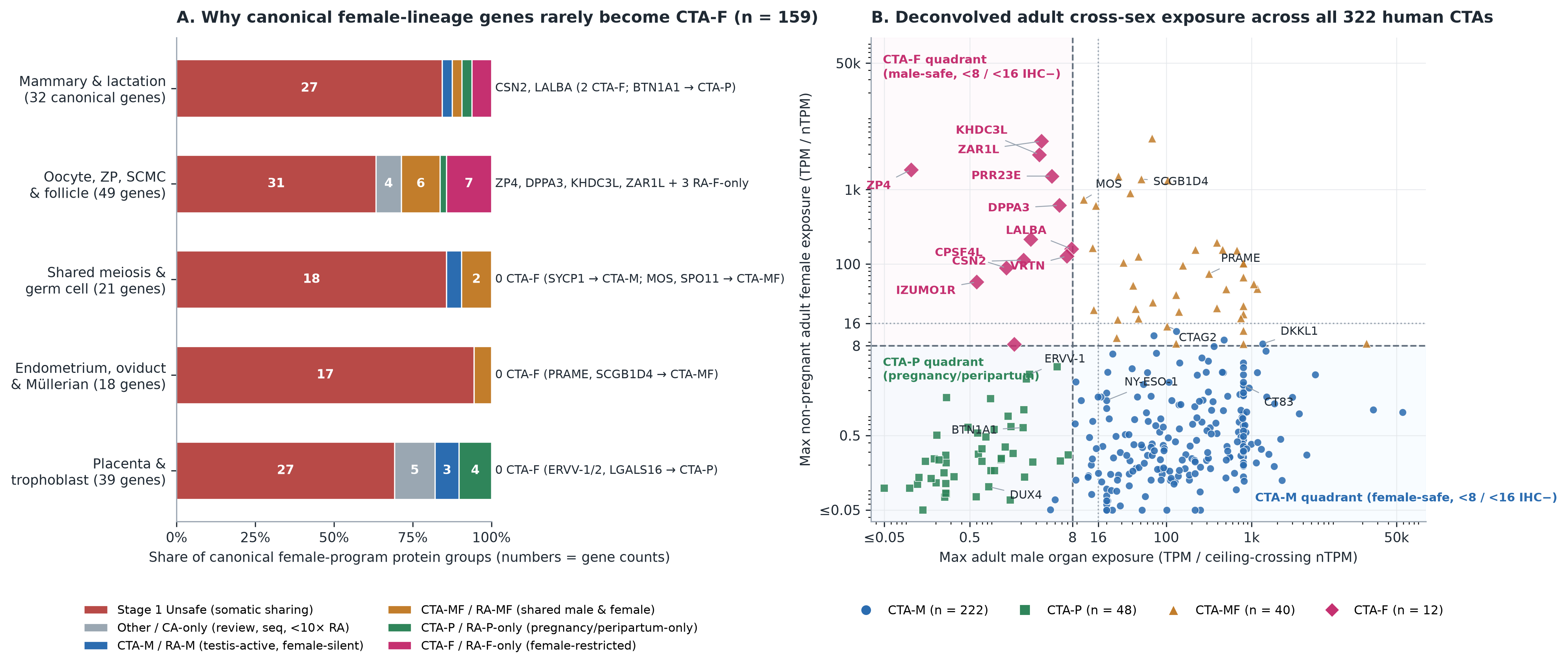
Figure 15. (A) Fate of 159 canonical mammary, oocyte/follicular, meiotic, Müllerian/endometrial, and placental protein groups across OncoRef's safety, enrichment, and sex-restriction gates (full 159-gene audit CSV). (B) Live deconvolved adult male versus non-pregnant, non-lactating adult female exposure across all 322 human CTAs (8 TPM / 8 nTPM Protected base dashed lines; 16 TPM / 16 nTPM IHC− ceiling dotted lines).
Why so few CTA-F and RA-F antigens exist—even across BRCA_TNBC, OV, UCEC, UCS, and CESC
Across the entire human coding proteome (19,893 protein groups), 10,000 protein groups reach ≥10 nTPM in at least one non-placental adult female reproductive or mammary organ (ovary, endometrium, fallopian tube, cervix, vagina, breast), yet 9,993 (99.93%) fail Stage 1 normal-tissue safety (Unsafe) (9,980 by bulk somatic RNA, 9,924 by HPA somatic scRNA-seq clusters, and 6,805 by HPA somatic immunohistochemistry), leaving just 27 protein groups in the entire genome with non-placental female consensus ≥10 nTPM and somatic consensus <4 nTPM. Auditing 159 canonical female-program genes across five biological lineages reveals four distinct quantitative mechanisms driving this attrition:
| Canonical female program | Genes | Stage 1 Unsafe | Other / CA-only | RA-M / CTA-M | RA-MF / CTA-MF | RA-P / CTA-P | RA-F (CTA-F / RA-F-only) |
|---|---|---|---|---|---|---|---|
| Mammary & lactation | 32 | 27 (84%) | 0 | 1 | 1 | 1 | 2 (LALBA (CTA-F), CSN2 (CTA-F)) |
| Oocyte, ZP, SCMC & follicle | 49 | 31 (63%) | 4 | 0 | 6 | 1 | 7 (ZP4 (CTA-F), BMP15 (RA-F-only), WEE2 (RA-F-only), PABPN1L (RA-F-only), ZAR1L (CTA-F), KHDC3L (CTA-F), DPPA3 (CTA-F)) |
| Shared meiosis & germ cell | 21 | 18 (86%) | 0 | 1 | 2 | 0 | 0 (none) |
| Endometrium, oviduct & Müllerian | 18 | 17 (94%) | 0 | 0 | 1 | 0 | 0 (none) |
| Placenta & trophoblast | 39 | 27 (69%) | 5 | 3 | 0 | 4 | 0 (none) |
- Evolutionary exocrine and ciliated mucosal homology (
Stage 1 Unsafeeliminates 63%–94% of canonical female-organ markers). Unlike seminiferous tubules—which evolved a specialized blood–testis barrier and dedicated chromatin/sperm-tail machinery—adult female reproductive and mammary epithelia share developmental origin and secretory machinery with vital or protected somatic organs: - Mammary gland as a modified cutaneous apocrine gland: Luminal breast markers massively expressed in
BRCAandBRCA_TNBCremain active in salivary serous/mucus acini, eccrine/apocrine skin glands, bronchus, and cornea—excludingPIP(GCDFP-15,141,212 TPMBRCA/15,008 TPMTNBC→16,000 nTPMsalivary gland),SCGB2A2(mammaglobin-A,112,378 TPMBRCA/56,831 TPMTNBC→690 nTPMskin),MUCL1(85,652 TPMTNBC→740 nTPMskin +630 nTPMsalivary),CSN3(κ-casein,14,566 TPMTNBC→260 nTPMsalivary mucus +66 nTPMbulk),ELF5(1,044 TPMTNBC→230 nTPMsalivary),ROPN1/ROPN1B(129–329 TPMTNBC→32–33 nTPMsalivary serous + corneal melanocytes),VTCN1/B7-H4(3,716 TPMTNBC→52 nTPMbronchial club +17 nTPMkidney), andANKRD30A/NY-BR-1(273 TPMBRCA/80.8 TPMTNBC→4.9 nTPMcortical excitatory neurons). - Müllerian tract (
endometrium,fallopian tube,endocervix) as intermediate mesoderm and ciliated mucosa: Gynecologic lineage markers highly expressed inOV,UCEC,UCS, andCESCshare intermediate-mesoderm identity with renal tubules (PAX8:2,535 TPMOV,681 TPMUCEC→350 TPMkidney), secretory transport with choroid plexus, alveolar type 2 cells, bronchial club cells, and pancreatic ducts (FOLR1:4,869 TPMOV,1,598 TPMUCEC→2,900 nTPMchoroid plexus +800 nTPMrenal proximal tubule;SLC34A2/NaPi2b:2,966 TPMOV,927 TPMUCEC→2,200 nTPMlung AT2;WFDC2/HE4:41,779 TPMUCEC,20,031 TPMOV→18,000 nTPMbronchus;MUC16/CA-125&MSLN→ corneal epithelium + bronchus;PAEP/glycodelin &CLDN6→19–65 nTPMpancreatic ducts;OVGP1:3,501 TPMUCEC→65 TPMnaive CD4 T cells +20 TPMcerebellum), while oviduct-enriched structural genes (CFAP141,ANKRD66,DNAAF6) are motile-cilia axonemal subunits shared with respiratory bronchial ciliated cells and ependyma. -
Placental hormones and syncytial retroelements: Trophoblast hormones reactivated in
CESC,UCS,UCEC, and basalBRCAare shared with or paralogous to pituitary gonadotrophs/somatotrophs and endocrine pancreas (CGA:8,938 TPMBRCA_Basal,3,118 TPMCESC→4,300 nTPMpituitary;CGB3/5/8:318 TPMCESC,182 TPMUCS→28 nTPMpancreas +13 nTPMpituitary;GH2→100 nTPMpituitary;ERVW-1/syncytin-1:227 TPMUCEC→24 nTPMbrain white matter;HLA-G:718 TPMBRCA→320 TPMmemory Tregs;ALPP→72 nTPMlung AT1). -
Adult testis pachytene transcriptional scanning captures shared germline, endometrial, and placental antigens into
CTA-MFandCTA-M. Human pachytene spermatocytes and round spermatids open chromatin genome-wide and transcribe>80%of protein-coding loci, whereas adult oocytes arrest in dictyate prophase I without analogous scanning: - Endometrial/ovarian tumor antigens active in both tracts (
CTA-MF): The strongest safe antigens inUCEC,UCS, andOV—includingSCGB1D4(3,576 TPMUCEC,1,384 TPMfallopian tube,383 TPMuterus →51.2 TPMepididymis+20.2 nTPMtestis),PRAME(505 TPMUCEC,470 TPMUCS,59.3 TPMovary→310.9 TPMtestis), andCTAG2(604 TPMOV,77.0 TPMvagina,35.7 TPMovary→101.9 TPMtestis)—strongly exceed the calibrated ceiling in both sexes (CTA-MF). - Oocyte/SCMC and meiotic factors co-expressed in spermatogenesis (
CTA-MF): Even when postmenopausal bulkovarylooks low, HPA ovarian oocytescRNA-seqand adulttestisconfirm substantial dual-sex germline expression acrossFOXR1(660 nTPMoocytes,23.9 TPMtestis),OOSP2(540 nTPMoocytes,103.9 TPMtestis),ACTL8(401 nTPMoocytes,38.5 TPMtestis),NLRP4(32.5 TPMUCEC,56.6 nTPMoocytes,18.5 TPMtestis),PIWIL3(30.9 nTPMoocytes,40.8 TPMtestis),DMRTB1,ADAD1, andMPC1L(CTA-MF), whereas oocyte/maternal factors with only low IHC-negative testis background (DPPA3at5.6 TPM,VRTNat6.9 TPM,PRR23Eat4.6 TPMtestis) cleanly classify asCTA-F, andSYCP1/DKKL1/GAGE2A/PAGE1(<16IHC-negative female background) classify asCTA-M. -
Placental
CT-Xantigens silent in non-pregnant women (CTA-M&CTA-P): Trophoblast-expressed X-linked CTAs frequently derepressed inBRCA_TNBC,UCEC,UCS,OV, andCESC—such asXAGE3(234 TPMTNBC,206 TPMUCEC),PLAC1(88.5 TPMBRCA,52.5 TPMUCS,47.8 TPMOV),CT83(193 TPMCESC,90.4 TPMTNBC), andMAGEA10(78.6 TPMCESC,53.6 TPMTNBC)—are silent across non-pregnant adult female organs (<2–3.3 TPM) while expressed at4.1–445 TPMin adulttestis, making them female-safeCTA-Mtargets forTNBCand gynecologic cancers! -
Postmenopausal bulk ovary dilution rescued by reproductive-age GTEx (
20–49) and adult human oocyte profiling (GSE107746) — yet autosomal oocyte genes stay epigenetically silent in most epithelial female tumors (RA-F-only/CTA-F). GTEx (n = 192, ~60% postmenopausal ages50–79) and HPA bulkovarysample follicularly depleted ovarian cortex where oocytes represent<0.01%of tissue mass, diluting pure oocyte mRNAs100–1,000×(BMP15 = 1.36 TPM,WEE2 = 1.44 TPM,PABPN1L = 1.54 TPM,ZAR1L = 1.24 TPM,KHDC3L = 3.85 TPM). Stratifying GTEx female organs to reproductive-ageXXwomen (ages 20–49) and integrating stage-replicated adult human folliculogenesis RNA-seq (GSE107746,128QC-passing libraries across primordial, primary, secondary, and antral oocytes and primordial-to-preovulatory granulosa cells) directly quantifies adult female germ-cell expression—promotingCPSF4L(265.7 TPMadult oocytes, male≤3.69 TPM) fromCA only → CTA-FandMOS(734.1 TPMadult antral oocytes +10.8 nTPMspermatocytes/spermatids) fromCA only → CTA-MF, reclassifyingIZUMO1R(JUNO,33.6 TPMadult oocytes),ACCSL(28.7 TPM), andTBXT(T,8.4 TPMprimordial oocytes) intoCTA-F(12totalCTA-Fs), movingBMP15(369.5 TPMadult oocytes),OR1N1(13.5 TPM, held fromCAby the chemosensory GPCR guard), andOR52D1(11.2 TPM) intoRA-F-only, and unmasking adult oocyte transcription across dual-sex meiotic/germline CTAs (DMRTC2,CIMIP2A,CBY2,EBLN1,LYPD4,DCAF4L2,MAGEC1,FTHL17,MAGEB16,CCDC42,ANKRD60,SPO11,TGM4→CTA-MF). Even with adult oocyte expression fully resolved, autosomal maternal-effect genes require oocyte-specific transcription factors (FIGLA,NOBOX,LHX8) rather than passive DNA hypomethylation and stay<4–11 TPMacross epithelialOV,UCEC,UCS, andCESC(PABPN1L,WEE2,BMP15,TCL1B,OR52D1,OR1N1→RA-F-only). -
Single-assay somatic gates on remaining canonical oocyte factors. The remaining textbook oocyte/zona genes fail specific somatic screens:
ZP1(18 TPMpituitary),ZP2(100.5 TPMTNBC→59 TPMcerebellum + IHC),ZP3(143.8 TPMUCEC→150 nTPMbronchial basal cells),NLRP5/MATER(50.8 TPMBRCA→22 nTPMparathyroid),OOEP(49.7%alveolar type 2 rare-cell UMI),FIGLAandPADI6(14 TPMinDICEM2 macrophages / NK cells vs.8 TPMimmune ceiling, and<10 TPMin all female tumors), andTUBB8(10.3 TPMUCEC,121.8 TPMDSRCT→Other:Reviewdue to β-tubulin paralog cross-mapping in corticalsnRNA-seq).
All 18 human RA-F antigens (12 CTA-F and 6 RA-F-only):
| Protein | Subset | Somatic N (TPM) | Qualifying RA peak (TPM) · compartments | Male repro max (testis scRNA) | XY resting breast (TPM) | Pan-cancer tumor peak |
|---|---|---|---|---|---|---|
CSN2 |
CTA-F |
2.99 | 28,460.4 · lactating_breast | 1.22 TPM (2.2 nTPM) | 2.14 | 99,761.81 · BRCA |
LALBA |
CTA-F |
0.78 | 45,625.2 · lactating_breast / resting_breast | 7.76 TPM (4.3 nTPM) | 2.34 | 79,700.44 · BRCA |
DPPA3 |
CTA-F |
4 | 4,090.46 · embryo | 5.62 TPM (3.4 nTPM) | 0.08 | 2,816.91 · TGCT |
TBXT |
CTA-F |
8.73 | 245.09 · embryo | 1.67 TPM (1 nTPM) | 0.87 | 1,125.51 · SARC_CHOR |
KHDC3L |
CTA-F |
6.06 | 2,953.83 · embryo / ovary | 3.26 TPM (1 nTPM) | 0.62 | 1,115.44 · TGCT |
IZUMO1R |
CTA-F |
1.75 | 57.43 · embryo / ovary | 0.6 TPM (0 nTPM) | 0.2 | 87.02 · MENINGIOMA |
ZP4 |
CTA-F |
0.1 | 1,855.54 · embryo / ovary | 0.1 TPM (0.5 nTPM) | 0.04 | 74.44 · LUSC |
VRTN |
CTA-F |
1.21 | 127.95 · embryo / ovary | 6.87 TPM (4.6 nTPM) | 0.12 | 64.15 · TGCT |
PRR23E |
CTA-F |
0.73 | 1,518.22 · embryo / ovary | 4.59 TPM (2.2 nTPM) | 0.31 | 52.63 · B_ALL |
CPSF4L |
CTA-F |
2.2 | 88.55 · ovary | 1.35 TPM (0.5 nTPM) | 0.79 | 28.67 · BLCA |
ACCSL |
CTA-F |
0.7 | 160.22 · embryo / ovary | 2.59 TPM (3.1 nTPM) | 0.35 | 21.43 · SARC_PEC |
ZAR1L |
CTA-F |
1.05 | 4,469.27 · embryo / ovary | 3.46 TPM (2.8 nTPM) | 0.17 | 12.08 · T_ALL |
OR1N1 |
RA-F-only |
1 | 12.16 · embryo / ovary | 0.98 TPM (0.5 nTPM) | 0.46 | 98.33 · OV |
PABPN1L |
RA-F-only |
11.77 | 940.84 · embryo / ovary | 3.88 TPM (0.3 nTPM) | 0.85 | 53.93 · T_ALL |
WEE2 |
RA-F-only |
1.67 | 590.55 · embryo / ovary | 0.79 TPM (1.6 nTPM) | 0.6 | 10.7 · STAD |
OR52D1 |
RA-F-only |
1 | 13.6 · ovary | 7.16 TPM (0 nTPM) | 0.25 | 9.01 · B_ALL |
BMP15 |
RA-F-only |
0.25 | 322.12 · embryo / ovary | 1.5 TPM (2.6 nTPM) | 0.13 | 1.77 · MESO |
TLE7 |
RA-F-only |
0.07 | 18.45 · embryo | 3.89 TPM (5.2 nTPM) | 0.1 | 1.34 · B_ALL |
Case study: why both CSN2 (β-casein) and LALBA (α-lactalbumin) are CTA-F (and BTN1A1 is CTA-P)
Milk-droplet proteins are the canonical expectation for female-specific breast cancer targets (LALBA reaches 79,700 TPM in BRCA, 2,877 TPM in BRCA_TNBC, and 45,625 TPM in lactating breast and is an active clinical TNBC vaccine target, e.g. NCT04674306; CSN2 reaches 99,762 TPM in BRCA and 988 TPM in BRCA_TNBC; BTN1A1 reaches 427.5 TPM in BRCA/BRCA_TNBC). Interrogating all 514 deconvolved GTEx Breast_Mammary_Tissue biopsies (178 XX female, 336 XY male) alongside 424 GTEx/HPA Testis and 282 Prostate libraries—and calibrating HostContext to OncoRef's Protected (8 TPM / 8 nTPM) + negative-IHC (2× = 16) gate—explains why CSN2 and LALBA both classify as CTA-F, whereas BTN1A1 classifies as CTA-P:
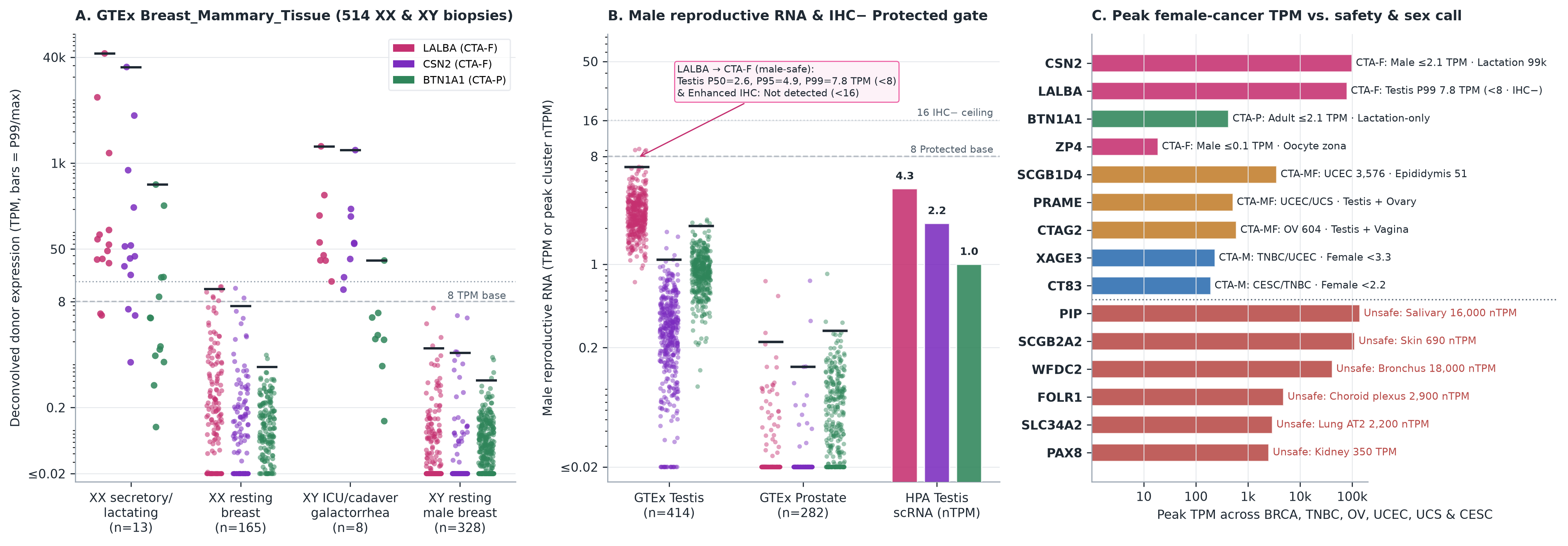
Figure 16. (A) Donor-level LALBA, CSN2, and BTN1A1 expression across 514 GTEx Breast_Mammary_Tissue biopsies split by genetic sex (XX vs. XY) and coordinated 4-gene milk-secretory state, isolating 8/336 (2.4%) XY cadaver galactorrhea donors (XIST ≤ 0.09 TPM, RPS4Y1 = 178–280 TPM) from 328 non-secretory resting male breasts. (B) Adult male reproductive-organ distributions (414 GTEx Testis, 282 GTEx Prostate, and HPA testis germ-cell scRNA-seq), showing complete male silence of CSN2 and BTN1A1 and why LALBA's 4.87 TPM P95 / 7.76 TPM P99 spermatid transcription with negative Enhanced testis IHC clears the calibrated 8 TPM Protected / 16 TPM IHC− gate (LALBA → CTA-F). (C) Peak tumor TPM across BRCA, BRCA_TNBC, OV, UCEC, UCS, and CESC for retained candidates versus excluded somatic-sharing clinical markers.
- Isolating ectopic male galactorrhea in
XYGTExBreast_Mammary_Tissueclears resting male breast (≤2.34 TPM) across all three milk proteins. Across all336genetically confirmedXYmale breast donors (XIST = 0.00–0.09 TPM,RPS4Y1 = 178–280 TPM,DDX3Y = 54–107 TPM—ruling out sample swaps or female splash), 97.6% (328/336) have near-zero milk-gene RNA (XYrestingP50 = 0.00 TPM;P95 = 0.10 TPMforCSN2and0.38 TPMforLALBA; purity-weightedhost_exposureP99 = 2.14 TPMforCSN2,2.34 TPMforLALBA, and0.67 TPMforBTN1A1). Only 8 hospitalized/ICU male cadaver donors (GTEX-11PRGatLALBA = 1,797 / CSN2 = 1,572 / CSN1S1 = 675 / CSN3 = 377 TPM,GTEX-139T8at327 / 62 / 195 / 62 TPM,GTEX-XMD1at161 / 156 / 287 / 180 TPM,GTEX-R55Fat63 / 202 / 81 / 8 TPM, plusGTEX-1CB4J,GTEX-1P4AB,GTEX-1N2DW,GTEX-T5JC) exhibit coordinated 4-gene prolactin-driven secretory induction (male galactorrhea from critical-illness hyperprolactinemia, dopamine-antagonist antiemetics/antipsychotics, cirrhosis, or spironolactone). Separating coordinated milk-operon activation (≥3of{LALBA, CSN1S1, CSN2, CSN3}≥5 TPMwith peak≥15 TPM) from physiologicalresting_breast—and unifying peripartumembryo+placenta+lactating_breastintoCTA-P—cleanly promotesCSN2(male_sex_organ_max_tpm = 1.22 TPM,XXbreast glandularLowIHC) toCTA-FandBTN1A1(male_sex_organ_max_tpm = 2.11 TPM,XX resting_breast = 1.02 TPM,86.2 TPMexclusively inlactating_breast) toCTA-P. - Why
LALBA(45,625 TPMlactating breast vs.7.76 TPMIHC-negative testis) belongs inCTA-Frather thanCTA-MF. UnlikeCSN2(0/414GTEx testes≥4 TPM),LALBA(ENSG00000167531,0.0%31-mer paralog overlap,ENST00000301046MANE Select) exhibits genuine low-level spermatogenic transcription reflecting its evolutionary origin as a duplicate of c-type lysozyme (LYZ/ sperm-acrosomalLYZL1/2/4/6): across 414 deconvolved GTExTestisbiopsies,LALBAmeasures median2.57 TPM, P954.87 TPM,host_exposureP997.76 TPM, max9.24 TPM, with 4.3 nTPM in HPA late spermatids (seminal vesicle3.58 TPM,prostate0.22 TPM,epididymis0.00 TPM), while HPAEnhanced-reliability immunohistochemistry isNot detectedacrosstestis(seminiferous ductsandLeydig cells),epididymis,prostate, andseminal vesicle. Applying an unadjusted<4 TPM(Vital-organ) gate totestiswould penalize~5 TPMuntranslated spermatid chromatin leakage (6,000×below lactating mammary RNA!) more strictly than Stage 1 screens somaticProtectedorgans (8 TPMbase,16–64 TPMwith negative IHC—validated clinically byIMA203onPRAMEat10.93 TPMadrenal /12.0 nTPMheart fibroblasts with0organ toxicity). Under OncoRef's harmonizedProtected(<8 TPM / <8 nTPM) + negative-IHC (<16 TPM / <16 nTPM)HostContext,LALBAclears every adult male compartment (7.76 < 8.0base and< 16.0IHC−) while crossing inXX resting_breast(160.2 nTPMluminal cells,12.8 TPMbulk) andlactating_breast(45,625 TPM), classifyingLALBAasCTA-F(and excluded underHostContext(lactating=True)); callers seeking an ultra-strict<4 TPMunadjusted RNA screen can still passHostContext(protect=("testis",), max_tpm=4.0, negative_ihc_multiplier=1.0).
Representative gene-by-gene disposition table across mammary, oocyte, meiotic, Müllerian, and placental lineages (download all 159 genes as CSV)
Download the complete machine-readable audit: female-lineage-audit.csv.
| Biological program | Gene | Call | Top BRCA / TNBC / Gyn cohorts (TPM) | Pan-cancer peak (TPM) | Quantitative disposition & gating measurement |
|---|---|---|---|---|---|
| Mammary & lactation | CSN2 |
CTA-F |
BRCA:99,761.81, BRCA_TNBC:987.61, OV:75.06 | 99,761.81 (BRCA) |
Qualifies CTA-F via lactating_breast; male repro max 1.22 TPM, XY resting breast 2.14 TPM (<8 / <16 IHC−) |
| Mammary & lactation | BTN1A1 |
CTA-P |
BRCA:427.5, BRCA_TNBC:427.5, BRCA_Basal:6.73 | 427.5 (BRCA) |
Adult-absent in non-pregnant/non-lactating men & women (CTA-P via lactating_breast) |
| Mammary & lactation | LALBA |
CTA-F |
BRCA:79,700.44, BRCA_TNBC:2,877.1, BRCA_Basal:1,274.66 | 79,700.44 (BRCA) |
Qualifies CTA-F via lactating_breast / resting_breast; male repro max 7.76 TPM, XY resting breast 2.34 TPM (<8 / <16 IHC−) |
| Mammary & lactation | CSN1S1 |
Unsafe |
BRCA:15,447.65, BRCA_TNBC:8,978.76, BRCA_Basal:40.09 | 16,571.94 (RT) |
Unsafe (HPA tissue clusters) — brain/excitatory neurons: 16.9 nTPM (ceil 4) |
| Mammary & lactation | CSN3 |
Unsafe |
BRCA:14,565.83, BRCA_TNBC:14,565.83, BRCA_Basal:14,565.83 | 14,565.83 (BRCA) |
Unsafe (Normal bulk / HPA tissue clusters) — salivary gland/mucus glandular cells: 261.4 nTPM (ceil 8) |
| Mammary & lactation | SCGB2A2 |
Unsafe |
BRCA:112,378.02, BRCA_TNBC:56,831.4, OV:7,377.42 | 112,378.02 (BRCA) |
Unsafe (HPA normal protein / Normal bulk / HPA tissue clusters) — skin/bulk: 685.3 nTPM (ceil 8) |
| Mammary & lactation | PIP |
Unsafe |
BRCA:141,211.63, BRCA_TNBC:15,008.58, BRCA_Basal:975.84 | 141,211.63 (BRCA) |
Unsafe (HPA normal protein / Normal bulk / HPA tissue clusters) — salivary gland/bulk: 16,308.1 nTPM (ceil 8) |
| Mammary & lactation | MUCL1 |
Unsafe |
BRCA:85,652.06, BRCA_TNBC:85,652.06, BRCA_Basal:36,047.21 | 85,652.06 (BRCA) |
Unsafe (HPA normal protein / Normal bulk / HPA tissue clusters) — skin/bulk: 737.4 nTPM (ceil 8) |
| Mammary & lactation | ANKRD30A |
Unsafe |
BRCA:273.01, BRCA_TNBC:80.83, BRCA_Basal:58.29 | 273.01 (BRCA) |
Unsafe (HPA tissue clusters) — brain/excitatory neurons: 4.9 nTPM (ceil 4) |
| Mammary & lactation | ROPN1 |
Unsafe |
BRCA:136.27, BRCA_Basal:136.27, BRCA_TNBC:128.85 | 163.1 (SKCM) |
Unsafe (HPA tissue clusters) — salivary gland/serous glandular cells: 32.9 nTPM (ceil 8) |
| Mammary & lactation | ELF5 |
Unsafe |
BRCA:1,043.99, BRCA_TNBC:1,043.99, BRCA_Basal:1,043.99 | 1,043.99 (BRCA) |
Unsafe (Normal bulk / HPA tissue clusters / Adult cornea) — salivary gland/serous glandular cells: 232.5 nTPM (ceil 8) |
| Oocyte, ZP, SCMC & follicle | ZP4 |
CTA-F |
BRCA:18.85, BRCA_TNBC:18.85, BRCA_Basal:18.85 | 74.44 (LUSC) |
Qualifies CTA-F via embryo / ovary; male repro max 0.1 TPM, XY resting breast 0.04 TPM (<8 / <16 IHC−) |
| Oocyte, ZP, SCMC & follicle | ZP1 |
Unsafe |
BRCA:8.21, BRCA_TNBC:8.21, UCS:4.4 | 96.13 (SARC_LPS_UNSPEC) |
Unsafe (Normal bulk / HPA tissue clusters / DICE immune) — pituitary gland/bulk: 17.76 TPM (ceil 4) |
| Oocyte, ZP, SCMC & follicle | ZP2 |
Unsafe |
BRCA:100.49, BRCA_TNBC:100.49, BRCA_Basal:100.49 | 144.85 (LUAD) |
Unsafe (HPA normal protein / Normal bulk) — cerebellum/bulk: 58.84 TPM (ceil 4) |
| Oocyte, ZP, SCMC & follicle | ZP3 |
Unsafe |
UCEC:143.83, BRCA:108.81, OV:88.2 | 318.73 (HNSC) |
Unsafe (Normal bulk / HPA tissue clusters / HPA immune / Monaco immune / Adult cornea) — bronchus/basal respiratory cells: 145.6 nTPM (ceil 16) |
| Oocyte, ZP, SCMC & follicle | BMP15 |
RA-F-only |
UCEC:0.99, OV:0.93, BRCA:0.37 | 1.77 (MESO) |
RA-F-only via embryo / ovary; no somatic tumor reaches 10× H₀ (peak 1.77 TPM in MESO) |
| Oocyte, ZP, SCMC & follicle | WEE2 |
RA-F-only |
OV:1.06, BRCA:0.65, CESC:0.37 | 10.7 (STAD) |
RA-F-only via embryo / ovary; no somatic tumor reaches 10× H₀ (peak 10.7 TPM in STAD) |
| Oocyte, ZP, SCMC & follicle | PABPN1L |
RA-F-only |
OV:2.71, BRCA:1.38, UCEC:0.38 | 53.93 (T_ALL) |
RA-F-only via embryo / ovary; no somatic tumor reaches 10× H₀ (peak 53.93 TPM in T_ALL) |
| Oocyte, ZP, SCMC & follicle | KHDC3L |
CTA-F |
BRCA:6.3, BRCA_TNBC:6.3, BRCA_Basal:6.3 | 1,115.44 (TGCT) |
Qualifies CTA-F via embryo / ovary; male repro max 3.26 TPM, XY resting breast 0.62 TPM (<8 / <16 IHC−) |
| Oocyte, ZP, SCMC & follicle | ZAR1L |
CTA-F |
BRCA:2.8, BRCA_TNBC:2.8, BRCA_Basal:2.8 | 12.08 (T_ALL) |
Qualifies CTA-F via embryo / ovary; male repro max 3.46 TPM, XY resting breast 0.17 TPM (<8 / <16 IHC−) |
| Oocyte, ZP, SCMC & follicle | FIGLA |
Unsafe |
BRCA:4.06, BRCA_TNBC:4.06, BRCA_Basal:4.06 | 8.23 (SARC_SYN) |
Unsafe (DICE immune) — blood/M2: 13.91 TPM (ceil 8) |
| Oocyte, ZP, SCMC & follicle | PADI6 |
Unsafe |
CESC:1.6, BRCA:0.2, OV:0.13 | 12.28 (LAML_ELNadv) |
Unsafe (DICE immune) — blood/NK: 14.39 TPM (ceil 8) |
| Oocyte, ZP, SCMC & follicle | NLRP5 |
Unsafe |
BRCA:50.76, CESC:43.74, BRCA_TNBC:2.75 | 50.76 (BRCA) |
Unsafe (Normal bulk) — parathyroid gland/bulk: 21.7 nTPM (ceil 8) |
| Oocyte, ZP, SCMC & follicle | TUBB8 |
Other:Review |
UCEC:10.31, BRCA:5.46, CESC:4.4 | 121.84 (SARC_DSRCT) |
Other:Review — brain/glutamatergic neuron paralog/snRNA review |
| Oocyte, ZP, SCMC & follicle | DPPA3 |
CTA-F |
UCEC:10.5, UCS:2.01, OV:0.49 | 2,816.91 (TGCT) |
Qualifies CTA-F via embryo; male repro max 5.62 TPM, XY resting breast 0.08 TPM (<8 / <16 IHC−) |
| Oocyte, ZP, SCMC & follicle | OOSP2 |
CTA-MF |
BRCA:4.11, OV:0.24, CESC:0.17 | 145.07 (RT) |
Shared male (103.92 TPM / 11.6 nTPM testis; XY breast 0.1 TPM) & female (1,344.32 TPM / 539.7 nTPM ovary) → CTA-MF |
| Oocyte, ZP, SCMC & follicle | NLRP4 |
CTA-MF |
UCEC:32.54, UCS:16.62, OV:10.93 | 280.5 (BL) |
Shared male (18.45 TPM / 27.6 nTPM testis; XY breast 0.08 TPM) & female (1,514.19 TPM / 56.6 nTPM ovary) → CTA-MF |
| Shared meiosis & germ cell | HORMAD1 |
Unsafe |
BRCA:169.55, BRCA_TNBC:169.55, BRCA_Basal:169.55 | 169.55 (BRCA) |
Unsafe (HPA tissue clusters / DICE immune / Adult cornea / Established rare normal-cell RNA) — blood/MONOCYTES: 17.98 TPM (ceil 8) |
| Shared meiosis & germ cell | SYCP1 |
CTA-M |
BRCA:46.28, BRCA_TNBC:9.67, BRCA_Basal:8.73 | 296.47 (SARC_EWS) |
Active in male repro (127.26 TPM / 1,610.5 nTPM testis) while non-pregnant adult female <8 / <16 IHC− → CTA-M |
| Mammary & lactation | SCGB1D4 |
CTA-MF |
UCEC:3,576.17, BRCA:301.22, OV:106.32 | 3,576.17 (UCEC) |
Shared male (51.19 TPM / 20.2 nTPM testis; XY breast 0.29 TPM) & female (1,383.54 TPM / 0 nTPM ovary) → CTA-MF |
| Endometrium, oviduct & Müllerian | PRAME |
CTA-MF |
BRCA:516.74, UCEC:505.16, UCS:469.9 | 3,692.46 (SCLC) |
Shared male (310.91 TPM / 318 nTPM testis; XY breast 0.63 TPM) & female (74.07 TPM / 22.1 nTPM ovary) → CTA-MF |
| Endometrium, oviduct & Müllerian | OVGP1 |
Unsafe |
UCEC:3,501.36, OV:2,521.56, BRCA:28.54 | 3,501.36 (UCEC) |
Unsafe (Normal bulk / HPA tissue clusters / DICE immune) — blood/CD4_NAIVE: 65.02 TPM (ceil 8) |
| Endometrium, oviduct & Müllerian | PAEP |
Unsafe |
CESC:2,968.67, OV:2,030.05, UCEC:504.22 | 24,014.21 (SKCM) |
Unsafe (Normal bulk / HPA tissue clusters) — pancreas/ductal cells: 19 nTPM (ceil 8) |
| Endometrium, oviduct & Müllerian | MUC16 |
Unsafe |
OV:1,132.03, CESC:791.04, UCEC:254.95 | 1,132.03 (OV) |
Unsafe (HPA normal protein / HPA tissue clusters / Adult cornea) — cornea/conjunctiva/limbal superficial epithelium: 5.48 CP10K (ceil 0.04) |
| Endometrium, oviduct & Müllerian | WFDC2 |
Unsafe |
UCEC:41,779.28, CESC:23,544.45, OV:20,003.98 | 41,779.28 (UCEC) |
Unsafe (HPA normal protein / Normal bulk / HPA tissue clusters / Adult cornea) — bronchus/club cells: 17,897.2 nTPM (ceil 4) |
| Endometrium, oviduct & Müllerian | PAX8 |
Unsafe |
OV:2,535.4, UCEC:680.52, CESC:463.62 | 2,973.82 (THCA) |
Unsafe (HPA normal protein / Normal bulk / HPA tissue clusters) — kidney/bulk: 351.62 TPM (ceil 4) |
| Mammary & lactation | FOLR1 |
Unsafe |
OV:4,868.97, UCEC:1,597.94, BRCA:760.44 | 4,868.97 (OV) |
Unsafe (Normal bulk / HPA tissue clusters) — choroid plexus/bulk: 2,944.1 nTPM (ceil 4) |
| Mammary & lactation | SLC34A2 |
Unsafe |
OV:2,966.4, UCEC:927.43, BRCA:574.35 | 6,096.65 (LUAD) |
Unsafe (HPA normal protein / Normal bulk / HPA tissue clusters / Adult cornea) — lung/alveolar cells type 2: 2,214.3 nTPM (ceil 4) |
| Endometrium, oviduct & Müllerian | CLDN6 |
Unsafe |
OV:1,005.71, UCEC:584.64, BRCA:543.45 | 1,048.06 (LUAD) |
Unsafe (Normal bulk / HPA tissue clusters) — pancreas/ductal cells: 64.8 nTPM (ceil 8) |
| Placenta & trophoblast | ERVV-1 |
CTA-P |
BRCA:13.51, CESC:8.01, BRCA_Basal:4.02 | 236.35 (KIRP) |
Adult-absent in non-pregnant/non-lactating men & women (CTA-P via embryo / placenta) |
| Placenta & trophoblast | ERVV-2 |
CTA-P |
BRCA:25.11, OV:16.84, BRCA_TNBC:6.26 | 221.24 (KIRC) |
Adult-absent in non-pregnant/non-lactating men & women (CTA-P via embryo / placenta) |
| Placenta & trophoblast | ERVW-1 |
Unsafe |
UCEC:226.91, BRCA:3.69, BRCA_TNBC:3.69 | 724.2 (SARC_RMS_ARMS) |
Unsafe (Normal bulk / HPA tissue clusters) — white matter/bulk: 23.7 nTPM (ceil 4) |
| Placenta & trophoblast | PLAC1 |
CTA-M |
BRCA:88.53, UCS:52.46, OV:47.81 | 152.61 (WILMS) |
Active in male repro (4.12 TPM / 17.1 nTPM testis) while non-pregnant adult female <8 / <16 IHC− → CTA-M |
| Placenta & trophoblast | CGA |
Unsafe |
BRCA:8,937.77, BRCA_Basal:8,937.77, CESC:3,118.42 | 8,937.77 (BRCA) |
Unsafe (HPA normal protein / Normal bulk / HPA tissue clusters) — pituitary gland/bulk: 4,272.4 nTPM (ceil 4) |
| Placenta & trophoblast | CGB3/5/8 |
Unsafe |
CESC:318.09, UCS:182.04, BRCA:179.04 | 4,615.2 (LUAD) |
Unsafe (Normal bulk / HPA tissue clusters) — pancreas/mixed cell types: 27.9 nTPM (ceil 4) |
| Placenta & trophoblast | XAGE3 |
CTA-M |
BRCA:233.76, BRCA_TNBC:233.76, BRCA_Basal:233.76 | 350.38 (ADCC) |
Active in male repro (5.97 TPM / 20.6 nTPM testis) while non-pregnant adult female <8 / <16 IHC− → CTA-M |
| Mammary & lactation | CT83 |
CTA-M |
CESC:193.17, BRCA:96.2, BRCA_Basal:96.2 | 193.17 (CESC) |
Active in male repro (445.31 TPM / 5,359.9 nTPM testis) while non-pregnant adult female <8 / <16 IHC− → CTA-M |
Comparative multi-species framework: human, dog, and mouse
OncoRef applies one mathematical definition of CA, RA, CTA, tumor_activation_mode, pure in vitro cell-line purity tracking, and the 4-way physiological sex-restriction partition (RA-M/CTA-M, RA-F/CTA-F, RA-P/CTA-P, RA-MF/CTA-MF) across human (9606), domestic dog (9615), and laboratory mouse (10090)—with all 8/8 screening pillars active in every species and zero cross-species label borrowing (full multi-species whitepaper, dataset bindings CSV, cross-species ortholog concordance CSV).
| Species (taxon) | Pinned references | Comparison unit(s) | Evidence pillars | Packaged catalog status |
|---|---|---|---|---|
Homo sapiens (human, 9606) |
ensembl115 |
TPM |
8/8 active | 322 CTA · 66 CA only · 146 RA only · 1,110 Other · 18,249 Unsafe |
Canis lupus familiaris (dog, 9615) |
ensembl98, refseq106 |
TPM, TMM-CPM |
8/8 active | 118 CTA · 127 CA only · 313 RA only · 2,201 Other · 17,323 Unsafe |
Mus musculus (mouse, 10090) |
ensembl115 |
TPM |
8/8 active | 8 CTA · 30 CA only · 303 RA only · 2,514 Other · 18,578 Unsafe |
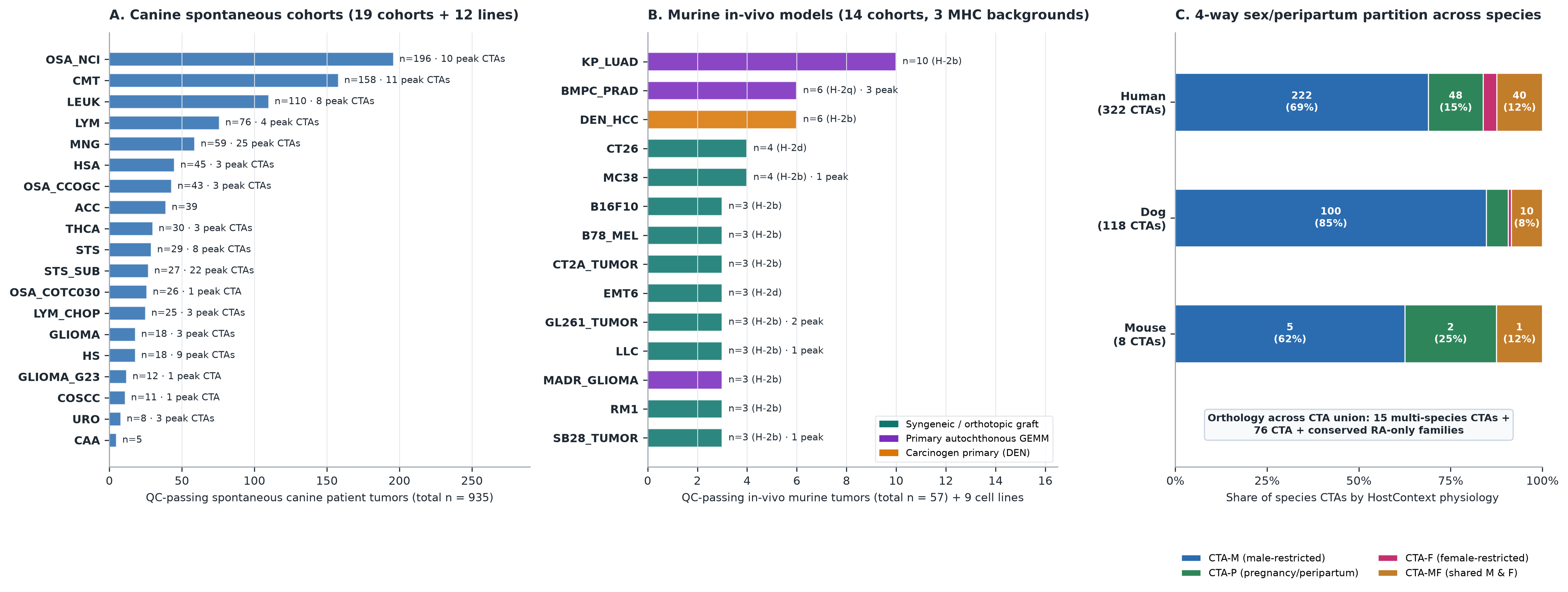
Figure 17. (A) Spontaneous companion-dog in vivo patient tumor cohorts (19 cohorts across 935 QC-passing primary patient tumors, paired with 12 canine cancer cell lines) and per-cohort peak CTA contributions. (B) Murine in vivo syngeneic, orthotopic, primary GEMM, and carcinogen-induced cohorts (14 cohorts across 57 in vivo tumors spanning H-2b, H-2d, and H-2q, paired with 9 pure in vitro murine cancer cell lines). (C) Consistent male-germline dominance (CTA-M) across the 4-way HostContext physiological partition in human (322 CTAs), dog (118 CTAs), and mouse (8 CTAs), alongside mammalian CTA orthology conservation.
Homo sapiens (taxon 9606)
All 8/8 screening pillars are active across 19,893 Ensembl 115 protein groups (20,099 coding loci), combining deconvolved GTEx v11 (reproductive-age XX 20–49 female stratification) and HPA v23 donor P95 baselines, HPA/DICE/Monaco immune panels, consortium-deduplicated CELLxGENE and Siletti rare-cell UMI atlases, HPA immunohistochemistry, GSE107746 adult ovarian follicles, Petropoulos/Tyser/Molè embryos, monogenic chemosensory GPCR guards, and 135 QC-passing in vivo tumor cohorts (132 baseline cohorts + 3 upgraded linear-TPM cohorts THYMCA, BCC, cSCC; 222 CTA-M, 48 CTA-P, 12 CTA-F, 40 CTA-MF; 311/322 = 96.6% ectopic).
Canis lupus familiaris (taxon 9615)
Canine comparative oncology is evaluated genome-wide across 20,082 Ensembl 98 CanFam3.1 (GCA_000002285.2, cross-referenced to RefSeq 106 UU_Cfam_GSD_1.0) protein groups (20,199 coding loci, 8/8 active pillars): 118 CTA (100 CTA-M, 7 CTA-P, 1 CTA-F, 10 CTA-MF; 114/118 = 96.6% ectopic; 8 independently expressed ≥10× in pure canine cancer cell lines), 127 CA only, and 313 RA only across 19 spontaneous companion-dog patient tumor cohorts (935 patient samples spanning osteosarcoma, mammary carcinoma, hemangiosarcoma, multicentric B/T-cell lymphoma, soft-tissue sarcoma, invasive urothelial carcinoma, oral squamous cell carcinoma, acanthomatous ameloblastoma, histiocytic sarcoma, glioma, meningioma, adrenocortical & thyroid carcinoma, and acute leukemia) paired with 12 pure in vitro canine cancer cell lines (CLBL-1, 8 MGT mammary lines, 3 HS histiocytic sarcoma lines), Bgee 15.2 + GSE219045 + companion-dog normal/macrophage RNA panels, GSE225599 healthy companion-dog circulating leukocyte 10x scRNA-seq (7 healthy donors), activated-TIL checkpoint/cytokine exclusions, and Pfizer 38-tissue quantitative TMT proteomics (MSV000099744). Across the 14 literature-curated canine RT-PCR nominations (hindriks2025, nemec2019), PRAME (CTA, CTA-M) and SSX6 (CTA-M) survive quantitative somatic safety and in vivo tumor enrichment (canine whitepaper section).
Mus musculus (taxon 10090)
Murine preclinical screening is anchored on the complete Ensembl 115 GRCm39 (GCA_000001635.9, C57BL/6J) proteome (21,433 protein groups across all 8/8 active pillars: 8 CTA [5 CTA-M, 2 CTA-P, 0 CTA-F, 1 CTA-MF; 6/8 = 75.0% ectopic; 3 independently expressed ≥10× in pure murine cancer cell lines], 30 CA only, 303 RA only) across 14 in vivo syngeneic, orthotopic, primary GEMM, and carcinogen-induced tumor cohorts (57 in vivo tumors) plus 9 pure in vitro murine cancer cell lines (4T1, P815, EO771, Hepa1-6, ID8, GL261_LINE, MB49, MOC1, MOC22). Across all 433 distinct mammalian CTA ortholog families spanning human, dog, and mouse, 15 (ADAM2, ANTXRL, C3orf22, CCDC166, CSN2, DPPA5, LUZP4, PASD1, PLAC1/Plac1, PRAME, PRDM14, PSMA8, TEX19/Tex19.1, TRIM42, TRIML1) independently qualify as CTA in two or more species (and 91 as conserved CTA or RA-only)—demonstrating why CTA catalogs must be constructed natively per species rather than projected by orthology (murine & cross-species orthology section).
Methods: protein grouping, sources, and thresholds
Protein-group counting unit
Source gene identifiers across RNA, single-cell, and protein atlases map to human Ensembl 115 loci. Each locus gets one qualified reference translation—preferring MANE Select on the primary assembly, then Ensembl canonical—checked for coding biotype, complete start/stop codons, uninterrupted ORF, and absence of translation conflicts (transcript selection audit).
Paralogous loci encoding identical proteins (SPANXA1/2, XAGE1A/B, VCY/1B) collapse into one protein group by representative amino-acid sequence even when cDNAs differ. Wherever sample identities exist, member-locus expression is summed within each sample before comparing across cohorts. The 563 records lacking a qualified representative sequence stay visible; missing translation blocks admission even when RNA is measured (sequence and peptide-subtraction API).
Evidence sources and native-TPM coverage
OncoRef pins 324 SHA-256-verified files across 1,221 source/context rows and 135 QC-passing in vivo tumor cohorts (132 baseline cohorts, 130 in the initial 2026-11-10 audit table, plus 3 upgraded linear-TPM cohorts THYMCA, BCC, cSCC). Incompatible assay units are never pooled; every dataset stays in its native scale and enters only the layer it supports:
| Evidence pillar | Primary resources | Native statistic and role |
|---|---|---|
Healthy baseline (N, D) |
GTEx v11, HPA v23 biopsies and brain, HPA/DICE/Monaco sorted immune | Within-site donor or biopsy P95 in native TPM (optional mean_plus_2std sensitivity mode) sets the non-thymic healthy reference (N) and Disposable maximum (D). |
| Normal-tissue safety screens | HPA consensus and scRNA clusters, HPA normal IHC, CELLxGENE Census + Siletti, Collin cornea, adult bone/olfactory panels | Tiered RNA ceilings (TPM/nTPM/CP10K), reliable positive IHC, matched negative-IHC credit, consortium-deduplicated rare-cell UMI screens, and monogenic chemosensory GPCR holds. |
| Tumor and reproductive/embryo RNA | 135 QC-passing in vivo tumor cohorts, GTEx/HPA reproductive biopsies, GSE107746 adult ovarian follicles, Petropoulos/Tyser/Molè embryos |
Individual QC-passing in vivo tumor libraries qualify CA (with tumor_activation_mode tracking ectopic vs. homologous cohorts); reproductive samples or supported embryo lineages qualify RA. |
| Curated literature and clinical controls | 149 catalog-mapped papers (CTA, oncofetal/DUX4, placental, clinical trials, normal counterevidence) + 16 TCR-T/ImmTAC regimens | Provenance metadata, clinical safety calibration, and curated normal-expression exclusions; positive nominations alone never grant admission. |
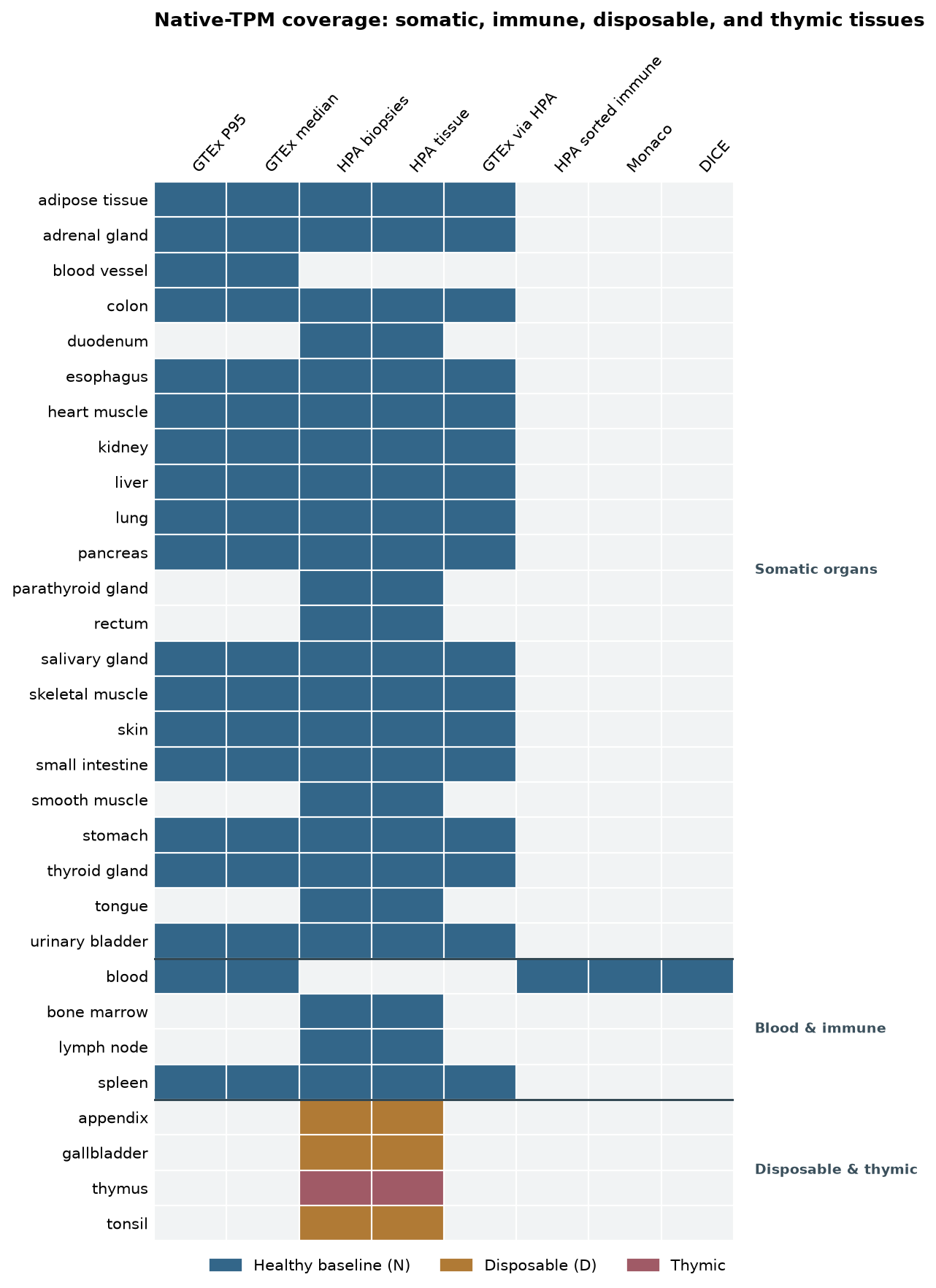
Figure 18. Native-TPM tissue coverage across somatic organs, immune subsets, disposable tissues, and thymus (empty out-of-panel columns omitted). Colored cells mark qualifying coverage for at least one assessed protein group; gray marks no qualifying coverage.
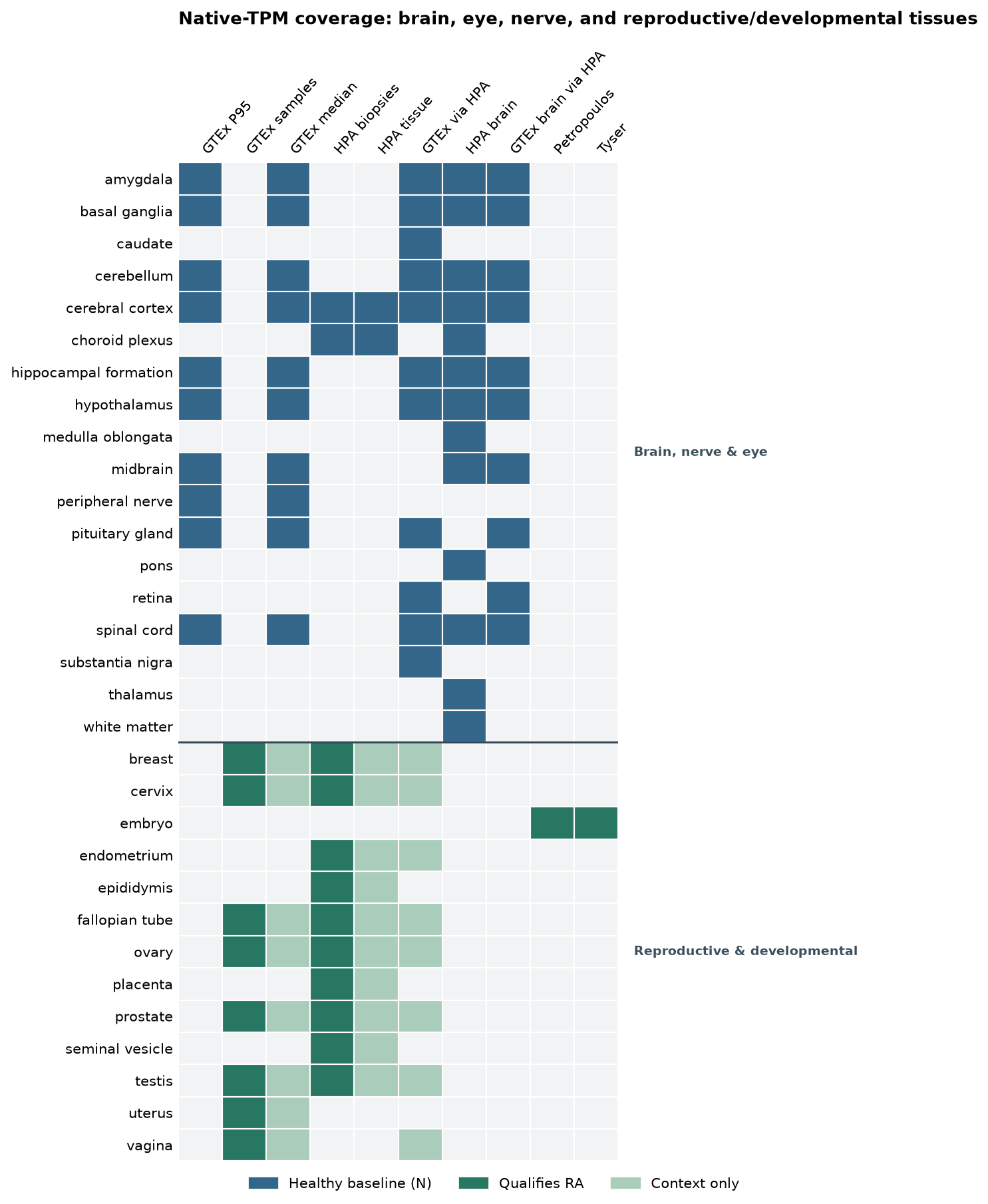
Figure 19. Native-TPM coverage across brain, eye, nerve, reproductive, and embryonic tissues. Qualifies RA marks individual reproductive samples or supported embryo-lineage means capable of qualifying RA; Context only marks tissue summaries retained for display.
Exact quantitative gate thresholds and rare-cell provenance rules
- Bulk, cluster, and immune RNA ceilings: Base limits in TPM and nTPM are 4 for Vital, 8 for Protected, 16 for Manageable. Matched negative IHC across routine contexts of the tissue raises the ceiling by 2× (Approved), 4× (Supported), or 8× (Enhanced), alongside limited registry clinical adjustments. Exceeding a
VitalorProtectedceiling establishesUnsafe;ManageableestablishesUnsafeonly above 128. - Donor-resolved rare-cell RNA and consortium provenance: Evaluated in native UMI counts per adult donor and named cell type. In a
Vitalpopulation, a donor signal requires ≥10 cells and ≥1% of cells with ≥2 molecules (replicated across independent study groups), or ≥5% in a single study;Protectedpopulations double those frequency cutoffs. Shared consortium collections (Baylor/Chen eye, Sanes eye, Allen reference brain, Michigan kidney, Teichmann heart) and donors embedded in integrated atlases (HLCA, Baylor/Chen eye, SEA-AD) are resolved to their original study group and biological donor ID before counting replication. Replicated signals without locus mapping risk (or with independent bulk or gene-specific confirmation) establishUnsafe; unresolved locus attribution or single-study signals go toOther:Review. - Structural and home-tissue gates: Unsupported nested sequences, read-through loci, or ≥95% 9-mer containment in
Unsafeproteins produceOther:Sequence. A curated adult normal tissue outside the native-TPM panels (DSPPodontoblasts) or an unvalidated monogenic chemosensory GPCR (OR*,TAS1R*,TAS2R*,VN1R*) assignsOther:Unscreened tissuewhenRAis negative (orReproductive Antigen onlywhenRAqualifies); fetal-only tissues (AMELXin developing tooth epithelium) keep their developmental scope. - Eligibility and Disposable cap: Eligibility requires complete coverage across 35 healthy contexts, target peak above every measured non-reproductive and Disposable value, and Disposable expression ≤ 32 TPM and ≤ 32 nTPM.
- Embryo lineage support for RA: Well-sampled lineages require ≥20 cells, ≥5 cells at ≥1 TPM, and ≥10% positive cells; smaller lineages require ≥5 cells, ≥50% positive cells, and replication in two independent embryos of the same stage and lineage. Within-site donor/biopsy P95 dampens isolated healthy outliers but cannot diagnose carryover or prove absence from an unmeasured rare cell type.
Source-family rules and versioned file inventory (324 files across 1,221 contexts)
| Source family | Evidence provided | Role in classification |
|---|---|---|
| Ensembl 115, MANE and sequence registry | Locus IDs, transcript flags, CDS qualification, sequence digests, read-through maps | Define protein-group counting units and test translation, nesting, and Unsafe 9-mer containment. |
| GTEx v11 | Individual site TPM, donor/library IDs, donor age brackets, QC annotations | Non-reproductive sites contribute the within-site linear donor P95 (after multiplex-bleed removal). Reproductive sites (XX 20–49 stratified in female HostContext) qualify RA. |
| HPA bulk tissue and brain (incl. GTEx via HPA) | Individual tissue biopsies, tissue/brain-region means, consensus nTPM, anatomical mappings | Native TPM enters the healthy reference (within-tissue biopsy P95 where available) or RA-qualifying reproductive samples. Consensus nTPM runs its own normal gate. |
| HPA sorted blood, DICE and Monaco | Sorted immune populations, donor TPM, ranked values, published means, immune nTPM | HPA donor P95 and DICE single-locus P95 enter native comparison; DICE multi-locus groups use the conservative sum of member maxima; Monaco retains the published mean. |
| HPA single-cell clusters and normal IHC | Cell-type nTPM, staining grades, antibody IDs, reliability scores | Screen normal cell clusters and reliable positive protein findings; matched negative IHC can raise RNA ceilings. |
| CELLxGENE Census and Siletti brain | Versioned H5AD studies, donor IDs, cell types, molecule counts | Grade sparse normal-cell expression by donor penetration, independent study replication, nuclear spillover geometry, and locus mapping risk. |
| Collin cornea and conjunctiva | Adult, developmental, and disease ocular cell counts with donor metadata | Dedicated adult corneal normal gate in counts per 10,000 (CP10K) requiring ≥10 multi-UMI cells. |
| Specialized anatomy & chemosensory GPCR guards | Adult bone & olfactory panels, monogenic GPCR screen (OR*/TAS1R*/TAS2R*/VN1R*), developmental dental/skeletal atlases |
Exclude ceiling-violating adult home genes as Unsafe and hold unscreened sub-niches and monogenic sensory GPCRs out of CA/CTA. |
| GSE107746 adult follicles & Petropoulos/Tyser/Molè embryos | Primordial-to-antral human oocyte/granulosa TPM (GSE107746) and preimplantation/CS7 embryo lineage TPM |
Quantify adult female germ-cell HostContext and developmental RA enrichment on native scales. |
| Tumor cohorts | Per-sample matrices, sample/patient IDs, ≤2.5% OR gDNA QC, homologous vs. ectopic cohort provenance |
135 in vivo cohorts qualify CA and populate tumor_activation_mode. |
| Curated papers, proteomics and TCR trials | Nominated gene lists, normal counterevidence, 16 clinical TCR-T/ImmTAC benchmarks |
Calibrate proxy safety ceilings and enforce isoform-scoped clinical organ clearance. |
| Inventory role | Versioned files |
|---|---|
| assay observations | 4 |
| cell atlas | 4 |
| comparison or sample metadata | 9 |
| curated data | 8 |
| curation input | 125 |
| native assay or supplement | 42 |
| tumor expression | 132 |
Reproducing the catalog and downloads
Every external reference file and per-sample tumor matrix required for a clean rebuild (policy oncoref.target-selection.2026-11-26.2) is SHA-256-pinned and fetched through OncoRef's uniform CLI (no out-of-band downloads or machine-local paths):
# 1. Fetch and verify all pinned reference datasets (add --include-tumors for all 135 tumor cohorts)
python -m oncoref.curation fetch --include-tumors

# 2. Rebuild the full curation graph (catalog, host exposure, figures, reports, whitepaper)
python -m oncoref.curation build

# 3. Verify every tracked implementation file, catalog table, and whitepaper artifact byte-for-byte
python -m oncoref.curation check
python scripts/render_antigen_whitepaper.py --check
Limitations
Cross-cohort tumor matrices come from distinct studies and processing pipelines; OncoRef enforces nonnegative comparable TPM and ≤2.5% olfactory-receptor gDNA library QC rather than cross-study batch correction. In rare-cell atlases, count matrices cannot separate paralog cross-mapping from genuine sparse transcription without read-level realignment or locus-specific assays (as in CTAG2), and while known consortium collections and integrated-atlas donor overlaps are deduplicated, undocumented donor reuse across unrelated public studies cannot be ruled out. Single-sample RNA peaks do not measure intratumoral clonality, translated protein abundance, peptide–MHC presentation, or receptor-specific structural mimicry (such as MAGEA3 a3a → TTN).
Reference and download index
| Resource | Contents |
|---|---|
| Interactive antigen explorer | Multi-species interactive browser across human, dog, and mouse with physiological sex presets, ectopic/replication toggles, and CSV export |
| Multi-species antigen whitepaper | Full human (9606), canine (9615), and murine (10090) parameterization, in vivo cohorts, in vitro cell-line references, and ortholog ledgers |
| Summary figures and distributions | Threshold heatmaps, scale distributions, rare-cell plots, and stage breakdowns |
| Classification rules · Build guide | Policy contract, CLI commands, and reproducible build instructions |
| Tissue injury hierarchy · Tissue tiers · Patient-specific filtering | Cited adult organ and cell-type injury assessments and patient-profile filtering |
| Sequence API and peptide subtraction · Data download API | Ensembl 115 reference translations, k-mer subtraction, and programmatic dataset retrieval |
Registered file inventory (sources.csv) |
All 324 pinned source files, catalog selectors, and SHA-256 digests |
Studied CTA dispositions (studied-proteins.csv) |
Full measurements and exclusion reasons for all 2,238 published or clinical anchor proteins |
Candidate tumor rankings (tumor-ranks.csv) |
Peak tumor TPM, folds, cohort/sample IDs, and patient counts for all 534 candidates |
Curated literature sources (literature-sources.csv) |
Disposition counts across all 149 catalog-mapped papers grouped by antigen class |
Clinical TCR gold-standard benchmark (clinical-tcr-gold-standard.csv) |
Potency-proven human TCR-T and ImmTAC target, response, and clinical toxicity curation (16 regimens) evaluated against OncoRef's safety proxies |
Sex-restricted antigens (sex-restricted-antigens.csv) |
Disjoint 4-way RA-M/CTA-M, RA-F/CTA-F, RA-P/CTA-P, and RA-MF/CTA-MF calls across all 468 human RAs with organ TPMs |
Female-lineage CTA audit (female-lineage-audit.csv) |
Gene-by-gene disposition, BRCA/TNBC/OV/UCEC/UCS/CESC tumor peaks, and gating normal/male measurements across 159 canonical mammary, oocyte, meiotic, Müllerian, and placental genes |
Cross-species CTA orthologs (cross-species-orthologs.csv) |
Ortholog mapping and native catalog calls across 433 mammalian CTA families in human (9606), dog (9615), and mouse (10090) |
| Normal RNA coverage · Tumor coverage ledger · Literature adjudication | Audit ledgers for healthy panels, tumor cohorts, and literature reviews |