Multi-species antigen whitepaper: human, canine, and murine parameterization
Interactive antigen explorer · Main antigen whitepaper · Species & data groups API · Dataset bindings (CSV) · Non-human nominations (CSV) · Cross-species orthologs (CSV)
Jump to: Goals & architecture · Ectopic, TILs & GPCRs · Anatomy & sex subsets · 8-pillar matrix · Human (9606) · Dog (9615) · Mouse (10090) · Cross-species orthology · API & CLI
Abstract
Translational cancer immunotherapy moves vaccine constructs, T-cell receptor designs, and preclinical safety benchmarks across humans, outbred companion dogs with spontaneous cancers, and syngeneic or genetically engineered mouse models. Treating "cancer–testis antigen (CTA)" as a human gene list projected onto animals by symbol orthology fails in both directions: CT-X and zygotic-genome-activation (ZGA) gene arrays evolve rapidly across mammals (NY-ESO-1, SPANX, VCX/Y, GAGE, XAGE, DUX4, PRAMEF vs. murine Mageb, Pramel, Sbp, Pbsn), accessory reproductive and disposable lymphoid organs differ anatomically across species, and heterogeneous assay scales (TPM, nTPM, TMM-CPM, droplet UMI, IHC, pooled TMT-iBAQ) cannot be merged or converted by rule of thumb.
OncoRef solves comparative antigen discovery by separating species-invariant mathematical definitions from per-species genome, anatomical, dataset, and threshold parameterizations (oncoref.species_policies, oncoref.species_target_selection). Across human (9606, 19,893 PEGs, 322 CTAs), domestic dog (9615, 20,082 PEGs, 118 CTAs), and laboratory mouse (10090, 21,433 PEGs, 8 CTAs), all 8/8 canonical screening pillars are active in every species with zero cross-species label borrowing.
Goals and species-invariant architecture
Within any mammalian species S with SHA-256-verified proteome reference R_S, comparative anatomy profile A_S, and declared single-panel comparison unit u_S, every coding locus traverses the identical four-step pipeline:
- Stage 0 — Identical-sequence protein-equivalence grouping. Qualified coding translations within
R_Scollapse into identical-sequence protein-equivalence groups. Within each expression library, complete member-locus abundance is summed before summarizing across donors, while every annotated isoform translation is retained for ≥95% 9-mer containment against that species' Unsafe proteins and downstream host self-proteome subtraction. - Stage 1 — Multi-modal normal somatic & activated-immune safety (
Unsafeprecedence). Each normal-tissue dataset is evaluated in its own native unit and assay rule—bulk somatic and sorted/activated immune RNA ceilings (Vital ≤ 4,Protected ≤ 8,Manageable ≤ 16hold /> 128Unsafe, after uniform≤ 2.5%ectopic olfactory-receptor≥ 5 TPMgenomic-DNA library QC), donor-resolved rare-cellUMIscreens (≥10cells and≥1%multi-molecule cells across≥2independent studies or≥5%in one study;2×inProtected), normal protein staining or quantitative mass-spectrometry proteomics, and curated adult normal-organ literature. Confirmed Vital/Protected adult somatic expression permanently assigns Unsafe. - Stage 2 — Sequence, unscreened-niche & monogenic chemosensory GPCR eligibility (
Other). Surviving proteins with incomplete required normal coverage or unresolved paralog/host attribution enterOther:Review; proteins nested≥95%inUnsafe9-mers or readthrough loci enterOther:Sequence; and proteins residing in unscreened adult micro-niches—including all unvalidated monogenic chemosensory GPCRs (OR*/COR*/Olfr*,TAS1R*,TAS2R*,VN1R*/Vmn*r*)—carryhome_tissue_unmeasured = True, blocking CA/CTA admission (Other:Unscreened tissueorReproductive Antigen only). - Stage 3 — Symmetric
10 × H₀in vivo enrichment,tumor_activation_mode, and in vitro cell-line references. Across non-thymic, non-reproductive somatic baselineN(within-organ donor P95), species-applicable non-thymicDisposablemaximumD(capped at≤ 32), and detection floorF_S = 1in unitu_S, let H₀ = max(N, D, F_S): - Cancer Antigen (CA): clears shared eligibility, has
home_tissue_unmeasured == False, and reaches ≥ 10 × H₀ in at least one QC-passing in vivo patient, syngeneic/orthotopic graft,GEMM, or carcinogen-induced tumor sample of species S. Pure in vitro cancer cell lines (comparison_cell_lines) never grantCAorCTAon their own; instead they populatecell_line_max_tpm,cell_line_top_model, andqualifying_cell_lines. - Reproductive Antigen (RA): clears shared eligibility and reaches ≥ 10 × H₀ in an adult reproductive sample or cell-supported embryonic lineage of species S.
- Cancer–Testis Antigen (CTA): the intersection CTA = CA ∩ RA, annotated with
tumor_activation_mode("ectopic","ectopic_and_lineage_retained", or"lineage_retained").
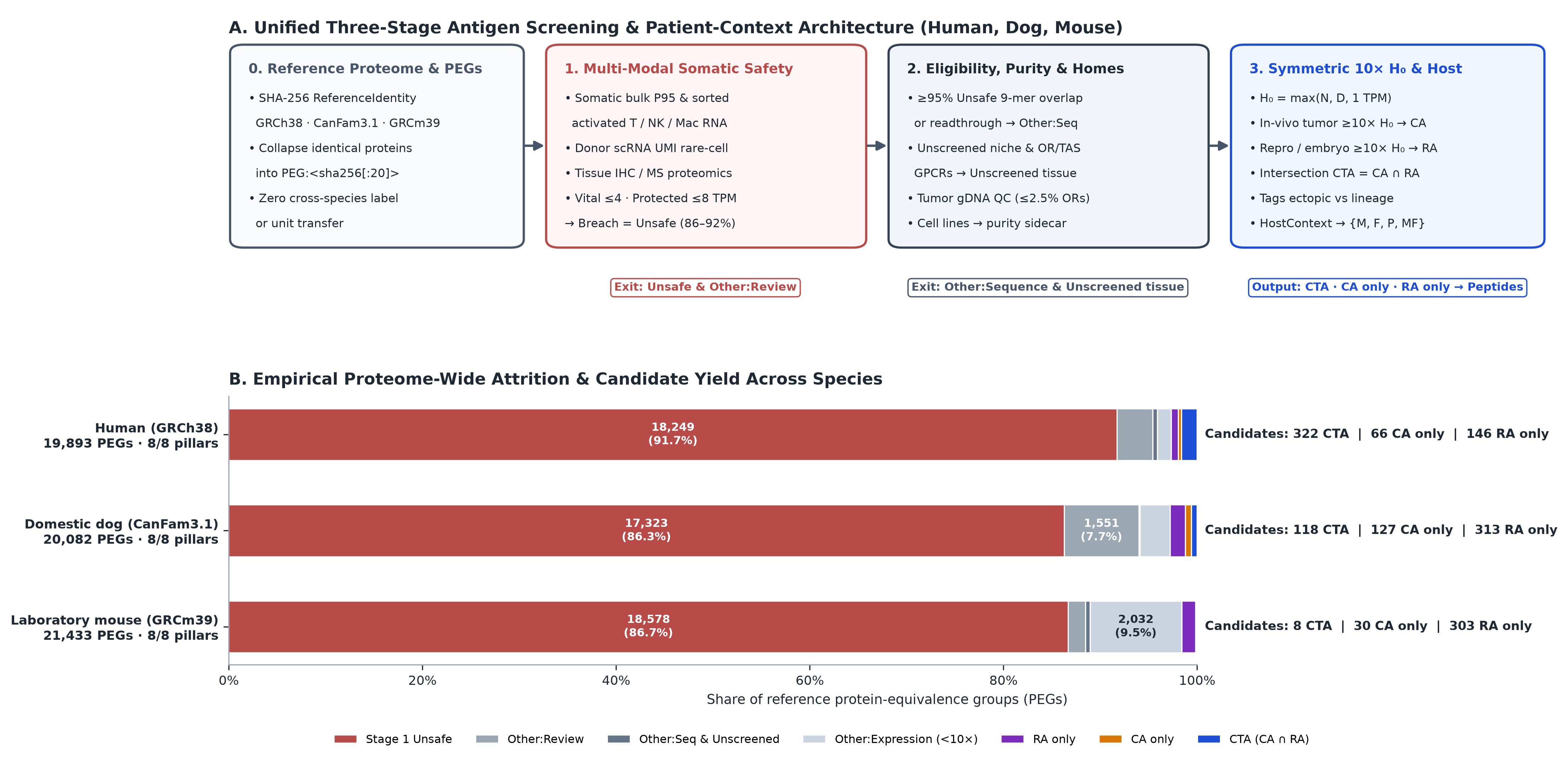
Figure 1. (A) Species-invariant three-stage screening and downstream HostContext architecture. (B) Empirical proteome-wide attrition across human (19,893 PEGs), domestic dog (20,082 PEGs), and laboratory mouse (21,433 PEGs), all evaluated across 8/8 active evidence pillars.
[!NOTE] Negative-IHC RNA ceiling multipliers (
2×Approved,4×Supported,8×Enhanced) apply only where a species has routine-context, cell-type-resolved antibody validation (humanHPA v23). Pooled mass-spectrometry proteomics (dogPfizerTMT-iBAQ) and literature-curated developmental/adult staining (mouseMGIGXDTS28) supply affirmative Unsafe / review-hold gates when positive, and never inflate RNA ceilings when absent.
Ectopic activation, in vivo purity, and chemosensory GPCR guards
Harmonizing target discovery across human, dog, and mouse uncovered three cross-cutting methodological requirements that apply identically across species:
- Tracking
tumor_activation_modewithout discarding homologous-organ targets: Across all three species, 75%–97% of biological CTAs exhibit true ectopic activation in non-homologous somatic cancers (311/322 = 96.6% in human; 114/118 = 96.6% in dog; 6/8 = 75.0% in mouse). Retaining homologous-organ witnesses (SEMG2in humanPRAD,CSN2/CSN3in canineCMT,Pbsn/Sbpin murineBMPC_PRAD) insideCTAwithtumor_activation_mode = "lineage_retained"preserves valid clinical/preclinical targets for hosts where the homologous organ is absent or expendable (HostContext), while letting pan-cancer callers filter directly ontumor_activation_mode != "lineage_retained". - Separating in vivo tumors from pure in vitro cancer cell lines diagnoses host
TILcontamination: In vivo tumors mix malignant cells with host leukocytes, whereas pure in vitro cell lines lack host stroma but acquire culture-specific drift. Requiring in vivo tumor witnesses forCA/CTAwhile evaluating 12 canine and 9 murine pure cancer cell lines separately as an experimental model reference immediately unmasks hostLAK/NKcytolytic granzymes (Gzmd,Gzme,Gzmf,Gzmg), which reach443–2,138 TPMinside in vivoMC38/CT26/B16F10grafts (via infiltrating host NK cells) yet collapse to0.05–2.26 TPMin pure cultured tumor cells—confirming their exclusion as activated-NKUnsafehost transcripts while simultaneously identifying which genuine CTAs (Hmga2,Tex19.1,Wfdc13,Pramel13, canineHORMAD1) have ready-to-use syngeneic or canine in vitro target lines (qualifying_cell_lines). - Uniform monogenic chemosensory GPCR hold (
0 CA / 0 CTA): Singular-receptor choice in~0.1%of olfactory sensory neurons and taste/solitary chemosensory cells dilutesOR*/COR*/Olfr*,TAS1R*,TAS2R*, andVN1R*/Vmn*r*~1,000×in whole-mucosa RNA. Enforcinghome_tissue_unmeasured = Trueacross all three species prevents29humanCA onlyGPCRs and3humanCTAORs (as well as canineCOR*and murineOlfr*/Vmn*r*loci) from enteringCAorCTA.
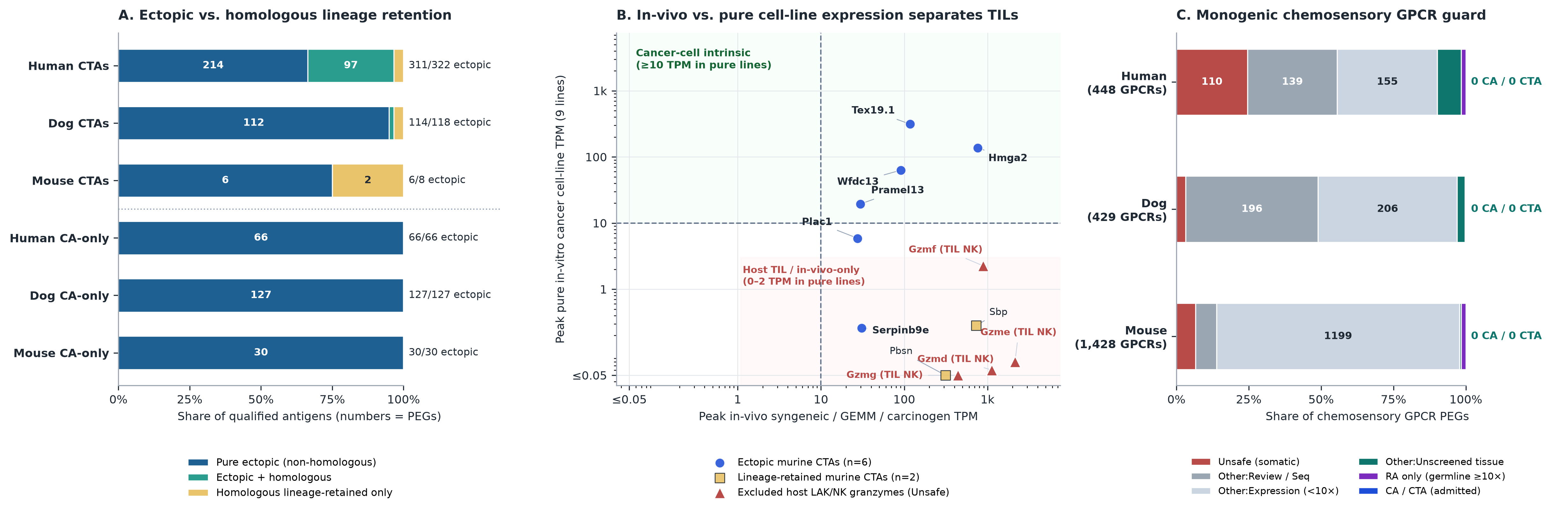
Figure 2. (A) CTA and CA only breakdown by tumor_activation_mode across human, dog, and mouse. (B) In vivo murine tumor TPM versus pure in vitro cell-line TPM separating cancer-intrinsic CTAs from excluded host TIL NK granzymes (Gzmd–g). (C) Monogenic chemosensory GPCR dispositions across human (448), dog (429), and mouse (1,428), yielding 0 CA / 0 CTA in all three species.
Comparative anatomy and sex-restricted subsets
Every RA and CTA in every species belongs to one of four mutually exclusive host-physiology classes, defined by the same HostContext protection algebra parameterized by that species' actual reproductive, mammary, thymic, and disposable organs in normal-tissue-taxonomy.yaml:
RA-M(CTA-M/RA-M-only· Male-restricted, non-pregnant female-safe): RA (or CTA) eligible when protecting every non-pregnant, non-lactating female adult reproductive and resting-mammary compartment of species S (< 8native RNA units—< 16inhumanwhere routine IHC isnot_detected—with measured coverage and resolved protein status), while expressed in male organs.RA-F(CTA-F/RA-F-only· Female-restricted, male-safe): RA (or CTA) eligible when protecting every male adult reproductive compartment (plus resting mammary tissue in species where adult males retain mammary ducts,humananddog; inmouse, fetal androgen regression at E14.5 ablates male mammary buds), while expressed in non-pregnant female reproductive or resting-mammary compartments.RA-P(CTA-P/RA-P-only· Pregnancy / peripartum-only, adult-absent across non-pregnant, non-lactating men & women): RA (or CTA) eligible under full non-pregnant, non-lactating adult organ protection in both sexes—expressed inembryo,placenta, orlactating_mammary(lactating_breast) and silent across every adult male and non-pregnant, non-lactating female reproductive and resting-mammary compartment. For male/female CTAs that are additionally active inplacentaorlactating_mammary(PLAC1,XAGE3,LALBA,CSN2),HostContext(pregnant=True)/HostContext(lactating=True)andperipartum_antigen_ids()enforce organ-level exclusions.RA-MF(CTA-MF/RA-MF-only· Shared male & female): RA (or CTA) expressed in adult reproductive/resting-mammary organs of both sexes (or lacking measured opposite-sex clearance, failing closed).
| Species | Core reproductive / embryonic | Male accessory | Female tract | Mammary | Non-thymic Disposable (D) |
|---|---|---|---|---|---|
Homo sapiens (9606) |
embryo, placenta, testis, ovary | epididymis, prostate, seminal vesicle | fallopian tube, uterus, endometrium, cervix, vagina | lactating_breast, resting_breast | appendix, gallbladder, tonsil, hair follicle, cutaneous_melanocyte |
Canis lupus familiaris (9615) |
embryo, placenta, testis, ovary | epididymis, prostate | fallopian tube, uterus, uterine_horn, endometrium, cervix, vagina | lactating_mammary, resting_mammary | gallbladder, tonsil, hair follicle, cutaneous_melanocyte |
Mus musculus (10090) |
embryo, placenta, testis, ovary | epididymis, prostate, coagulating_gland, seminal vesicle | fallopian tube, uterus, uterine_horn, endometrium, cervix, vagina | lactating_mammary, resting_mammary | gallbladder, hair follicle, cutaneous_melanocyte |
Comparative anatomy directly shapes both enrichment denominators and host protection:
- Accessory male glands: Dogs anatomically lack seminal vesicles and bulbourethral glands (
prostateis the sole major accessory gland), whereas mice carry a distinctcoagulating_gland(anterior prostate) alongsideseminal vesicleandprostate. Requestingseminal vesiclein a canineHostContextraises an immediateValueErrorrather than silently dropping the constraint. - Bicornuate female tract & gonadectomy: Both dogs and mice add
uterine_horn(normalized automatically underuterus), and companion-animal oncology frequently treats spayed (ovariohysterectomized) or castrated hosts whereHostContext(absent=("ovary", "uterus", "uterine_horn", "endometrium"), species="dog")explicitly records surgically absent organs distinct from accepted tissue injury. - Disposable somatic organs (
D): Neither dogs nor mice possess a vermiformappendix, and mice also lack palatinetonsil, narrowing non-thymicDisposable(D) from five compartments in human to four in dog and three in mouse.
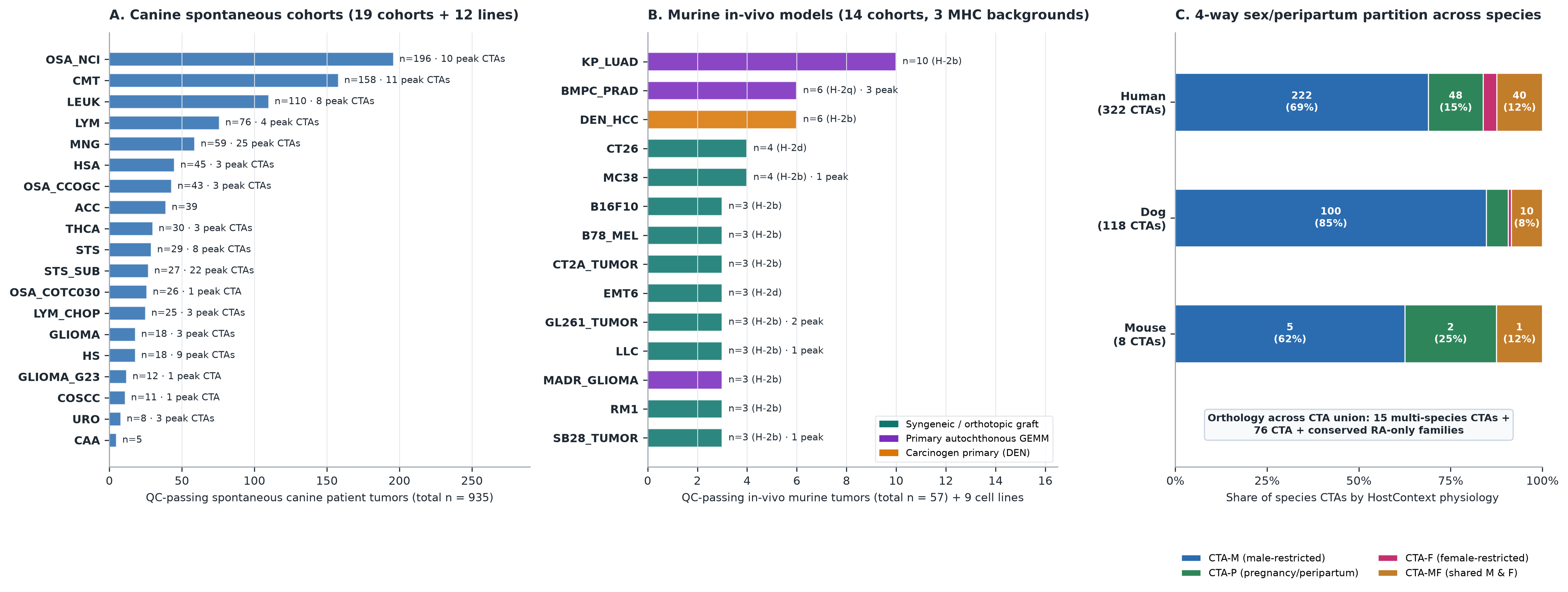
Figure 3. (A) Spontaneous companion-dog patient tumor cohorts (19 cohorts, 935 primary patient samples, plus 12 canine cell lines). (B) Murine in vivo cohorts (14 cohorts, 57 in vivo tumors across H-2b, H-2d, and H-2q, plus 9 murine cell lines). (C) 4-way physiological sex-restriction partition (CTA-M, CTA-P, CTA-F, CTA-MF) across human, dog, and mouse.
Eight-pillar cross-species parameterization matrix
All 8/8 canonical screening pillars are active across human (9606), domestic dog (9615), and laboratory mouse (10090) (download full binding table):
| Screening pillar | Human (9606) | Domestic dog (9615) | Laboratory mouse (10090) |
|---|---|---|---|
| Reference proteome & identical-sequence protein-equivalence groups (PEG) | ensembl115 (amino-acid sequence) — active_in_catalog | ensembl98 + refseq106 (amino-acid sequence) — active_in_catalog | ensembl115 (amino-acid sequence) — active_in_catalog |
| Healthy non-thymic, non-reproductive baseline (N) & Disposable maximum (D) | gtex_v11 + hpa_v23_biopsies + sorted_immune (TPM) — active_in_catalog | bgee_v15_2_dog_25exps + gse219045_dog_atlas + companion_normal_5gse (TPM) — active_in_catalog | bgee_v15_2_mouse_12exps + gse219045_mouse_atlas + gse322844_wt_liver (TPM) — active_in_catalog |
| Normal somatic bulk & sorted immune RNA safety ceilings | hpa_rna_consensus + gtex_tissue_rna + hpa_brain + dice + monaco (TPM; nTPM) — active_in_catalog | bgee_v15_2_dog_somatic + gse219045_dog_atlas + gse283373_alveolar_mac (TPM) — active_in_catalog | bgee_v15_2_mouse_somatic + gse219045 + immgen_gse109125_gse122108 + gse181223_bmdm + gse287306_gse336796_gse302070_nk_treg + sarma1999 (TPM; qualitative RT-PCR/Southern) — active_in_catalog |
| Single-cell cluster & donor-resolved rare-cell UMI safety screens | cellxgene_census + siletti_brain + hpa_single_cell + collin_cornea (UMI counts; nTPM; CP10K) — active_in_catalog | gse225599_healthy_dog_pbmc_10x (UMI counts) — active_in_catalog | tabula_muris_10x (UMI counts) — active_in_catalog |
| Normal-tissue protein staining (IHC) or mass-spectrometry proteomics | hpa_normal_tissue + external_ihc (categorical IHC grade + reliability) — active_in_catalog | pfizer-dog-protein (within-plex bleed-corrected molar ppm (from rIBAQ)) — active_in_catalog | mgi_gxd_6_27 (curated adult IHC/Immunoblot detections) — active_in_catalog |
| Adult reproductive & embryonic/placental enrichment (RA) and host exposure | gtex_repro + hpa_repro + petropoulos + tyser + mole (TPM; UMI/staining context) — active_in_catalog | bgee_repro_embryo + gse219045_dog_repro + gse119810_normal_mammary + pfizer_fallopian_endometrium (TPM; molar ppm (Fallopian_Tube)) — active_in_catalog | bgee_repro_embryo + gse219045 + accessory_tract_lactation_7gse (TPM) — active_in_catalog |
| QC-passing tumor cohorts for cancer enrichment (CA) | oncoref_tumor_union_135_cohorts (TPM) — active_in_catalog | dog_19_spontaneous_cohorts_plus_12_cell_lines (TPM) — active_in_catalog | mouse_14_invivo_cohorts_plus_9_cell_lines (TPM) — active_in_catalog |
| Curated normal counterevidence, unscreened adult homes & published nominations | normal_expression_literature + rare_cell_attribution_reviews + cta_literature_149 (curated verdicts & citations) — active_in_catalog | hindriks2025 + nemec2019 + canine_til_effector_gates (curated RT-qPCR & cross-reference index) — active_in_catalog | vandeneynde1991 + sarma1999 + lak_granzyme_counterevidence (curated primary-source XMLs & GenBank records) — active_in_catalog |
Homo sapiens (human · taxon 9606)
Human target selection is evaluated across 19,893 protein-equivalence groups (20,099 Ensembl 115 coding loci) under policy oncoref.target-selection.2026-11-26.2: 322 CTA (311/322 = 96.6% with ectopic activation, 11 homologous lineage-retained), 66 CA only, 146 RA only (534 total candidates), 1,110 Other, and 18,249 Unsafe. Stratifying GTEx v11 female reproductive and mammary organs to reproductive-age XX women (ages 20–49, gtex.donor_age()) and integrating stage-replicated adult human folliculogenesis/oocyte RNA-seq (GSE107746, 128 QC-passing libraries across 9 cell-type × stage strata) partitions the 468 Reproductive Antigens (322 CTAs) into 342 RA-M (222 CTA-M), 60 RA-P (48 CTA-P), 18 RA-F (12 CTA-F), and 48 RA-MF (40 CTA-MF). See the main antigen whitepaper for clinical TCR gold-standard benchmarks, human figures, and edge-case audits.
| Canonical role | Dataset(s) | Native unit | Status | Threshold / screening rule |
|---|---|---|---|---|
| Reference proteome & identical-sequence protein-equivalence groups (PEG) | ensembl115 — Human Ensembl 115 GRCh38 + MANE Select |
amino-acid sequence | active_in_catalog |
Prefer MANE Select then Ensembl canonical; collapse identical translations into PEG; >=95% 9-mer Unsafe containment -> Other:Sequence |
| Healthy non-thymic, non-reproductive baseline (N) & Disposable maximum (D) | gtex_v11 + hpa_v23_biopsies + sorted_immune — GTEx v11, HPA v23 tissues/brain & HPA/DICE/Monaco immune |
TPM | active_in_catalog |
Within-site linear donor P95 sets non-thymic somatic N and Disposable D (<=32 TPM); H0 = max(N, D, 1 TPM) |
| Normal somatic bulk & sorted immune RNA safety ceilings | hpa_rna_consensus + gtex_tissue_rna + hpa_brain + dice + monaco — HPA v23 consensus/brain/immune, GTEx v11 medians & DICE/Monaco |
TPM; nTPM | active_in_catalog |
Base ceilings Vital <=4, Protected <=8, Manageable <=16 (Unsafe >128) in native unit; matched negative IHC raises ceiling 2x/4x/8x |
| Single-cell cluster & donor-resolved rare-cell UMI safety screens | cellxgene_census + siletti_brain + hpa_single_cell + collin_cornea — CELLxGENE Census, Siletti brain, HPA v23 scRNA clusters & Collin cornea |
UMI counts; nTPM; CP10K | active_in_catalog |
UMI: >=10 cells and >=1% >=2-UMI cells across >=2 consortium-deduplicated study groups (or >=5% in 1 study; 2x in Protected); cornea CP10K /100 nominal ceiling |
| Normal-tissue protein staining (IHC) or mass-spectrometry proteomics | hpa_normal_tissue + external_ihc — HPA v23 normal immunohistochemistry & curated external staining |
categorical IHC grade + reliability | active_in_catalog |
Approved/Supported/Enhanced positive staining in Vital/Protected tissues -> Unsafe; routine-context negative IHC grants RNA headroom |
| Adult reproductive & embryonic/placental enrichment (RA) and host exposure | gtex_repro + hpa_repro + petropoulos + tyser + mole — GTEx/HPA adult reproductive samples & Petropoulos/Tyser/Molè embryos |
TPM; UMI/staining context | active_in_catalog |
RA qualifies at >=10 x H0 in adult reproductive samples or cell-supported embryo lineages; per-compartment maxima feed HostContext (<8 TPM / <8 nTPM, 2x with negative IHC) |
| QC-passing tumor cohorts for cancer enrichment (CA) | oncoref_tumor_union_135_cohorts — 135 QC-passing per-sample in-vivo human tumor cohorts (TCGA, TARGET, BEAT-AML, Treehouse, GEO) |
TPM | active_in_catalog |
CA qualifies when >=1 QC-passing in-vivo tumor library reaches >=10 x H0; tags ectopic vs lineage_retained activation |
| Curated normal counterevidence, unscreened adult homes & published nominations | normal_expression_literature + rare_cell_attribution_reviews + cta_literature_149 — Reviewed normal-tissue literature, #711 Ensembl 115 attribution ledger & 149 CTA/oncofetal papers |
curated verdicts & citations | active_in_catalog |
Verified adult Vital/Protected expression -> Unsafe; unscreened adult home (olfactory/chemosensory GPCRs, taste bud, bone, dental pulp, hair follicle) -> Other:Unscreened tissue |
Canis lupus familiaris (domestic dog · taxon 9615)
Spontaneous canine cancers—appendicular osteosarcoma, multicentric B- and T-cell lymphoma, visceral hemangiosarcoma, mammary carcinoma, soft-tissue sarcoma, invasive urothelial carcinoma, oral squamous cell carcinoma, acanthomatous ameloblastoma, histiocytic sarcoma, glioma, meningioma, adrenocortical & thyroid carcinoma, and acute leukemia—develop in outbred, immunocompetent companion dogs sharing human environmental exposures. Canine target selection is evaluated genome-wide across 20,082 Ensembl 98 CanFam3.1 (GCA_000002285.2, cross-referenced to NCBI RefSeq 106 UU_Cfam_GSD_1.0) protein-equivalence groups (20,199 coding loci, 8/8 evidence pillars active): 118 CTA (114/118 = 96.6% with ectopic activation; 8 also ≥10× in pure canine cell lines), 127 CA only, 313 RA only (558 total candidates), 2,201 Other, and 17,323 Unsafe. Across the 431 canine Reproductive Antigens (118 CTAs), comparative canine HostContext partitioning yields 400 RA-M (100 CTA-M), 8 RA-P (7 CTA-P), 6 RA-F (1 CTA-F), and 17 RA-MF (10 CTA-MF).
Canine dataset and threshold parameterization
| Canonical role | Dataset(s) | Native unit | Status | Threshold / screening rule |
|---|---|---|---|---|
| Reference proteome & identical-sequence protein-equivalence groups (PEG) | ensembl98 + refseq106 — Canine Ensembl 98 CanFam3.1 (GCA_000002285.2, primary) & NCBI RefSeq 106 (UU_Cfam_GSD_1.0) |
amino-acid sequence | active_in_catalog |
Complete GTF/cDNA/ncRNA/peptide FASTA pins; identical translations collapse into canine PEG: |
| Healthy non-thymic, non-reproductive baseline (N) & Disposable maximum (D) | bgee_v15_2_dog_25exps + gse219045_dog_atlas + companion_normal_5gse — Bgee 15.2 adult canine multi-organ RNA-seq, GSE219045 300-sample organ atlas & healthy companion-dog adrenal/blood/marrow/gingiva/brain/liver/lung/spleen controls |
TPM | active_in_catalog |
Within-organ donor P95 across 24 required (36 evaluated) non-thymic adult somatic contexts sets N and canine Disposable D (gallbladder, tonsil, hair follicle); <=2.5% ectopic OR gDNA QC |
| Normal somatic bulk & sorted immune RNA safety ceilings | bgee_v15_2_dog_somatic + gse219045_dog_atlas + gse283373_alveolar_mac — Bgee 15.2 adult canine somatic/leukocyte RNA, GSE219045 whole-blood/marrow/lymph-node atlas & GSE283373 primary canine alveolar macrophages |
TPM | active_in_catalog |
Tiered somatic & macrophage ceilings Vital <=4, Protected <=8, Manageable <=16 (Unsafe >128) TPM without negative-IHC multipliers |
| Single-cell cluster & donor-resolved rare-cell UMI safety screens | gse225599_healthy_dog_pbmc_10x — GSE225599 healthy companion-dog circulating leukocyte 10x single-cell UMI atlas (7 healthy donors H_1..H_7) |
UMI counts | active_in_catalog |
Evaluates donor-resolved circulating T/NK lymphocytes, monocytes, neutrophils (Protected) and platelets (Vital) on native CanFam3.1 ENSCAFG IDs via assess_rare_cell_rna |
| Normal-tissue protein staining (IHC) or mass-spectrometry proteomics | pfizer-dog-protein — Pfizer 38-tissue canine quantitative proteomics (MSV000099744, 9,929 protein groups) |
within-plex bleed-corrected molar ppm (from rIBAQ) | active_in_catalog |
Sequence-reconciled Vital (>25 ppm Unsafe, 10-25 ppm hold) & Protected (>50 ppm Unsafe, 20-50 ppm hold) tissue-pool protein gates after 10% same-plex reproductive TMT bleed subtraction; never grants negative-IHC RNA multipliers |
| Adult reproductive & embryonic/placental enrichment (RA) and host exposure | bgee_repro_embryo + gse219045_dog_repro + gse119810_normal_mammary + pfizer_fallopian_endometrium — Bgee 15.2 testis/ovary/placenta/d33-d44 embryos, GSE219045 male/female reproductive tract, GSE119810 normal resting/lactating mammary & Pfizer Fallopian_Tube/Endometrium proteomics |
TPM; molar ppm (Fallopian_Tube) | active_in_catalog |
RA qualifies at >=10 x H0 across canine compartments (uterine_horn, absent seminal vesicle, milk-operon secretory separation) and populates canine HostContext |
| QC-passing tumor cohorts for cancer enrichment (CA) | dog_19_spontaneous_cohorts_plus_12_cell_lines — 19 spontaneous companion-dog patient tumor cohorts across 13 histologies (OSA, CMT, HSA, LYM, GLIOMA, URO, STS, COSCC, CAA, HS, MNG, ACC, THCA, LEUK) + 12 canine cancer cell lines (CLBL-1, 8 MGT, 3 HS) |
TPM | active_in_catalog |
CA qualifies strictly in >=1 QC-passing (<=2.5% OR gDNA) spontaneous in-vivo patient tumor at >=10 x H0; cell lines populate cell_line_* model-selection reference only |
| Curated normal counterevidence, unscreened adult homes & published nominations | hindriks2025 + nemec2019 + canine_til_effector_gates — Curated canine CTA nominations (14 candidates), somatic RT-qPCR holds & essential canine activated-TIL checkpoint/cytokine exclusions |
curated RT-qPCR & cross-reference index | active_in_catalog |
Reconciles all 14 published canine nominations onto CanFam3.1, holds somatic RT-PCR positives, excludes essential TIL checkpoints/cytokines, and enforces zero cross-species CTA transfer |
Key canine methodological rules enforced in code (oncoref.canine, oncoref.species_target_selection, scripts/build_dog_target_catalog.py):
- Single-scale linear
TPMsomatic & macrophage panels + Cufflinks paralog guard:Bgee 15.2(25healthy canine RNA-seq experiments deduplicated by SRA Run ID, routing BarkBase gestationald33–d44libraries inSRP114662toembryoand excluding neonatal/puppy stages), the 300-sample sex-stratified Preclinical Species Gene Expression Database (GSE219045, normalized within-sample fromFPKMto exactTPM), 64 normal female mammary biopsies (GSE119810, split by coordinated 4-gene milk-operon induction intolactating_mammaryvs.resting_mammary, keeping unmeasured male canineresting_mammaryfail-closed), primary companion-dog adrenal, blood, bone marrow, gingiva, brain, liver, lung, and spleen controls (GSE294265,GSE294391,GSE272909,GSE252794,GSE288068), andGSE283373primary BAL alveolar macrophages cover all 24 required (36evaluated) somatic contexts plus13RNA-measured reproductive/embryonic compartments (+1proteome_onlyfallopian tube) under uniform≤ 2.5%ectopic olfactory-receptor (COR*/OR*) gDNA QC. BarkBaseTMM-CPM(46shared SRA runs) is never pooled withTPM, Cufflinks multi-mappingFPKMcohorts mask phase-invariant≥5%31-mer paralog-ambiguous loci, and unannotated single-exon intronless loci sharing≥50%9-mers withUnsafesomatic paralogs (CanFam3.1processed-retrocopy risk) are held inOther:Reviewacross all cohorts. - Healthy companion-dog circulating leukocyte 10x scRNA-seq (
GSE225599, closing the 8th pillar) & activated-TIL gates: Donor-resolved 10x Chromium UMI matrices across 7 healthy companion dogs (H_1..H_7) (Ammons et al. 2023,CanFam3.1) resolveT/NK lymphocyte,monocyte, andneutrophil(Protected) plusplatelet(Vital) per donor viaassess_rare_cell_rna(150,155donor × cell-type evaluations, excludingOS_1..OS_10tumor-bearing dogs andManageableB cells), paired with curated canine activated-TIL checkpoint/cytokine exclusions (PDCD1,TNFRSF4,TNFSF4,IFNG,IFNB1,IL17A,IL17F,CD70,TNFRSF8,SIGLEC15) so tumor-infiltrating T-cell transcripts in lymphoma/melanoma biopsies never masquerade as tumor antigens. - Pooled 38-tissue proteomics with within-plex TMT bleed subtraction (
pfizer-dog-protein): MassIVEMSV000099744(9,929canine protein groups converted fromrIBAQto within-channel molarppm, subtracting10%same-plex reproductive reporter-ion bleed) supplies affirmative Unsafe (Vital > 25 ppm,Protected > 50 ppm) and review-hold (Vital 10–25 ppm,Protected 20–50 ppm) gates with zero negative-IHC RNA ceiling multipliers.fallopian tube(Pool3126) carriescoverage = "proteome_only"and fails closed (unresolved) when directly protected.
Spontaneous canine patient tumor cohorts (19 in vivo cohorts, 935 samples)
| Cohort | Model | Breeds / DLA | Accession | Samples | Quantification |
|---|---|---|---|---|---|
OSA_NCI — Spontaneous primary & metastatic appendicular osteosarcoma (NCI COTC021/022) |
spontaneous_patient_tumor | multi-breed companion dogs (diverse DLA) |
GSE238110 |
196 | linear TPM from raw integer counts and CanFam3.1 exonic_bp |
OSA_COTC030 — Spontaneous primary appendicular osteosarcoma (NCI COTC030 trial) |
spontaneous_patient_tumor | multi-breed companion dogs (diverse DLA) |
GSE304066 |
26 | linear TPM from verified raw integer counts and CanFam3.1 exonic_bp |
OSA_CCOGC — Canine Comparative Oncology & Genomics Consortium (CCOGC) osteosarcoma |
spontaneous_patient_tumor | Labrador, Greyhound, Rottweiler, Golden Retriever & mixed (diverse DLA) |
GSE239948 |
43 | linear TPM from expected counts and CanFam3.1 exonic_bp |
CMT — Spontaneous canine mammary gland carcinoma |
spontaneous_patient_tumor | multi-breed female companion dogs (diverse DLA) |
GSE119810 |
158 | within-sample linear TPM from FPKM |
HSA — Spontaneous canine visceral hemangiosarcoma |
spontaneous_patient_tumor | multi-breed companion dogs (diverse DLA) |
GSE95183 |
45 | within-sample linear TPM from FPKM |
LYM — Spontaneous canine multicentric B- and T-cell lymphoma |
spontaneous_patient_tumor | multi-breed companion dogs (diverse DLA) |
GSE95184 |
76 | within-sample linear TPM from FPKM |
GLIOMA — Spontaneous prosencephalic high-grade oligodendroglioma |
spontaneous_patient_tumor | French Bulldog, Boxer & Boston Terrier (diverse DLA) |
GSE284559 |
18 | linear TPM from raw counts and CanFam3.1 exonic_bp |
LYM_CHOP — Spontaneous de novo multicentric B- and T-cell lymphoma (CHOP cohort) |
spontaneous_patient_tumor | multi-breed companion dogs (diverse DLA) |
GSE130874 |
25 | linear TPM from raw counts and CanFam3.1 exonic_bp |
GLIOMA_G23 — Spontaneous Grade II/III oligodendroglioma |
spontaneous_patient_tumor | Boxer, French Bulldog & companion breeds (diverse DLA) |
GSE160124 |
12 | linear TPM from featureCounts and Length |
URO — Spontaneous invasive urinary bladder urothelial carcinoma |
spontaneous_patient_tumor | multi-breed companion dogs (diverse DLA) |
GSE199292 |
8 | linear TPM from raw/expected counts and CanFam3.1 exonic_bp |
STS — Spontaneous subcutaneous & oral soft-tissue sarcoma |
spontaneous_patient_tumor | multi-breed companion dogs (diverse DLA) |
GSE214154 |
29 | linear TPM from raw counts and CanFam3.1 exonic_bp |
STS_SUB — Spontaneous fibrosarcoma, peripheral nerve sheath & perivascular wall sarcoma |
spontaneous_patient_tumor | multi-breed companion dogs (16 patients) (diverse DLA) |
GSE208664 |
27 | linear TPM from HTSeq raw counts and CanFam3.1 exonic_bp |
COSCC — Spontaneous canine oral squamous cell carcinoma |
spontaneous_patient_tumor | multi-breed companion dogs (diverse DLA) |
GSE317244 |
11 | linear TPM from raw counts and CanFam3.1 exonic_bp |
CAA — Spontaneous canine oral acanthomatous ameloblastoma |
spontaneous_patient_tumor | multi-breed companion dogs (diverse DLA) |
GSE317244 |
5 | linear TPM from raw counts and CanFam3.1 exonic_bp |
HS — Spontaneous disseminated & hemophagocytic histiocytic sarcoma |
spontaneous_patient_tumor | Bernese Mountain Dog (diverse DLA) |
GSE288068 |
18 | linear TPM from HTSeq raw counts and CanFam3.1 exonic_bp |
MNG — Spontaneous intracranial & spinal meningioma |
spontaneous_patient_tumor | multi-breed companion dogs (diverse DLA) |
GSE250310 |
59 | linear TPM from featureCounts and Length |
ACC — Spontaneous functional adrenocortical adenoma & carcinoma |
spontaneous_patient_tumor | multi-breed companion dogs (diverse DLA) |
GSE196108 |
39 | linear TPM from raw counts and CanFam3.1 exonic_bp |
THCA — Spontaneous follicular & compact thyroid gland carcinoma |
spontaneous_patient_tumor | multi-breed companion dogs (diverse DLA) |
GSE289443 |
30 | linear TPM from raw counts and CanFam3.1 exonic_bp |
LEUK — Spontaneous canine acute myeloid & lymphoid leukemia |
spontaneous_patient_tumor | multi-breed companion dogs (diverse DLA) |
GSE345838 |
110 | linear TPM from featureCounts and Length |
Pure in vitro canine cancer cell-line purity & model-selection panel (12 lines)
Pure in vitro canine lines (canine.cell_lines()) are strictly segregated from in vivo CA/CTA admission and populate cell_line_max_tpm, cell_line_top_model, and qualifying_cell_lines:
| Cell line | Histology | Origin / breed | Accession | Samples | Quantification |
|---|---|---|---|---|---|
CLBL-1 — Canine diffuse large B-cell lymphoma line CLBL-1 (vehicle controls) |
DLBCL |
German Shepherd (DLA-88) |
GSE287971 |
9 | linear TPM from raw counts and CanFam3.1 exonic_bp |
HS_BD — Canine histiocytic sarcoma cell line HS_BD |
HS |
Bernese Mountain Dog (DLA) |
GSE288068 |
1 | linear TPM from HTSeq raw counts and CanFam3.1 exonic_bp |
HS_OD — Canine histiocytic sarcoma cell line HS_OD |
HS |
Bernese Mountain Dog (DLA) |
GSE288068 |
1 | linear TPM from HTSeq raw counts and CanFam3.1 exonic_bp |
HS_PJ — Canine histiocytic sarcoma cell line HS_PJ |
HS |
Rottweiler (DLA) |
GSE288068 |
1 | linear TPM from HTSeq raw counts and CanFam3.1 exonic_bp |
MGT_122 — Canine mammary gland tumor cell line MGT 122 |
CMT |
companion dog mammary line (DLA) |
GSE230271 |
1 | within-sample linear TPM from FPKM |
MGT_316 — Canine mammary gland tumor cell line MGT 316 |
CMT |
companion dog mammary line (DLA) |
GSE230271 |
1 | within-sample linear TPM from FPKM |
MGT_408 — Canine mammary gland tumor cell line MGT 408#2 |
CMT |
companion dog mammary line (DLA) |
GSE230271 |
1 | within-sample linear TPM from FPKM |
MGT_414 — Canine mammary gland tumor cell line MGT 414#2 |
CMT |
companion dog mammary line (DLA) |
GSE230271 |
1 | within-sample linear TPM from FPKM |
MGT_421 — Canine mammary gland tumor cell line MGT 421#1 |
CMT |
companion dog mammary line (DLA) |
GSE230271 |
1 | within-sample linear TPM from FPKM |
MGT_506 — Canine mammary gland tumor cell line MGT 506#3 |
CMT |
companion dog mammary line (DLA) |
GSE230271 |
1 | within-sample linear TPM from FPKM |
MGT_612 — Canine mammary gland tumor cell line MGT 612 |
CMT |
companion dog mammary line (DLA) |
GSE230271 |
1 | within-sample linear TPM from FPKM |
MGT_703 — Canine mammary gland tumor cell line MGT 703#2 |
CMT |
companion dog mammary line (DLA) |
GSE230271 |
1 | within-sample linear TPM from FPKM |
Top canine CTAs by peak in vivo tumor expression
| Rank | Protein | Sex subset | Mode | Peak cohort | Tumor TPM | N TPM | RA peak TPM | Cell lines ≥10× | Qualifying reproductive compartments |
|---|---|---|---|---|---|---|---|---|---|
| 1 | CSN3 |
CTA-MF |
lineage_retained |
CMT |
65,068.53 | 5 | 60,012.11 | — | lactating_mammary / resting_mammary |
| 2 | CSN2 |
CTA-MF |
lineage_retained |
CMT |
30,394.7 | 5.43 | 28,450.54 | — | lactating_mammary / resting_mammary |
| 3 | CSN1S1 |
CTA-MF |
ectopic_and_lineage_retained |
CMT |
24,030.79 | 2.51 | 16,753.21 | — | testis / lactating_mammary / resting_mammary |
| 4 | ENSCAFG00000023585 |
CTA-M |
ectopic |
COSCC |
238.77 | 4.67 | 94.6 | — | testis |
| 5 | ENSCAFG00000019160 |
CTA-M |
ectopic |
HS |
222.37 | 0.08 | 53.62 | HS_BD, HS_OD |
testis |
| 6 | PLD6 |
CTA-M |
ectopic |
STS_SUB |
197.39 | 1.49 | 96.42 | — | testis |
| 7 | ENSCAFG00000012690 |
CTA-M |
ectopic |
HS |
194.18 | 2.85 | 522.03 | — | testis |
| 8 | ENSCAFG00000003142 |
CTA-MF |
ectopic |
LEUK |
193.6 | 0.92 | 1,592.07 | — | resting_mammary |
| 9 | CHRNG |
CTA-P |
ectopic |
STS |
167.82 | 2.41 | 106.73 | — | embryo |
| 10 | FKBP6 |
CTA-M |
ectopic |
STS_SUB |
163.3 | 0.33 | 131.13 | — | testis |
| 11 | HORMAD1 |
CTA-MF |
ectopic |
OSA_CCOGC |
163.11 | 3.44 | 351.1 | HS_PJ |
testis |
| 12 | GPC2 |
CTA-M |
ectopic |
HSA |
152.12 | 10.25 | 126.44 | — | embryo / testis |
| 13 | ENSCAFG00000032105 |
CTA-M |
ectopic |
STS |
145.48 | 0.24 | 104.27 | — | testis |
| 14 | CATSPER3 |
CTA-M |
ectopic |
STS_SUB |
144.61 | 1.84 | 54.18 | — | testis |
| 15 | IGF2BP1 |
CTA-P |
ectopic |
OSA_COTC030 |
137.67 | 1.42 | 46.65 | — | embryo |
Packaged canine nomination ledger (14 literature RT-PCR candidates)
| Candidate | Reference gene ID(s) | Mapping | Source(s) | Native obs. | Catalog call | Missing for quantitative CA/RA |
|---|---|---|---|---|---|---|
AKR1E2 |
608809 |
unique | nemec2019 | 2 | Unsafe |
complete_tissue_panel; independent_sample_total; independent_donor_total; measured_negative_or_censored_observations; reproductive_observations; quantification_reference |
CAGE1 |
609230 |
unique | hindriks2025 | 22 | Other:Review |
complete_tissue_panel; independent_sample_total; independent_donor_total; quantification_reference |
CTCFL |
477271 |
unique | hindriks2025 | 22 | Other:Review |
complete_tissue_panel; independent_sample_total; independent_donor_total; quantification_reference |
DDX53 |
119868264 |
unique | hindriks2025 | 22 | Other:Review |
complete_tissue_panel; independent_sample_total; independent_donor_total; quantification_reference |
IGF2BP3 |
482357 |
unique | nemec2019 | 1 | Unsafe |
complete_tissue_panel; independent_sample_total; independent_donor_total; measured_negative_or_censored_observations; reproductive_observations; tumor_observations; quantification_reference |
MAGE |
403710, 492173 |
ambiguous | hindriks2025 | 47 | Other:Expression / Reproductive Antigen only |
complete_tissue_panel; independent_sample_total; independent_donor_total; quantification_reference; unique_complete_gene_mapping |
MAGEA13P |
492173 |
unique | hindriks2025 | 2 | Other:Expression |
complete_tissue_panel; independent_sample_total; independent_donor_total; measured_negative_or_censored_observations; somatic_observations; quantification_reference |
MAGEB10 |
403710 |
unique | hindriks2025 | 1 | Reproductive Antigen only |
complete_tissue_panel; independent_sample_total; independent_donor_total; measured_negative_or_censored_observations; somatic_observations; tumor_observations; quantification_reference |
NT5C1B |
100856179 |
unique | nemec2019, hindriks2025 | 24 | Unsafe |
complete_tissue_panel; independent_sample_total; independent_donor_total; quantification_reference |
PAGE3-like |
119868444 |
unique | hindriks2025 | 22 | Unsafe |
complete_tissue_panel; independent_sample_total; independent_donor_total; quantification_reference |
PRAME |
477552 |
unique | hindriks2025 | 22 | CTA |
complete_tissue_panel; independent_sample_total; independent_donor_total; quantification_reference |
SPECC1 |
489524 |
unique | nemec2019 | 2 | Unsafe |
complete_tissue_panel; independent_sample_total; independent_donor_total; measured_negative_or_censored_observations; reproductive_observations; quantification_reference |
SSX6 |
612524 |
unique | hindriks2025 | 22 | CTA |
complete_tissue_panel; independent_sample_total; independent_donor_total; quantification_reference |
TPX2 |
477186 |
unique | nemec2019 | 2 | Unsafe |
complete_tissue_panel; independent_sample_total; independent_donor_total; measured_negative_or_censored_observations; reproductive_observations; quantification_reference |
Evaluating all 14 published canine RT-PCR nominations (hindriks2025, nemec2019) against genome-wide canine somatic RNA, GSE225599 healthy PBMC 10x scRNA-seq, and 38-tissue proteomics shows why quantitative somatic gates are essential: PRAME (CTA, CTA-M) and SSX6 (CTA-M) are validated as genuine canine CTAs across spontaneous patient cohorts, MAGEB10 qualifies as Reproductive Antigen only, MAGEA13P (Other:Expression) and ambiguous MAGE (Other:Expression / Reproductive Antigen only) stay below CA, CAGE1/CTCFL/DDX53 remain held in Other:Review, and somatic-expressed nominees (AKR1E2, IGF2BP3, NT5C1B, PAGE3-like, SPECC1, TPX2) are excluded as Unsafe due to healthy canine blood, bone marrow, lung, brain, or liver expression.
Mus musculus (laboratory mouse · taxon 10090)
Preclinical vaccine, TCR, and bispecific studies in mice require host-proteome peptide subtraction and endogenous normal-tissue screening on mouse-native coordinates rather than human-to-mouse symbol projection—especially across X-linked CTA families (Magea, Mageb, Xlr, Trap1a, Pramef) where copy number and tissue regulation diverge sharply from primates.
Murine target selection is evaluated genome-wide across 21,433 Ensembl 115 GRCm39 protein-equivalence groups (21,760 primary-assembly coding loci, 8/8 evidence pillars active under harmonized ≤ 2.5% ectopic Olfr gDNA library QC and monogenic chemosensory GPCR holds): 8 CTA (6/8 = 75.0% with ectopic activation; 3 also ≥10× in pure murine cancer cell lines), 30 CA only, 303 RA only (341 total candidates), 2,514 Other, and 18,578 Unsafe. Across the 311 murine Reproductive Antigens (8 CTAs), 16-compartment HostContext partitioning yields 159 RA-M (5 CTA-M), 76 RA-P (2 CTA-P), 26 RA-F (0 CTA-F), and 50 RA-MF (1 CTA-MF).
Murine dataset and threshold parameterization
| Canonical role | Dataset(s) | Native unit | Status | Threshold / screening rule |
|---|---|---|---|---|
| Reference proteome & identical-sequence protein-equivalence groups (PEG) | ensembl115 — Mouse Ensembl 115 GRCm39 (GCA_000001635.9, C57BL/6J, 66,668 proteins) |
amino-acid sequence | active_in_catalog |
Complete GTF/cDNA/ncRNA/peptide FASTA pins; identical translations collapse into murine PEG: |
| Healthy non-thymic, non-reproductive baseline (N) & Disposable maximum (D) | bgee_v15_2_mouse_12exps + gse219045_mouse_atlas + gse322844_wt_liver — Bgee 15.2 adult murine multi-organ RNA-seq (12 experiments), GSE219045 sex-stratified preclinical organ atlas & GSE322844 WT liver |
TPM | active_in_catalog |
Within-organ donor P95 across 30 non-thymic adult somatic contexts sets N; H0 = max(N, D, 1 TPM); thymus stays in thymic scope |
| Normal somatic bulk & sorted immune RNA safety ceilings | bgee_v15_2_mouse_somatic + gse219045 + immgen_gse109125_gse122108 + gse181223_bmdm + gse287306_gse336796_gse302070_nk_treg + sarma1999 — Bgee 15.2 somatic RNA, GSE219045 organ atlas, ImmGen sorted/activated immune, LPS BMDMs, splenic/IL-15/IL-2/ionomycin NK & Treg panels & LAK granzyme/Sarma 1999 gates |
TPM; qualitative RT-PCR/Southern | active_in_catalog |
Quantitative somatic & sorted/activated immune panels apply Vital <=4, Protected <=8, Manageable <=16 (Unsafe >128) TPM without negative-IHC multipliers; excludes LAK cytolytic granzymes Gzmd/e/f/g and holds Trap1a |
| Single-cell cluster & donor-resolved rare-cell UMI safety screens | tabula_muris_10x — Tabula Muris 10x droplet single-cell UMI atlas across 10 adult Vital/Protected somatic organs |
UMI counts | active_in_catalog |
Enters assess_rare_cell_rna (>=10 cells, >=5% single-study or bulk/GXD-confirmed >=1% >=2-UMI in Vital, 2x in Protected) with Ensembl 115 31-mer/host mapping-risk flags |
| Normal-tissue protein staining (IHC) or mass-spectrometry proteomics | mgi_gxd_6_27 — MGI Gene Expression Database (GXD 6.27) TS28 adult Immunohistochemistry (MMO:0000498) & Immunoblot (MMO:0000672) |
curated adult IHC/Immunoblot detections | active_in_catalog |
>=2 independent publications in Vital/Protected adult somatic organs -> Unsafe; 1 publication -> Other:Review hold; never grants negative-IHC RNA ceiling multipliers |
| Adult reproductive & embryonic/placental enrichment (RA) and host exposure | bgee_repro_embryo + gse219045 + accessory_tract_lactation_7gse — Bgee 15.2 & GSE219045 gonads/placenta/embryo plus WT anterior prostate (coagulating_gland), ventral prostate, seminal vesicle, oviduct, uterine horn, endometrium, cervix, vagina & lactating mammary |
TPM | active_in_catalog |
RA qualifies at >=10 x H0 across all 16 murine compartments (including coagulating_gland, seminal vesicle, uterine_horn, lactating_mammary) and populates 16-organ HostContext |
| QC-passing tumor cohorts for cancer enrichment (CA) | mouse_14_invivo_cohorts_plus_9_cell_lines — 14 strain-explicit in-vivo murine tumor cohorts (MC38, CT26, B16F10, B78_MEL, LLC, EMT6, RM1, GL261_TUMOR, CT2A_TUMOR, SB28_TUMOR, MADR_GLIOMA, KP_LUAD, BMPC_PRAD, DEN_HCC) + 9 pure cancer cell lines (4T1, P815, EO771, Hepa1-6, ID8, GL261_LINE, MB49, MOC1, MOC22) |
TPM | active_in_catalog |
CA qualifies strictly in >=1 QC-passing in-vivo tumor sample at >=10 x H0 on Ensembl 115 TPM; pure cell lines populate cell_line_* purity/model-selection reference only |
| Curated normal counterevidence, unscreened adult homes & published nominations | vandeneynde1991 + sarma1999 + lak_granzyme_counterevidence — Van den Eynde 1991 (P1A DBA/2 P815 clone 211), Sarma 1999 normal-tissue follow-up & IL-2/IL-12/IL-18 LAK granzyme counterevidence |
curated primary-source XMLs & GenBank records | active_in_catalog |
Preserves exact 224-aa AAA40475.1 / ENSMUSP00000059448.4 protein equivalence alongside BALB/c somatic counterevidence and host TIL granzyme exclusions |
Key murine methodological rules enforced in code (oncoref.mouse, oncoref.species_target_selection, scripts/build_mouse_target_catalog.py):
- Complete pinned Ensembl 115 GRCm39 host proteome:
mouse.references.ensure_reference("ensembl115")verifies SHA-256-pinned GTF, cDNA, ncRNA, and protein FASTAs (66,037 qualified primary-assembly coding translations across 21,433PEGs and 21,760 coding loci), enabling full murinePEGgrouping, 9-mer Unsafe containment, and offlinePeptideIndexself-proteome subtraction (mouse-proteome-sequences). - In vivo tumor cohorts vs. pure in vitro murine cancer cell lines: Reference coordinates belong to C57BL/6J (
GRCm39), while 14 in vivo cohorts (57samples) span C57BL/6 (H-2b) (MC38,B16F10,B78_MEL,LLC,RM1,KP_LUAD,GL261_TUMOR,CT2A_TUMOR,SB28_TUMOR,MADR_GLIOMA,DEN_HCC), BALB/c (H-2d) (CT26,EMT6), and FVB (H-2q) (BMPC_PRAD), paired with 9 pure in vitro cancer cell lines (4T1,P815,EO771,Hepa1-6,ID8,GL261_LINE,MB49,MOC1,MOC22inmouse.cell_lines()). Importantly, whereas expanding outbred spontaneous companion-dog cohorts (7 → 19cohorts,935patients) more than doubled canine CTAs (54 → 118), expanding in vivo murine models (6 → 14cohorts) while stripping out4hostTILNK granzymes (Gzmd–g) and evaluating pure in vitro4T1/P815separately inmouse.cell_lines()yields 8 in vivo murine CTAs—reflecting both the absence of primateCT-Xgene arrays in rodents and the rapid single-oncogene kinetics of inbredGEMM/syngeneic models compared with multi-year epigenetic hypomethylation in spontaneous human and canine cancers. - Multi-modal normal & cytokine-activated NK/Treg/macrophage safety without negative-IHC inflation: Adult somatic bulk RNA (
Bgee 15.2+GSE219045+GSE322844untreated WT liver), sorted & activated immune populations (ImmGenULIGSE109125,ImmGenMNPGSE122108, WTLPS/IL-4primary BMDMsGSE181223, splenic/IL-15 NKGSE287306, IL-2/ionomycin TregGSE336796, splenic CD4/BGSE302070, and curatedIL-2/IL-12/IL-18LAK/NKcytolytic granzymesGzmd–g),Tabula Muris10x droplet UMI (assess_rare_cell_rna), andMGI GXD 6.27adultTS28immunohistochemistry/immunoblot detections gate safety in their native units with zero negative-IHC RNA ceiling multipliers, while mapped-universe zero-count completion resolves all 16 murineHostContextcompartments.
Murine in vivo syngeneic, GEMM, and carcinogen tumor cohorts (14 cohorts, 57 samples)
| Cohort | Model | Host strain (MHC) | Accession | Samples | Quantification |
|---|---|---|---|---|---|
MC38 — MC38 subcutaneous colon adenocarcinoma |
syngeneic_graft | C57BL/6 (H-2b) |
GSE355313 |
4 | linear TPM from raw counts and gene_length |
B16F10 — B16-F10 subcutaneous melanoma |
syngeneic_graft | C57BL/6 (H-2b) |
GSE334005 |
3 | author linear TPM |
CT26 — CT26 subcutaneous colon carcinoma |
syngeneic_graft | BALB/c (H-2d) |
GSE334005 |
4 | author linear TPM |
LLC — Lewis lung carcinoma (LLC) subcutaneous graft |
syngeneic_graft | C57BL/6 (H-2b) |
GSE334005 |
3 | author linear TPM |
KP_LUAD — Primary Kras;Trp53 lung adenocarcinoma GEMM |
primary_gemm | C57BL/6 (H-2b) |
GSE277076 |
10 | linear TPM from raw counts and Ensembl 115 exonic_bp |
BMPC_PRAD — BMPC MYC;Pten primary & metastatic prostate adenocarcinoma GEMM |
primary_gemm | FVB (H-2q) |
GSE287166 |
6 | linear TPM from normalized counts and Ensembl 115 exonic_bp |
EMT6 — EMT6 mammary carcinoma in-vivo graft |
syngeneic_graft | BALB/c (H-2d) |
GSE334006 |
3 | author linear TPM |
RM1 — RM1 prostate carcinoma in-vivo graft |
syngeneic_graft | C57BL/6 (H-2b) |
GSE334006 |
3 | author linear TPM |
B78_MEL — B78 amelanotic melanoma subcutaneous graft |
syngeneic_graft | C57BL/6 (H-2b) |
GSE304809 |
3 | linear TPM from raw counts and Ensembl 115 exonic_bp |
GL261_TUMOR — GL261 orthotopic intracranial glioma |
syngeneic_graft | C57BL/6 (H-2b) |
GSE341165 |
3 | linear TPM from STAR raw counts and Ensembl 115 exonic_bp |
CT2A_TUMOR — CT-2A orthotopic high-grade astrocytoma |
syngeneic_graft | C57BL/6 (H-2b) |
GSE341165 |
3 | linear TPM from STAR raw counts and Ensembl 115 exonic_bp |
SB28_TUMOR — SB28 orthotopic poorly immunogenic glioblastoma |
syngeneic_graft | C57BL/6 (H-2b) |
GSE341165 |
3 | linear TPM from STAR raw counts and Ensembl 115 exonic_bp |
MADR_GLIOMA — MADR-mEGFRvIII autochthonous glioma |
primary_gemm | C57BL/6 (H-2b) |
GSE341165 |
3 | linear TPM from STAR raw counts and Ensembl 115 exonic_bp |
DEN_HCC — Diethylnitrosamine (DEN) carcinogen-induced primary hepatocellular carcinoma |
carcinogen_primary | C57BL/6 (H-2b) |
GSE322844 |
6 | within-sample linear TPM from FPKM |
Pure in vitro murine cancer cell-line purity & model-selection panel (9 lines)
| Cell line | Histology | Strain (MHC) | Accession | Samples | Quantification |
|---|---|---|---|---|---|
4T1 — 4T1 triple-negative mammary carcinoma cell line |
MAMMARY |
BALB/c (H-2d) |
GSE332912 |
3 | author linear TPM |
P815 — P815 mastocytoma cell line (native DBA/2 source of P1A/Trap1a) |
MAST |
DBA/2 (H-2d) |
GSE181773 |
3 | within-sample linear TPM from FPKM |
EO771 — EO771 mammary adenocarcinoma cell line (WT untreated) |
MAMMARY |
C57BL/6 (H-2b) |
GSE309307 |
6 | linear TPM from raw counts and Ensembl 115 exonic_bp |
Hepa1-6 — Hepa1-6 hepatocellular carcinoma cell line (DMSO controls) |
HCC |
C57BL/6L (H-2b) |
GSE329164 |
3 | linear TPM from raw counts and Ensembl 115 exonic_bp |
ID8 — ID8 ovarian surface epithelial carcinoma cell line (vehicle) |
OV |
C57BL/6 (H-2b) |
GSE349387 |
3 | linear TPM from expected counts and Ensembl 115 exonic_bp |
GL261_LINE — GL261 glioma cell line (in-vitro untreated controls) |
GLIOMA |
C57BL/6 (H-2b) |
GSE349688 |
3 | author linear TPM |
MB49 — MB49 urothelial bladder carcinoma cell line (control medium) |
BLCA |
C57BL/6 (H-2b) |
GSE350232 |
3 | author linear TPM |
MOC1 — MOC1 indolent immunogenic oral squamous carcinoma cell line |
HNSCC |
C57BL/6 (H-2b) |
GSE326892 |
3 | linear TPM from HTSeq raw counts and Ensembl 115 exonic_bp |
MOC22 — MOC22 aggressive oral squamous carcinoma cell line |
HNSCC |
C57BL/6 (H-2b) |
GSE326892 |
3 | linear TPM from HTSeq raw counts and Ensembl 115 exonic_bp |
Top murine CTAs by peak in vivo tumor expression
| Rank | Protein | Sex subset | Mode | Peak cohort | Tumor TPM | N TPM | RA peak TPM | Cell lines ≥10× | Qualifying reproductive compartments |
|---|---|---|---|---|---|---|---|---|---|
| 1 | Hmga2 |
CTA-MF |
ectopic |
SB28_TUMOR |
763.71 | 6.93 | 350.18 | 4T1, GL261_LINE, MOC1 (+1) |
embryo |
| 2 | Sbp |
CTA-M |
lineage_retained |
BMPC_PRAD |
729.12 | 3.94 | 320,740.64 | — | prostate / coagulating_gland / seminal vesicle |
| 3 | Pbsn |
CTA-M |
lineage_retained |
BMPC_PRAD |
312.65 | 2.67 | 60,870.76 | — | prostate / coagulating_gland / seminal vesicle |
| 4 | Tex19.1 |
CTA-M |
ectopic |
GL261_TUMOR |
117.81 | 6 | 98.1 | EO771, GL261_LINE, P815 |
placenta |
| 5 | Wfdc13 |
CTA-M |
ectopic |
GL261_TUMOR |
91.32 | 2.31 | 3,012.95 | GL261_LINE |
testis / epididymis |
| 6 | Serpinb9e |
CTA-P |
ectopic |
BMPC_PRAD |
30.81 | 1.21 | 1,088.84 | — | placenta |
| 7 | Pramel13 |
CTA-P |
ectopic |
MC38 |
29.86 | 2.78 | 183.89 | — | placenta |
| 8 | Plac1 |
CTA-M |
ectopic |
LLC |
27.6 | 2.15 | 486.25 | — | embryo / placenta |
Historical murine nomination check (P1A / Trap1a)
| Candidate | Reference gene ID(s) | Mapping | Source(s) | Native obs. | Catalog call | Missing for quantitative CA/RA |
|---|---|---|---|---|---|---|
P1A (Trap1a) |
ENSMUSG00000051257 |
unique | vandeneynde1991, sarma1999 | 6 | Other:Review |
complete_tissue_panel; independent_sample_total; independent_donor_total; measured_negative_or_censored_observations; quantification_reference |
P1A (Trap1a, ENSMUSG00000051257 / ENSMUST00000054534.4 / ENSMUSP00000059448.4, 224 aa) illustrates why OncoRef separates nomination provenance and pure cell-line expression from in vivo safety admission: the DBA/2 P815 rejection antigen (M36387.1 / AAA40475.1, Van den Eynde et al. 1991) encodes an identical 224-aa protein to C57BL/6J ENSMUSP00000059448.4 and reaches high expression in pure P815, EO771, Hepa1-6, and MOC22 cancer lines (cell_line_max_tpm), while endogenous somatic counterevidence in BALB/c lung, spleen, liver, and thymus (Sarma et al. 1999) plus quantitative multi-organ screening classify Trap1a as Other:Review rather than admitting it to CTA.
Cross-species CTA orthology across human, dog, and mouse
With independent genome-wide catalogs evaluated natively across human (322 CTAs), dog (118 CTAs), and mouse (8 CTAs), OncoRef quantifies directly how often a CTA in one mammal maps to a CTA in another (download full 433-family ortholog concordance table):
| Cross-species orthology regime (union of human, dog & mouse CTAs) | Ortholog families | Biological mechanism |
|---|---|---|
| Conserved multi-species CTA | 15 | Independently passes Stage 1 somatic safety AND 10× cancer + reproductive enrichment in ≥2 species (ADAM2, ANTXRL, C3orf22, CCDC166, CSN2, DPPA5, LUZP4, PASD1, PLAC1/Plac1, PRAME, PRDM14, PSMA8, TEX19/Tex19.1, TRIM42, TRIML1) |
| CTA + conserved RA-only ortholog | 76 | Conserved germline/reproductive restriction (RA) in ≥2 species, with ≥10× tumor reactivation observed in the broader cohort panel of one species (DPPA5, MAGEB18, CYLC1, ACTL8, ADAM2, AKAP4) |
| Divergent somatic / review gate | 177 | 1:1 ortholog exists across species, but somatic expression diverges evolutionary or is caught by deeper human single-cell/IHC screens (HORMAD1, DDX43, CLDN6, IGF2BP1) |
| Lineage-specific / paralog-diverged CTA | 165 | Primate-amplified CT-X/subtelomeric families (NY-ESO-1, SPANX*, VCX/Y, GAGE*, XAGE*, CT45A*, CT47A*, PRAMEF*, DUX4), canine-specific loci, or murine Gm*/Pramel*/Mageb*/Pbsn/Sbp expansions |
Why do only 15 of 433 mammalian CTA ortholog families independently qualify as CTA in two or more species (and 91 as conserved CTA or RA-only)? Three evolutionary and experimental mechanisms govern cross-species mapping:
- Rapid mammalian lineage amplification of CT-X and ZGA arrays: Nearly half of human CTAs—including
NY-ESO-1(CTAG1A/B),SPANXA/B/C/D/N,VCX/VCY,GAGE*,XAGE1A/B,CT45A*,CT47A*,DUX4(D4Z4),PRAMEF1–26,MBD3L2–5, andSSU72L1–5—originated or amplified in primates after boreoeutherian divergence and have no 1:1 coding ortholog in dog or mouse (human_cta_with_dog_orth_n = 131 / 322,human_cta_with_mouse_orth_n = 160 / 322), while rodents independently expandedPramel*,Mageb*, andSbp/Pbsn(CTA-Min mouse). - Conserved boreoeutherian germline/lactation core (
91families): Single-copy autosomal and ancient X-linked germline, placental, and milk genes conserve reproductive restriction across 95 million years of mammalian evolution—yielding conserved multi-species CTAs (ADAM2,ANTXRL,C3orf22,CCDC166,CSN2,DPPA5,LUZP4,PASD1,PLAC1/Plac1,PRAME,PRDM14,PSMA8,TEX19/Tex19.1,TRIM42,TRIML1), alongside conservedRAs (DPPA5,CIMIP4/TEX33,SPMIP9/TEX37,MEIOSIN/BHMG1,TBXT/T,DEFB123/Defb23,MAGEB18,CYLC1,ACTL8,ADAM2,AKAP4) whose tumor reactivation tracks histology breadth (135human cohorts vs.19canine cohorts vs.14murine models). - Divergent somatic regulation and single-cell resolution: Several conserved 1:1 orthologs (
HORMAD1,DDX43,CLDN6,IGF2BP1) qualify in canine somatic panels while failing human ultra-deep single-cell tissue cluster, adult cornea, or sorted-immune gates—underscoring why target safety must be evaluated natively in every species and never inferred across species boundaries.
Conserved multi-species CTA and RA-ortholog concordance table (91 families; download full CSV)
Download all 433 ortholog families: cross-species-orthologs.csv.
| Ortholog family | Human call (subset) | Dog call (subset) | Mouse call (subset) | Regime |
|---|---|---|---|---|
ACTL8 |
CTA (CTA-MF) |
Reproductive Antigen only (RA-M-only) |
absent |
CTA + conserved RA-only ortholog |
ACTL9 |
CTA (CTA-M) |
Reproductive Antigen only (RA-M-only) |
Unsafe |
CTA + conserved RA-only ortholog |
ACTRT2 |
CTA (CTA-M) |
Reproductive Antigen only (RA-M-only) |
Unsafe |
CTA + conserved RA-only ortholog |
ADAD1 |
CTA (CTA-MF) |
Reproductive Antigen only (RA-MF-only) |
Unsafe |
CTA + conserved RA-only ortholog |
ADAM2 |
CTA (CTA-M) |
CTA (CTA-M) |
Unsafe |
Conserved multi-species CTA |
AKAP4 |
CTA (CTA-M) |
Reproductive Antigen only (RA-M-only) |
Unsafe |
CTA + conserved RA-only ortholog |
ANTXRL |
CTA (CTA-M) |
CTA (CTA-M) |
Unsafe |
Conserved multi-species CTA |
BMP15 |
Reproductive Antigen only (RA-F-only) |
CTA (CTA-F) |
Reproductive Antigen only (RA-MF-only) |
CTA + conserved RA-only ortholog |
C10ORF120 |
CTA (CTA-M) |
Reproductive Antigen only (RA-M-only) |
absent |
CTA + conserved RA-only ortholog |
C12ORF50 |
CTA (CTA-M) |
Reproductive Antigen only (RA-M-only) |
absent |
CTA + conserved RA-only ortholog |
C16ORF90 |
CTA (CTA-M) |
Reproductive Antigen only (RA-M-only) |
absent |
CTA + conserved RA-only ortholog |
C2ORF78 |
CTA (CTA-M) |
Reproductive Antigen only (RA-M-only) |
absent |
CTA + conserved RA-only ortholog |
C3ORF22 |
CTA (CTA-M) |
CTA (CTA-M) |
absent |
Conserved multi-species CTA |
CAPZA3 |
Reproductive Antigen only (RA-M-only) |
CTA (CTA-M) |
Unsafe |
CTA + conserved RA-only ortholog |
CCDC116 |
CTA (CTA-M) |
Reproductive Antigen only (RA-M-only) |
Unsafe |
CTA + conserved RA-only ortholog |
CCDC166 |
CTA (CTA-M) |
CTA (CTA-M) |
Unsafe |
Conserved multi-species CTA |
CCDC179 |
CTA (CTA-M) |
Reproductive Antigen only (RA-M-only) |
Unsafe |
CTA + conserved RA-only ortholog |
CCDC182 |
CTA (CTA-M) |
Reproductive Antigen only (RA-M-only) |
Unsafe |
CTA + conserved RA-only ortholog |
CCDC197 |
Reproductive Antigen only (RA-M-only) |
CTA (CTA-M) |
absent |
CTA + conserved RA-only ortholog |
CCDC27 |
CTA (CTA-MF) |
Reproductive Antigen only (RA-M-only) |
Unsafe |
CTA + conserved RA-only ortholog |
CCDC63 |
CTA (CTA-MF) |
Reproductive Antigen only (RA-M-only) |
Unsafe |
CTA + conserved RA-only ortholog |
CCT8L2 |
CTA (CTA-M) |
Reproductive Antigen only (RA-M-only) |
absent |
CTA + conserved RA-only ortholog |
CER1 |
CTA (CTA-P) |
Other:Expression |
Reproductive Antigen only (RA-P-only) |
CTA + conserved RA-only ortholog |
CHRNG |
Unsafe |
CTA (CTA-P) |
Reproductive Antigen only (RA-M-only) |
CTA + conserved RA-only ortholog |
CIMIP4 |
CTA (CTA-M) |
Reproductive Antigen only (RA-M-only) |
Unsafe |
CTA + conserved RA-only ortholog |
CSN2 |
CTA (CTA-F) |
CTA (CTA-MF) |
Reproductive Antigen only (RA-MF-only) |
Conserved multi-species CTA |
CYLC1 |
Reproductive Antigen only (RA-MF-only) |
CTA (CTA-M) |
Unsafe |
CTA + conserved RA-only ortholog |
DEFB112 |
CTA (CTA-M) |
Unsafe |
Reproductive Antigen only (RA-M-only) |
CTA + conserved RA-only ortholog |
DEFB123 |
CTA (CTA-M) |
Other:Review |
Reproductive Antigen only (RA-MF-only) |
CTA + conserved RA-only ortholog |
DEFB126 |
CTA (CTA-M) |
Other:Review |
Reproductive Antigen only (RA-M-only) |
CTA + conserved RA-only ortholog |
DEFB129 |
CTA (CTA-M) |
Reproductive Antigen only (RA-M-only) |
Unsafe |
CTA + conserved RA-only ortholog |
DMRT1 |
CTA (CTA-M) |
Reproductive Antigen only (RA-M-only) |
Unsafe |
CTA + conserved RA-only ortholog |
DMRTC2 |
CTA (CTA-MF) |
Reproductive Antigen only (RA-M-only) |
Unsafe |
CTA + conserved RA-only ortholog |
DPPA5 |
CTA (CTA-MF) |
CTA (CTA-M) |
absent |
Conserved multi-species CTA |
DPRX |
CTA (CTA-M) |
Reproductive Antigen only (RA-F-only) |
absent |
CTA + conserved RA-only ortholog |
DUSP21 |
CTA (CTA-M) |
Reproductive Antigen only (RA-M-only) |
Unsafe |
CTA + conserved RA-only ortholog |
EFCAB9 |
Reproductive Antigen only (RA-M-only) |
CTA (CTA-M) |
Unsafe |
CTA + conserved RA-only ortholog |
ESX1 |
CTA (CTA-M) |
Other:Expression |
Reproductive Antigen only (RA-M-only) |
CTA + conserved RA-only ortholog |
FAM187B |
CTA (CTA-M) |
Reproductive Antigen only (RA-M-only) |
Unsafe |
CTA + conserved RA-only ortholog |
FMR1NB |
CTA (CTA-M) |
Reproductive Antigen only (RA-M-only) |
Unsafe |
CTA + conserved RA-only ortholog |
FOXL3 |
CTA (CTA-M) |
absent |
Reproductive Antigen only (RA-MF-only) |
CTA + conserved RA-only ortholog |
FSCB |
CTA (CTA-M) |
Reproductive Antigen only (RA-M-only) |
Unsafe |
CTA + conserved RA-only ortholog |
FSCN3 |
CTA (CTA-M) |
Reproductive Antigen only (RA-M-only) |
Unsafe |
CTA + conserved RA-only ortholog |
GK2 |
CTA (CTA-M) |
Reproductive Antigen only (RA-M-only) |
Unsafe |
CTA + conserved RA-only ortholog |
IQCA1L |
CTA (CTA-M) |
Reproductive Antigen only (RA-M-only) |
Unsafe |
CTA + conserved RA-only ortholog |
IQCF6 |
Reproductive Antigen only (RA-M-only) |
CTA (CTA-M) |
Unsafe |
CTA + conserved RA-only ortholog |
LCN9 |
CTA (CTA-M) |
Reproductive Antigen only (RA-M-only) |
Reproductive Antigen only (RA-M-only) |
CTA + conserved RA-only ortholog |
LIPI |
Unsafe |
CTA (CTA-M) |
Reproductive Antigen only (RA-M-only) |
CTA + conserved RA-only ortholog |
LRCOL1 |
Unsafe |
CTA (CTA-M) |
Reproductive Antigen only (RA-M-only) |
CTA + conserved RA-only ortholog |
LRRC52 |
CTA (CTA-M) |
Reproductive Antigen only (RA-M-only) |
Unsafe |
CTA + conserved RA-only ortholog |
LUZP4 |
CTA (CTA-M) |
CTA (CTA-M) |
Cancer Antigen only |
Conserved multi-species CTA |
MAGEB18 |
Reproductive Antigen only (RA-M-only) |
CTA (CTA-M) |
Other:Expression |
CTA + conserved RA-only ortholog |
MEIOSIN |
CTA (CTA-M) |
Reproductive Antigen only (RA-M-only) |
Other:Expression |
CTA + conserved RA-only ortholog |
MROH2B |
CTA (CTA-M) |
Reproductive Antigen only (RA-M-only) |
Unsafe |
CTA + conserved RA-only ortholog |
ODF1 |
CTA (CTA-M) |
Reproductive Antigen only (RA-M-only) |
Unsafe |
CTA + conserved RA-only ortholog |
ODF4 |
CTA (CTA-M) |
Reproductive Antigen only (RA-M-only) |
Unsafe |
CTA + conserved RA-only ortholog |
OLIG3 |
Other:Review |
CTA (CTA-P) |
Reproductive Antigen only (RA-F-only) |
CTA + conserved RA-only ortholog |
PASD1 |
CTA (CTA-M) |
CTA (CTA-M) |
Unsafe |
Conserved multi-species CTA |
PATE1 |
CTA (CTA-M) |
Other:Review |
Reproductive Antigen only (RA-M-only) |
CTA + conserved RA-only ortholog |
PATE3 |
CTA (CTA-M) |
Other:Review |
Reproductive Antigen only (RA-M-only) |
CTA + conserved RA-only ortholog |
PLAC1 |
CTA (CTA-M) |
absent |
CTA (CTA-M) |
Conserved multi-species CTA |
PRAME |
CTA (CTA-MF) |
CTA (CTA-M) |
absent |
Conserved multi-species CTA |
PRDM14 |
CTA (CTA-P) |
CTA (CTA-M) |
Reproductive Antigen only (RA-M-only) |
Conserved multi-species CTA |
PRSS58 |
CTA (CTA-M) |
Reproductive Antigen only (RA-M-only) |
Unsafe |
CTA + conserved RA-only ortholog |
PSMA8 |
CTA (CTA-M) |
CTA (CTA-M) |
Unsafe |
Conserved multi-species CTA |
RNASE11 |
CTA (CTA-M) |
absent |
Reproductive Antigen only (RA-M-only) |
CTA + conserved RA-only ortholog |
SMCP |
CTA (CTA-M) |
Reproductive Antigen only (RA-M-only) |
Unsafe |
CTA + conserved RA-only ortholog |
SPAG11A |
CTA (CTA-M) |
absent |
Reproductive Antigen only (RA-M-only) |
CTA + conserved RA-only ortholog |
SPAG11B |
CTA (CTA-M) |
Reproductive Antigen only (RA-M-only) |
Unsafe |
CTA + conserved RA-only ortholog |
SPATA19 |
CTA (CTA-M) |
Reproductive Antigen only (RA-M-only) |
Unsafe |
CTA + conserved RA-only ortholog |
SPEM2 |
CTA (CTA-M) |
Reproductive Antigen only (RA-M-only) |
Unsafe |
CTA + conserved RA-only ortholog |
SPMIP9 |
CTA (CTA-M) |
Reproductive Antigen only (RA-M-only) |
Unsafe |
CTA + conserved RA-only ortholog |
SYCP1 |
CTA (CTA-M) |
Reproductive Antigen only (RA-M-only) |
Unsafe |
CTA + conserved RA-only ortholog |
TBC1D21 |
CTA (CTA-M) |
Reproductive Antigen only (RA-M-only) |
Unsafe |
CTA + conserved RA-only ortholog |
TBXT |
CTA (CTA-F) |
Cancer Antigen only |
Reproductive Antigen only (RA-M-only) |
CTA + conserved RA-only ortholog |
TEX19 |
CTA (CTA-M) |
absent |
CTA (CTA-M) |
Conserved multi-species CTA |
TEX38 |
CTA (CTA-M) |
Reproductive Antigen only (RA-M-only) |
Unsafe |
CTA + conserved RA-only ortholog |
TEX44 |
CTA (CTA-M) |
Reproductive Antigen only (RA-M-only) |
Unsafe |
CTA + conserved RA-only ortholog |
TEX50 |
Reproductive Antigen only (RA-M-only) |
CTA (CTA-M) |
Unsafe |
CTA + conserved RA-only ortholog |
TEX55 |
CTA (CTA-M) |
Reproductive Antigen only (RA-M-only) |
Unsafe |
CTA + conserved RA-only ortholog |
TGIF2LX |
CTA (CTA-M) |
Reproductive Antigen only (RA-M-only) |
absent |
CTA + conserved RA-only ortholog |
TMEM270 |
CTA (CTA-M) |
Reproductive Antigen only (RA-M-only) |
Unsafe |
CTA + conserved RA-only ortholog |
TPD52L3 |
CTA (CTA-M) |
Reproductive Antigen only (RA-M-only) |
absent |
CTA + conserved RA-only ortholog |
TRIM42 |
CTA (CTA-MF) |
CTA (CTA-M) |
Unsafe |
Conserved multi-species CTA |
TRIML1 |
CTA (CTA-M) |
CTA (CTA-M) |
Unsafe |
Conserved multi-species CTA |
TRIML2 |
Unsafe |
CTA (CTA-M) |
Reproductive Antigen only (RA-P-only) |
CTA + conserved RA-only ortholog |
UBQLN3 |
CTA (CTA-M) |
Reproductive Antigen only (RA-M-only) |
Unsafe |
CTA + conserved RA-only ortholog |
VRTN |
CTA (CTA-F) |
Other:Expression |
Reproductive Antigen only (RA-P-only) |
CTA + conserved RA-only ortholog |
WFDC10A |
CTA (CTA-M) |
Reproductive Antigen only (RA-M-only) |
absent |
CTA + conserved RA-only ortholog |
WFDC13 |
Other:Review |
Reproductive Antigen only (RA-M-only) |
CTA (CTA-M) |
CTA + conserved RA-only ortholog |
ZCCHC13 |
Reproductive Antigen only (RA-MF-only) |
CTA (CTA-M) |
Unsafe |
CTA + conserved RA-only ortholog |
Programmatic and CLI access
Every species exposes the identical plain-language oncoref.antigens front door alongside per-species dataset, cohort, cell-line, and policy modules:
from oncoref import antigens, canine, human, mouse
from oncoref.species_policies import role_comparison_table

# 1. Cross-species summary and plain-keyword queries across human, dog, and mouse
antigens.summary()
female_safe_ctas = antigens.table(
    "CTA", sex="female", ectopic_only=True
)  # ectopic subset of 222 CTA-M + 48 CTA-P
pregnancy_only = antigens.table("CTA-P")  # 48 adult-absent pregnancy/peripartum CTAs
dog_ctas = antigens.table("CTA", species="dog", ectopic_only=True, replicated_only=True)
mouse_ctas = antigens.table("CTA", species="mouse")

# 2. Spayed/castrated or organ-protected host queries and self-proteome peptide subtraction
spayed_female_dog_ctas = antigens.table(
    "CTA",
    species="dog",
    sex="female",
    absent=("ovary", "uterus", "uterine_horn", "endometrium"),
)
antigens.explain("PRAME", species="dog", sex="female")
canine_unique_9mers = antigens.subtract("PRAME", species="dog", sex="female", lengths=[9])

# 3. Inspect declarative per-species thresholds, 8/8 dataset bindings, cohorts, and cell lines
human.screening_policy()
canine.tumor_cohorts()  # 19 spontaneous companion-dog tumor cohorts
canine.cell_lines()  # 12 pure canine cancer cell lines
mouse.tumor_cohorts()  # 14 in-vivo syngeneic / GEMM / carcinogen cohorts
mouse.cell_lines()  # 9 pure murine cancer cell lines
role_comparison_table()
# CLI queries across human, dog, and mouse, including --sex, --ectopic-only, and --replicated
oncoref antigens summary
oncoref antigens list --sex female --ectopic-only
oncoref antigens list --set CTA-P --format json
oncoref antigens list --set CTA --species dog --replicated
oncoref antigens explain PRAME --species dog --sex female
oncoref antigens explain P1A --species mouse